Why are we more preoccupied with rising house prices than building houses?
I certainly do not have the answer to that lofty title, but I was fortunate enough to be in the audience at St Paul's for the last in their series on this very subject.
Had I known about the series beforehand, I would have done my best to have attended as many - if not all - of the talks in the five-part series. The events were chaired by Canon Mark Oakley and had a number of influential speakers including Karen Armstrong, Camila Batmanghelidjh, Shami Chakrabarti and David Lammy MP. Each session focused on a different theme: compassion; freedom; peace; generosity and - on the night i went - 'togetherness'.
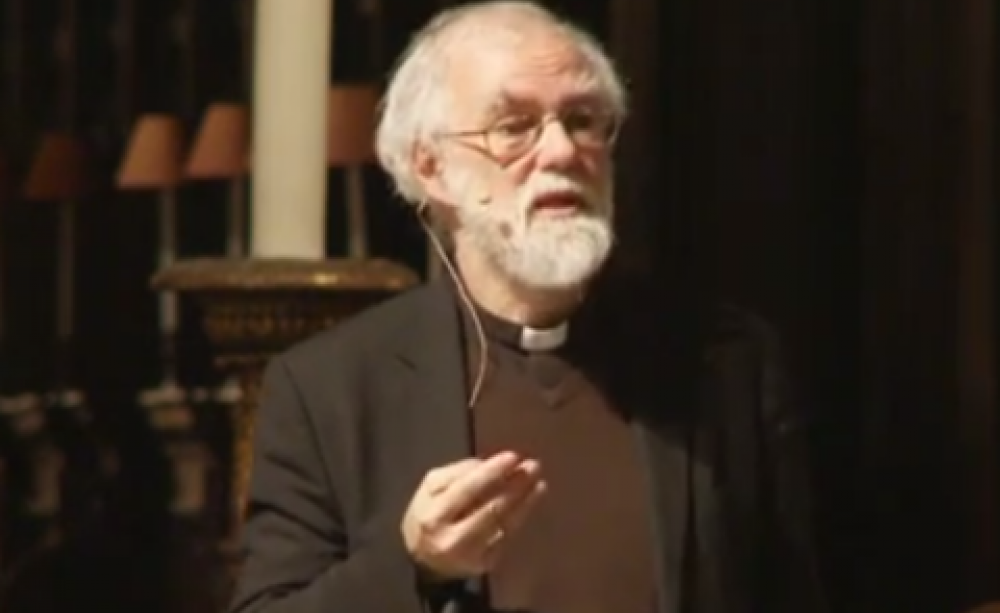
The talk I attended was with Rowan Williams, the former Archbishop of Canterbury, now Master of Magdalene College, Cambridge; and Michael Battle, the founder of the PeaceBattle Institute, which focuses on peace-making, transformation and spirituality.
I was drawn to the event because Rowan Williams is very much on my mind at the moment. A few months ago I had the pleasure of interviewing him for the 'My Green Life' column within Resurgence & Ecologist magazine. Rowan Williams also gave a wonderfully inspiring talk at our recent Festival of Wellbeing.
And, in March 2014, The Resurgence Trust will be holding a literary lunch where the former Archbishop of Canterbury will be speaking on Faith and Ecology. Tickets for this event can be booked in advance.
At the 90-minute event at St Paul's on 19 November, as we sat in the majestically holy building, there was a tremendous sense of "togetherness" amongst the audience which included a delegation of Tibetan parliamentarians in exile, as well as representatives from the Tutu Foundation UK and Occupy Faith.
Canon Mark Oakley was excellent in his role as compere for the evening. When he introduced Rowan Williams, he joked: "I suspect he is very much enjoying being the Master of Magdalene College Cambridge. In fact it is rumoured that he is seen skipping down the streets of Cambridge towards Tesco occasionally, without a care in the world."
Michael Battle was the first speaker and his talk focused on 'Ubuntu' - an African way of understanding that believes we are intimately bound up in each other. He spoke about how we need to be "trained" to see the other as a gift and how "the greatest gift is the other".
This theme is embodied in Ubunto through 'I am, because we are' and came across strongly in each of the presentations. I jotted down a lovely proverb he quoted: "A person is a person through other persons". His talk explored the necessity of social interaction, interdependence and social involvement for our wellbeing.
He told us how "we are obliged to recognise more and more fully how bound up we are in the life of a planet of limited resources. We are obliged to recognise that the damage we do to the life of this planet is in the not very long-run damage we do to our life."
Why are we more preoccupied with rising house prices than building houses?
There are three ways how together we can change the world, he explained. First, he "still believes that some sort of financial transaction tax is one of the ways we can express more effectively the realities as opposed to the fictions of our economic life." Second, he stressed how the education of women can lead to transformation within society at grassroots level.
Finally, he asked, "how can we attain global coordination over climate change?" And he only began to answer the question as he said:
"The truth is that this is one of those issues where no religion, no state, no party, no interest group can understand or deal with the problem alone. In order to tackle this issue we need each other."
The evening was engaging and memorable and I will certainly be listening again to this and other talks in the series in my search for more inspiration.
2013 Forum Series: How to Change the World: More than 200 wars have been fought since 1945. Two billion live in poverty. Climate change threatens human existence. Gandhi famously said we must be the change we want to see in the world, but in practice it can feel overwhelming. What can we do?
At St Paul's Cathedral this autumn, ten extraordinary people will debate how to make the world - and our lives - better: more compassionate, more peaceful, freer. The debates are chaired by Canon Mark Oakley and each evening includes plenty of time for questions from the audience.
All the events are in St Paul's Cathedral, last for 90 minutes, are free and unticketed.
Sharon Garfinkel works for the Resurgence Trust.