Orcas are among the most socially and neurologically complex creatures on Earth.
He has been captive for thirty-three years: for more than twenty he has lived entirely alone—the last orca in South America still on public display.
His tank at Mundo Marino is barely larger than his body, a sun-bleached oval of concrete and chlorinated water. He floats, unmoving, for hours at a stretch. The stillness has become its own kind of movement. His name is Kshamenk.
“Education can’t be built on loneliness, and care isn’t a cage,” I said in an open letter to Mundo Marino.
Atrophy
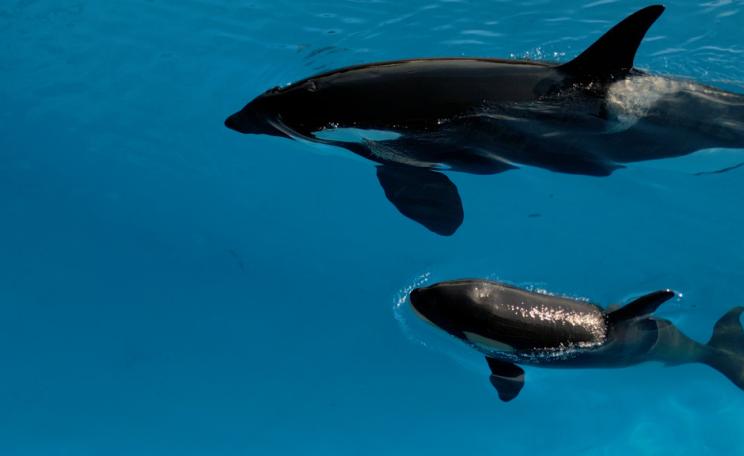
Orcas are among the most socially and neurologically complex creatures on Earth. In the wild they live in matrilineal pods whose vocal dialects are learned, not genetically inherited.
They teach, cooperate, grieve, and travel vast distances, often more than 100 kilometres in a day.
Remove one from that network and the result is not simply captivity but sensory collapse: the slow atrophy of an intelligence designed for depth, space, and song.
Decades of behavioural research show what confinement, being deprived of stimulation, does to cetaceans. Captivity shortens their average lifespan by more than half.
Many grind their teeth against concrete walls, exhibit repetitive “stereotypic” circling, or float listlessly at the surface. Blood cortisol levels rise; muscles atrophy; immune systems weaken.
Sanctuary
The irony is that the industry still sells this suffering as education. Visitors are told the whales are ambassadors for their species, living symbols of connection. Yet every ticket funds the antithesis of that message—turning a creature born for communal life into a solitary exhibit.
Public opinion is turning. France has outlawed dolphin shows; Canada has banned the breeding and import of whales and dolphins for entertainment; the Miami Seaquarium has closed its gates. The moral arc is bending, but slowly, and not yet far enough to reach Kshamenk.
Mundo Marino argues that Kshamenk cannot be released, that he was “rescued” from stranding in 1992 and could not survive in the wild.
That is not a justification for lifelong imprisonment; it is a reason to provide humane retirement. There is, at last, a credible alternative.
Last week the government of Nova Scotia granted the Whale Sanctuary Project a twenty-year lease to begin constructing the first dedicated North Atlantic cold-water sanctuary for belugas and orcas.
Jurisprudence
Set within a protected cove near Sherbrooke, it will offer deep natural water, open currents, and professional care—an environment where formerly captive whales can live out their remaining years with space, privacy, and partial autonomy.
It is, crucially, not a release into the wild but a transition from control to compassion. For whales like Kshamenk - too long confined, too dependent on human care - it offers the only morally defensible option left.
Orcas are among the most socially and neurologically complex creatures on Earth.
Argentina is uniquely positioned to lead on this issue. Its own courts have recognised that non-human animals can hold the right to liberty and dignity.
In 2015 the Buenos Aires judiciary declared an orangutan named Sandra a non-human person; in 2016 a chimpanzee named Cecilia was granted the same status. The reasoning was clear: captivity without necessity constitutes cruelty.
Under Law 14 346, which prohibits acts of cruelty or neglect toward animals, Mundo Marino’s ongoing confinement of an orca for display is not only unethical but arguably unlawful. The jurisprudence exists. What is missing is enforcement—and public will.
Spectacle
Grass-roots campaigners are stepping in where larger institutions have hesitated. TideBreakers, a small group of four former Sea Shepherd and UrgentSeas volunteers, is working unpaid and with deep personal commitment to Kshamenk’s wellbeing, focusing on improving his immediate welfare needs while campaigning for Ley Kshamenk.
The first objective is to obtain an independent veterinary assessment—the essential first step toward any possible move to a sanctuary.
As Charles Vinick of the Whale Sanctuary Project has said: “If anything were to change for Kshamenk, the park would have to agree to having an independent veterinary team come in and assess the state of his health - and determine if he is strong enough to survive a move.
"As far as we know, the courts have not yet required that independent vets be allowed into Mundo Marino.”
To secure that access, TideBreakers are preparing a law injunction and fundraising for specific, transparent goals.
Spectacle
These include improved nutrition - he is currently fed processed “meatballs” that are believed to be of very low quality meat, in place of fresh fish— a troubling practice that campaigners say they have never encountered at any other marine park.
And also reduced chlorine levels and more natural seawater, quieter soundscape, shade, and enrichment to help him regain strength.
PETA Latino, supported by PETA UK, is also preparing to launch a new global action page for Kshamenk, amplifying the international pressure for change. Together, these efforts are uniting moral outrage with legal momentum.
Meanwhile, the Whale Sanctuary Project’s government lease in Nova Scotia means that the physical refuge is no longer a dream but a permitted site under construction.
For the first time, the moral, legal, and logistical paths align. What remains is collective pressure—the single force that has ever moved institutions built on profit to acts of conscience.
Marine parks continue to operate because they occupy the blurred border between entertainment and conservation. They promise research, rehabilitation, and education, while their revenue depends on performance and spectacle. The result is moral greenwashing: the language of care masking the reality of exploitation.
Honour
Visitors often ask whether these whales and dolphins could survive outside captivity. The better question is whether captivity itself is survivable - for the animals or for our own ethical coherence.
Each child who presses a hand to the acrylic glass learns, however unconsciously, that domination can be disguised as affection.
Kshamenk’s story is no longer an anomaly; it is a mirror. It reflects the distance between what we know and what we choose to accept.
The science is clear, the legal precedents are in place, and the alternatives exist. What remains is to act before inertia becomes complicity.
He has been alone long enough. The next headlines about him should not be an obituary. They should mark the day a nation remembered that compassion is not weakness but honour.
This Author
Dr Rebecca Gaston is a UK-based writer and animal-welfare advocate working with international NGOs on marine-freedom campaigns.
Take Action
- Support and share the TideBreakers campaign for Kshamenk’s immediate welfare and the passage of Ley Kshamenk: https://tidebreakers.org/kshamenk-orca
- Refuse to visit or fund marine parks that display captive cetaceans.
Speak his name: Kshamenk is still alive—and there is still time.