The damage has already been done; what net zero gives us is the chance to limit future damage.
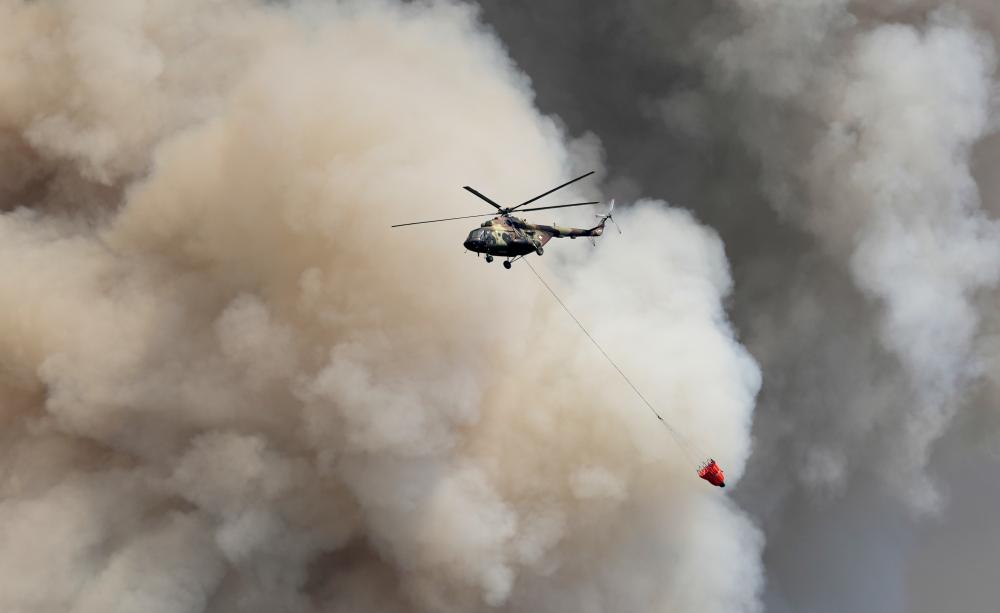
Wildfires across Europe, including unprecedented fires across Britain, have forced the evacuation of over 300,000 people and imperilled food supplies, according to UK supermarket bosses.
June’s heatwave is likely to have caused the death of 2,700 people, and significant economic damage. Droughts across much of the country are the “new normal”.
Spain and Britain have jointly agreed in a statement that “climate change is now a national security emergency facing Europe and threatening our way of life.”
READ: ZACK HANDS ANDY CLIMATE A TO Z
Harangues
But our politics is lagging well behind the reality. It took Zack Polanski’s speech last week, linking the wildfires to the climate crisis, and demanding fossil fuel companies carry the costs of dealing with them, to force Westminster to pay attention.
Otherwise, the usual debates over net zero miss the point, in two different ways. First, the “green transition” is happening already, and it’s been driven – in a spectacular, world-changing reversal of underdevelopment – by the countries of the Global South.
It’s Chinese solar PV and batteries that are electrifying sub-Saharan Africa. It’s Uruguay and Kenya that have achieved a near-total decarbonisation of their own electricity systems.
What’s even more impressive, in its own way, is what’s happening under the noses of even those governments who are actively hostile to the transition.
Last year, despite Trump’s harangues and deliberate attempts to block investment, 88 per cent of new electricity capacity installed in the US was renewable, led by solar PVs.
Damage
Some of that is driven by ongoing support from US States against the Federal government, but what’s making the switch happen, as in the Global South, are the hard economics of rapid improvements in the technology.
The figures speak for themselves: solar PV cost four times more than coal for each kilowatt hour generated in 2010, but is now less than half the price. Battery prices have fallen 96 per cent since 2010, with further declines expected as the technology continues to improve.
That’s the first way our net zero bickering misses the point. The transition is already here. The challenge is making it work for the benefit of the majority – which includes, for example, updating government policy so that it no longer subsidises older installations of renewable energy.
The damage has already been done; what net zero gives us is the chance to limit future damage.
The second way our arguments miss the point is less appealing. Achieving Net Zero will do nothing for wildfires or heatwaves or floods today.
The damage has already been done; what net zero gives us is the chance to limit future damage. That is why decarbonisation remains necessary.
Emergency
But we shouldn’t try to pitch it as the solution to the current effects of climate change. Building a windfarm won’t rebuild a burned-out house. Installing a solar panel won’t end a drought.
Worse yet, telling people whose houses have been burned down that they should have supported net zero is an argument almost guaranteed to drive people away.
This is a tension Reform have been adroitly exploiting, with Reform-led councils cutting EV vehicle spending to put more money (they claim) into flood defences.
And Richard Tice MP arguing that “Reform will scrap net zero and spend much less money faster on proper flood defences that will protect us now, not in 100–200 years”.
But nor, as the Spanish and British foreign ministers’ statement argues, is climate change purely a “national emergency” – perhaps akin to a war, with a beginning, a middle, and an end.
Burns
Climate change, and all its related crises, are the exact opposite of that: there is a beginning, and we are in it, but there is no realistic prospect of an end - including those that involve workable geoengineering.
Whatever we are living with now is open-ended – an endless, spiralling middle.
That should define our perceptions of the problem. For most of us, most of the time, climate change won’t be a visible terror. It will be, for example, the upwards creep of food prices, and the day-to-day breakdowns of systems that used to work better, from electricity generation to railways.
It is, in economist Jisun Park’s phrase, the experience of a Slow Burn. Climate change is not only the wildfire. It’s what is still happening when the wildfire burns out.
Vested
We don’t, yet, have a political language that can speak to this. But until progressive parties find a register to address the day-to-day grind of climate change as well as the emergencies, they will continue to face setbacks from those who, like Reform demanding flood money, or National Rally demanding subsidised home air conditioning, know better how to exploit these conditions.
Polanski won the Green Party leadership almost a year ago with the promise of “eco-populism”: marrying the longstanding concerns of the environmental movement with a harder-edged appeal demanding redistribution.
A year on, it’s perhaps time to flesh out the idea. In an age of open-ended chaos, eco-populism has to mean raising the demand for resilience for all, and to protect all, fairly, from the unstable climate.
It has to mean taking on the vested interests, from fossil fuel giants to supermarkets, that act to block this.
This Author
Dr James Meadway is an economist and a co-director of Verdant, a think tank for a just and green future.