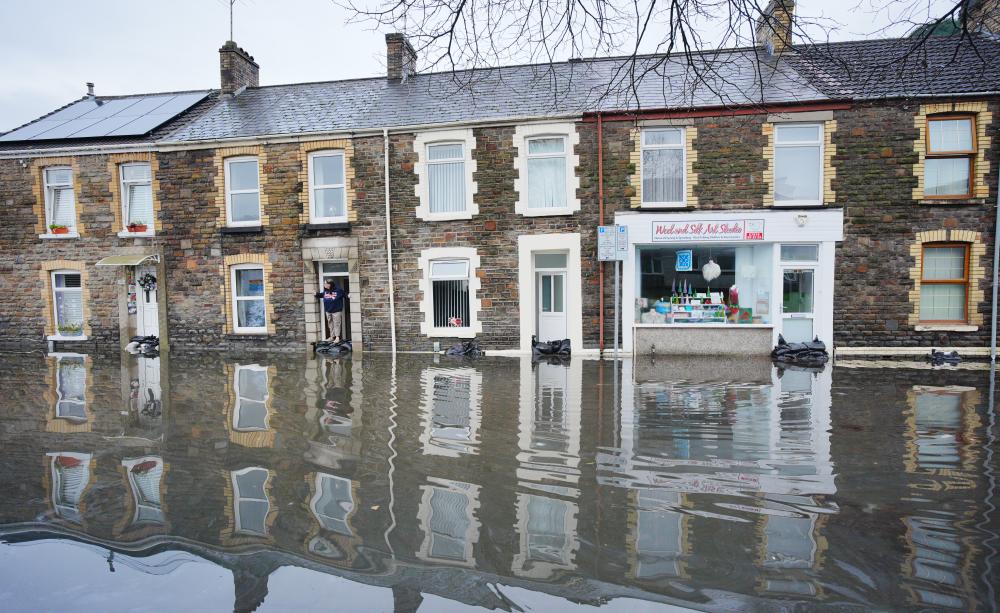
The shift from public to private flood financing threatens to exacerbate this dire situation.
Faced with escalating costs and impacts, and trapped by the punitive logic of austerity, Britain is turning to private finance to pay for its climate security.
Adaption to a hotter, more chaotic climate is no longer something that could be put off to some future date.
Half of the world’s children are exposed to at least three climate hazards, which drove almost 30 million from their homes last year. This is happening at “just” 1.4C of climate change.
Inflation
The UK’s Climate Change Committee (CCC) estimates that the country needs to invest £11 billion per year to adapt to climate change. The government is currently investing around one tenth of that amount. On almost every measure, the CCC reports the UK is ill prepared and not taking sufficient action.
In place of the level of public investment needed, the UK government is instead encouraging private investment in critical infrastructure such as Britain’s flood defences.
The UK faces a critical funding gap in flood management, with the Environment Agency (EA) stating it needs £230m annually just for routine asset maintenance.
Flood Re, the UK’s flooding reinsurance company, contends the UK needs to spend over £1 billion per year for flood defence investment, with other reports suggesting a minimum spend of £1.5 billion. Local government is mired in budgetary crises across Britain, and is unable to afford significant adaptation expenditure.
Around 3,000 of the UK's 38,000 high-consequence flood assets are in poor condition, while inflation is driving up the cost of both maintaining and building flood defences.
Security
Only 40 per cent of flood defences are publicly managed. The rest of Britain’s 165,000 flood defence assets are private.
Half of all private defences are owned by large companies such as Decathelon and Network Rail, while another 30 per cent are owned by large agri-businesses and aristocratic landowners.
The rest is owned by small landowners who often do not know they need to maintain them, or lack the ability to do so adequately.
Privately owned flood assets are twice as likely to be in "poor" or "very poor" condition compared to public defences, a situation made worse by the lack of effective enforcement by the Environment Agency.
The shift from public to private flood financing threatens to exacerbate this dire situation.
There is a serious shortfall in both new and maintenance spending for flood defences, on top of the broader shortfall in adaptation investment.
To fill this gap, private finance is rolling out the neoliberal playbook and looking to build a market in our flood security.
Cash
Flood defences have always been managed by a mix of public and private bodies. Until recently most private flood defences have been managed as a part of a property portfolio and as a legal obligation.
You had to manage the water running through your land as a matter of law. But in line with the broader trend in Britain to privatise essential infrastructure, flood defences are increasingly becoming financial assets.
A financial asset is an asset whose value is derived from a contractual claim to future revenue, such as stocks, securities and bonds.
To turn physical infrastructure – a water system or rail network, for example – into a financial asset you need to securitize or contractually package its future revenue streams.
This is typically done in three ways: the government gives a company a contract to take the risk or run the service (a public-private partnership); the government privatises a service, often granting a monopoly over an area or industry, or, thirdly, a company issues bonds based on the performance of the asset, where debt repayment is directly tied to the cash flows generated by that specific asset.
Defences
The first two are how successive British governments turned public services into private wealth, such as our water and sewage systems.
The third is common, and the preferred business approach to tackling environmental issues, and includes things like carbon credits and catastrophe bonds.
Ultimately what happens is all three are bundled up in bonds and shares, and sold onto investors like asset managers like Blackrock or Macquarie.
This is exactly what the recently launched FloodAction Coalition plan on doing in the UK.
“The FloodAction Coalition led by The Conduit, unites insurers, landowners, and investors to create a £1 billion market for water resilience by 2028—turning nature-based solutions into scalable, investable infrastructure for a climate-resilient future.”
FloodAction, largely a coalition of insurance and finance companies and large institutional landowners such as the National Trust and The Crown Estate, is not planning on building any defences itself. Instead, it is creating a national investment market for “natural flood management”.
Monitoring
Natural flood management (NFM) is the use of nature-based solutions - such as restoring wetlands, planting trees, and installing log dams - to slow, store, and filter water upstream to reduce flooding downstream.
The coalition will partner with landowners in river catchments and in key agricultural areas to fund the building of natural flood management schemes. They have already identified five projects that will serve as a blueprint for future investment.
They have also identified formally identified 50 priority river catchments across the UK to target for funding. Rather than treating these catchments are individual projects, the coalition is framing each catchment as an "opportunity cluster", where individual landowners can submit their projects to the coalition in order to secure funding.
The aim is to bundle up the individual projects within each cluster into a single, investable portfolio.
The coalition won’t buy or lease land, or build flood defences themselves. Instead, they plan on setting up a £1 billion market that will take bids from landowners and project managers and fund the installation, maintenance, and long-term monitoring of the defences.
Streams
The market will attract funds based on the promise of financial returns, based on the revenue generated by the projects coming from three primary sources.
The first is contracts within insurance companies. Insurance companies would pay into the fund to produce flood defences, with the payout to them being reduced future flood damages, and thus claims.
Crucially these avoided losses would be quantified, enabling insurance companies to have lower capital requirements, and to reduce their risk-weighted assets.
The second comes from the income earned through various government environmental schemes. There are a wide range of government environmental schemes that produce incomes for farmers and landowners.
The coalition would split these various income streams with the landowner, delivering a steady income as per other infrastructure asset investments.
Calculus
The third is the most significant of the three, and involves producing various kinds of ‘nature’ credits such as nutrient mitigation credits bought by water utilities and property developers to offset pollution, and Biodiversity Net Gain (BNG) units sold to corporate developers, as well as carbon credits.
The coalition would then stack these various revenue streams over an opportunity cluster, underpin them with performance metrics from things like the total cubic meters of water stored, BNG units generated and contractual incomes, and produce saleable bonds and securities that will offer institutional investors predictable yields paired with ESG credentials.
The coalition is not the only, or even first, attempt to turn environmental security into an asset class in the UK. There have been several schemes over the past decade, but the FloodAction Coalition is distinct insofar as its vision is to create a national market.
London’s role as a global hub for green finance means that if the project is successful, it is highly likely to be exported as a model for global climate adaptation markets in the future.
Our physical security has always been a question of economic calculus to different extents. In the UK, public flood defences have to be deemed ‘economical’ in order to be constructed.
Robust
Part of this calculus involves the number of people impacted, even if this is done by the economic proxy of housing values.
Where its not deemed economically viable, people are left with only two options: build the defences themselves, or move when there is no national fund to pay for relocation.
Faced with accelerating impacts, a lack of available funds and successive national governments who refuse to break with fiscal austerity, looking to innovative forms of private investment seems more than reasonable.
And indeed this is where both the current government and the Climate Change Committee both believe the future of flood defences lie.
NFM is increasingly well established as one of the key future elements of a robust national flood defence plan. Recent research by the Tyndall Centre contends that it could reduce future flood damage by up to £120 million by 2050.

Viable
Yet the same research also set out how NFM only roughly accounts for a total reduction in river (fluvial) flood damages of between nine and 13 per cent , and had to be combined with other, more traditional flood defences to make the full use of its potential.
NFM lacks the capacity to tackle more extreme flooding events. It can take up to 15 years for a NFM scheme to fully develop.
But there are two more fundamental concerns. The first is without an overall increase in funding for traditional flood defences, the coalition’s schemes risk having a limited positive impact on flooding.
This could be made worse as the public funding gap increases, driving more private investment towards flood defences that provide returns, rather than those that are economically less viable but still socially necessary.
Returns
Secondly, if successful the coalition’s approach shifts the entire basis on which flood defence investment is assessed.
It moves it from a cost-benefit analysis - essentially asking if building a specific flood defence is worth the expenditure of money given the damage it prevents - to a calculus of private returns on investment.
There will be investment in natural flood defences if, and only if, there is enough interest from insurance companies, enough money from government schemes, and ultimately if the project produces enough income from various nature-based credit schemes.
Finally, private flood defences are already poorly maintained. When flood defences are seen as assets delivering returns, the need to generate higher returns means there is a tendency is to minimise maintenance costs and overstate the impacts.
Survival
The UK is already seeing insurance companies retreat from providing flood and disaster coverage to “high risk” households. This is also happening in other countries around the world.
The shortfall in government funding is already putting more people and properties at risk. The shift from public to private flood financing threatens to exacerbate this dire situation.
The shift to a private flood defence market is not progress. It is the continuation of discredited neoliberal policies that have resulted not only in steady destruction of Britain’s critical infrastructure and the extraction of vast amounts of wealth from the UK.
As climate impacts worsen, what Britain needs is not more private finance but greater state investment. Our survival should not be a novel revenue stream for asset managers to exploit.
This Author
Dr Nicholas Beuret is a lecturer at the University of Essex researching the politics and political economy of climate change and the green transition. His book Or Something Worse: Why we ned to disrupt the climate transition is out now with Verso.