This brazen act of international criminality is not as an exhibit of US hard power and influence, but instead of its declining status.
Donald Trump has kicked off 2026 in his signature style. Six years ago, on January 3rd, 2020, the US carried out the assassination of Iranian Revolutionary Guards commander Qasem Soleimani. That strike, ordered by President Trump, was executed by a US drone.
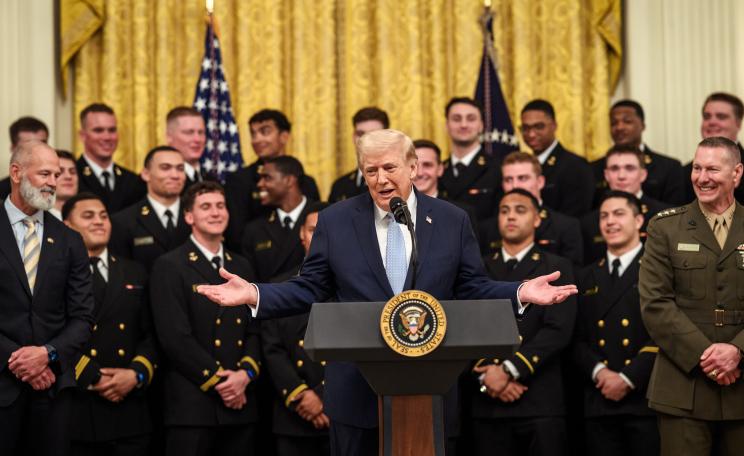
Now, six years later, Trump is invoking that same operation in his Mar-a-Lago press conference, presenting the capture of Nicolás Maduro, the president of Venezuela, as the latest in a series of US military successes under his leadership.
This article is based on today's episode of the Macrodose podcast, Venezuela, Greenland, and the New Resource Colonialism.
Never mind the defiance of international law, and state sovereignty, US Democrats in opposition, just like US allies abroad, have been typically spineless in their response. Blinking and wittering about Nicolas Maduro’s misdemeanours.
Norms
Keir Starmer, predictably, inevitably, was amongst the most spineless of the flock. With vague murmurings about international law, distancing any UK involvement, but conspicuously shy of any criticism of US action, and pro a quote unquote “democratic transition” in Venezuela.
That was followed by murmurings on Monday and Tuesday this week that the US probably shouldn’t invade Greenland next.
Despite what parts of the mainstream media would have you believe, this attack on Venezuela didn’t happen overnight. US saber-rattling has been building for months.
On top of a decade-long sanctions regime, Trump’s recent escalations included naval confrontations with Venezuelan-flagged vessels in the Caribbean - most notoriously, what appears to have been the extrajudicial killing of a fleeing crew.
The so-called 'leader of the free world' has never tried to hide his intentions here. Whereas more than 20 years ago, George W Bush spent months attempting to construct a legal case for the invasion of Iraq, Trump has no qualms about disregarding longstanding norms in international affairs.
Underinvestment
He bluntly told his Mar A Lago conference that quote “Venezuela has oil” and that the US wanted it.
Venezuela is supposed to have the largest proven oil reserves in the world, at over 300 billion barrels more than Saudi Arabia. But it’s worth noting that there are significant questions over its economic viability.
Venezuelan oil is typically extra heavy crude. It’s thick, sulphurous - 'sour' in the industry jargon - and requires hefty and expensive refining before it can be used.
That, in turn, requires hefty infrastructure - which has suffered significant underinvestment over the past decade as Venezuela’s economic woes worsened. Figures in Bloomberg suggest that at least $100bn of investment would be required over many years to properly exploit the country’s oilfields.
This brazen act of international criminality is not as an exhibit of US hard power and influence, but instead of its declining status.
Gas
Global oil markets currently have around a 3.8 billion barrel glut, meaning far more is being produced than is being bought, and prices are under significant downwards pressure as a result.
As the switch to electric vehicles and renewables gathers pace, demand for oil globally is weakening, with the International Energy Authority, back in 2024, even forecasting a 'peak' in global demand, after which it will fall away.
This, unfortunately, may not mean a peak in fossil fuel output overall. Fossil fuels are relatively quick and easy to access, and as we’ve seen with data centres in recent years, new demands for electricity can easily produce an upsurge in their use.
It’s why we’ve seen the US talk about making more use of its coal resources, with Washington providing a $600m subsidy to extend mining and the lifetime of existing coal plants. And why new gas turbine generators are being installed across the United States.
Peak
The extraordinary expansion of fossil fuel output over the last decade or so, the so-called 'shale revolution' that has seen smaller-scale hydraulic fracturing, aka fracking', operations roll out across the Great Plains, turned the US into a net exporter of fossil fuels for the first time in decades under president Joe Biden.
Trump has had no qualms in attempting to use this veritable glut of natural gas, in particular, as a bargaining chip in trade negotiations – promising vast, long-term deals on gas supplies to gas-hungry Taiwan, for example.
But fracking’s dirty secret – other than its addition to greenhouse gas emissions – is that the boom may be more like a bubble. Those new wells, delivered with fracking technologies, will be short-lived.
There’s some industry dispute over this, but at least some oil analysts point to US shale production having already reached its own peak over the last year, and forecast decline from here onwards.
Hegemon
On this basis, the Venezuela operation looks less like the carefully-planned action of a mighty “oil empire” (as Bloomberg’s Javier Blas claims), able to project its power across the world, and more like the slightly desperate gamble of a wounded giant.
Venezuela’s oil matters, despite the expense and the difficulty of obtaining and using the stuff, because it's the US that is starting to scrabble.
The frame needed to understand US actions under Trump remains, as it has done, of a one-time superpower confronted by serious, global challenges that it cannot overcome – of which China is the most obvious, although I’d suggest that climate change itself is increasingly another.
In this context, I think we can see this brazen act of international criminality not as an exhibit of US hard power and influence, but instead of its declining status as the global hegemon - a retrenchment of US power inside its own, presumed, hemisphere, and a withdrawal from its global position.
This Author
Dr James Meadway is an economist and former political advisor. This article is based on a transcript of an episode of Meadway's podcast, Macrodose.