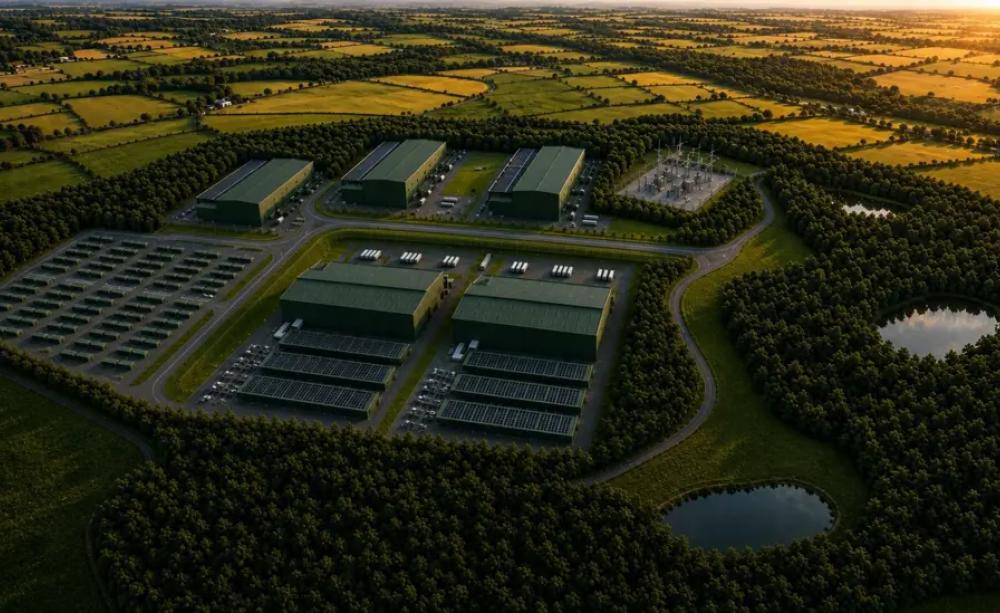
The monstrous megalithic construction they want to build will dominate the town.
Proposals for a huge AI data centre and battery energy storage system from energy infrastructure company Xlinks have triggered a furious response from residents across North Devon.
Xlinks claims the development would offer “a dedicated community benefit package [that] would be shaped by the community itself, alongside new on- and off-campus amenities — which could include public open space, a fitness centre, an electric bus depot or a business hub".
READ: DATA CENTRES COOLING DRIVES HEATWAVE DEMAND
But more than 200 people left Simon Morrish, the representative from Xlinks, in no doubt of the strength of feeling locally during at a packed meeting in Great Torrington Town Hall, chaired by Geoffrey Cox MP, late last month.
Catastrophic
“Who in this room is against this data centre?" one resident asked the sweltering crowd in the Town Hall. "Stand up if you agree with me.” One by one almost the entire meeting got to its feet.
A social media group for local residents opposing the project had grown to more than 5,000 members in the first week. The Down with Devon Data Campus and BESS campaign then held its first meeting on Monday, 30 June, at Great Torrington Town Hall with more than 100 people in attendance.
The company's promotional website shows massive data halls nestled in woodlands. Local campaigners say that the negative impact of the giant industrial site far outweighs the benefits.
Matt Whittaker, vice-chair of the campaign, said: "The monstrous megalithic construction they want to build will be seen for miles around and will dominate the town. It will have a disastrous impact on biodiverse farmland. We know we have less than six weeks to stop this project before it gets into the planning system.
"Our campaign has received a lot of interesting scientific documentation which we will be sharing with Geoffrey Cox MP and Torridge Council planning committee to show why going ahead with the data centre and BESS is a catastrophic mistake for that land."
Immortalised
Government policies have created conditions for a corporate land grab, he claimed. "The government's decision to designate data centres as 'national critical infrastructure' means there is a risk the plans get rubber-stamped," he added.
"Farmers can't pass on their land easily within their own families, so when the company behind this project wants to buy in return for signing a non-disclosure agreement it looks like easy money. That's the real story here."
The monstrous megalithic construction they want to build will dominate the town.
Many residents are also deeply worried about the impact on local water bodies, including the River Torridge, immortalised in the novel Tarka the Otter by Henry Williamson which charts the fictional life and death of an otter cub in North Devon’s “country of the two rivers.”
Consumption
Xlinks claims that the site has been selected because “North Devon’s mild year-round temperatures, winds and sun mean the site uses less energy and water than many other locations".
The company also says that it will build “attenuation ponds to reduce freshwater use”. It is unclear what the purpose of the ponds will be in the project as they are usually a feature built into drainage systems to manage stormwater run-off and reduce flooding risks, rather than acting as reservoirs.
Marketing claims by data centre developers frequently make bids for the label of the “UK’s largest". An extensive review of current and planned data centre projects conducted on behalf of Watershed Investigations suggests the North Devon proposal is genuinely among the biggest.
There appears to be 12GW in the commercial data centre sector already in operation or entering the planning system across the UK, with new projects being announced weekly.
The 1.5GW peak power consumption of the servers (or IT load) projected for the Devon data campus is equivalent to the peak consumption of all data centres operating in Britain in 2024.
Fuel
The Devon data campus will certainly entail significant water use. This might take place locally, at the power generation source or embedded across the supply chains for the machinery and cables installed there.
Professor Kaveh Madani is the director of the UN University Institute for Water, Environment and Health (UNU-INWEH) and co-author of a major report on the impact of data centres and AI on the living planet.
He said: “There is no AI infrastructure and data centre without an environmental impact. You can always improve the performance and reduce the footprint, but you can never fully eliminate the environmental impact.”
The UN report explains that the new industrial infrastructure of AI will take up vast amounts of land, use enormous quantities of water and power and fuel the climate crisis, while distributing any benefits very unevenly across the globe.
Wildlife
The “helicopter view of the whole landscape” is critical, Madani explained. That means not only looking at how water, land and carbon footprints interact with each other, but also understanding how people and nature across the world are affected by AI infrastructure projects.
“The fact that the Global South is the net loser in many ways does not mean that communities in the Global North would be immune to negative local impacts,” Madani said.
“We also have injustice problems in the Global North where those benefitting from data centres often don’t need to bear the local environmental costs.”
The environmental costs at other stages in the AI value chain would largely be borne by communities and wildlife far from Devon, he explained. This includes the damage "at the critical minerals extraction sites, at the semiconductor manufacturing sites, and at the electronic waste landfills".
This Author
Anne Alexander is a journalist and researcher. She is working currently working on a project with Watershed Investigations looking at the impact of data centres and the AI industry on the living planet.