SUV demand is manufactured through advertising and marketing.
Romesh Ranganathan and Sebastian Croft may have been the last men standing on The Celebrity Traitors this year, but the real winner? Jaguar Land Rover.
The Traitors involves 21 contestants being secluded in the remote Ardross Castle in the Scottish Highlands to take part in an elaborate game of Werewolf, and a series of challenges. The 'traitors' win prize money, and the 'celebrity traitors' raise money for charity.
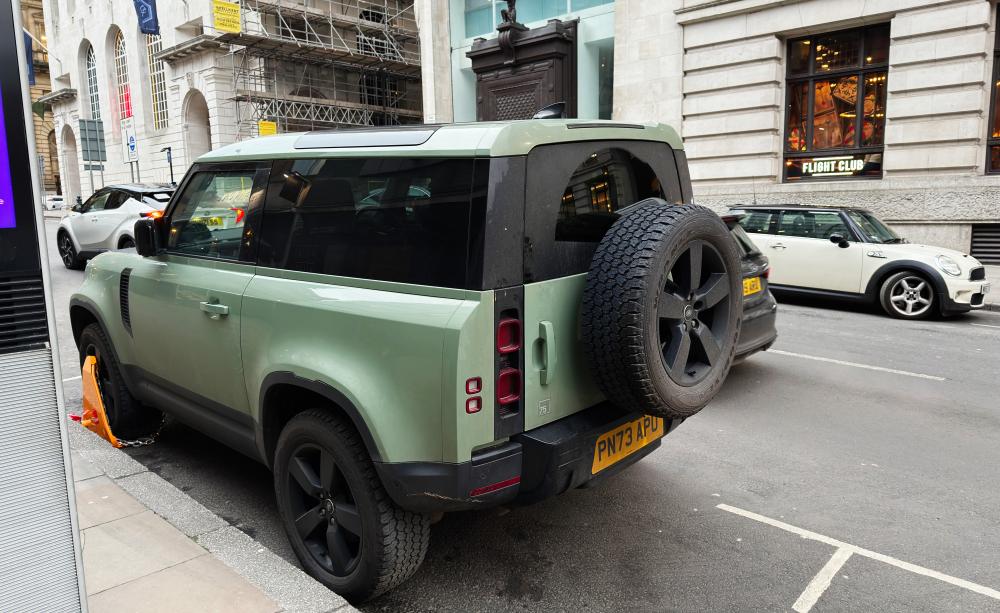
During this time they are chauffeured around the castle estate by a fleet of shiny black Land Rover Defenders. And in itself that’s fine. Land Rovers may well be an ideal vehicle for driving on Highland Estates.
Manufactured
The problem, of course, is that they don’t stay there. What we see on our screens we see on our streets, and Land Rovers, Range Rovers and a whole host of other oversized SUVs are now a common sight on just about every street in Britain.
One in three cars on UK roads is now an SUV, with more than 1.2 million more cars sold each year too large to fit inside a standard on-street parking bay.
Cars are getting 1.2 cm longer and 0.5 cm wider on average year-on-year, and bonnet heights are rising 0.5 cm every year. This effect is called ‘carspreading’, a word recently added to the dictionary.
And it didn’t happen by accident. The carmakers would like to say they make big cars in response to consumer demand.
The reality is that demand is manufactured through advertising and marketing. The companies reinvented the SUV from what was once the reserve of bona fide off-road drivers to a vehicle now seen as suitable for school runs and supermarket trips.
Exposure
Which returns us to The Traitors. The use of Land Rover Defenders throughout the programme is not subtle. The SUVs appear frequently and prominently on screen, with in-car scenes of the contestants discussing the game forming a major part of the show.
The luxurious castle setting and, in the case of The Celebrity Traitors, the use of the vehicles by well-known celebs, all aids the image of Land Rovers as aspirational status symbols in a way eerily - and I’m sure coincidentally - similar to this TV advert for Range Rover.
Adfree Cities found that in the 2026 series of The Celebrity Traitors, Land Rover Defenders were given an average of 33.5 seconds of screentime per episode, with 15 appearances on-screen per episode.
Defenders were on-screen for 12 uninterrupted seconds, easily as long as a TV ‘spot’ advert, in just one scene highlighted in a new analysis.
SUV demand is manufactured through advertising and marketing.
This exposure works. The Celebrity Traitors alone has an average of 13.35 million viewers per episode. During the 2025 series one online car market reported a 31 per cent increase in searches for black Land Rover Defenders.
Electric
Similarly, during the January 2024 series of The Traitors, with 1.63 million viewers, Auto Trader boasted a 39 per cent increase in similar searches.
The BBC does not allow commercial advertising, yet exposure via The Traitors and The Celebrity Traitors is demonstrably acting as advertising for JLR.
Using TV industry figures, Adfree Cities estimated the value of this advertising if JLR were to buy it on a commercial network such as ITV.
A short primetime TV advert reaching 15 million people - the number of viewers for the 2026 series of The Celebrity Traitors - would cost £1.07 million. Land Rover is essentially benefiting from the equivalent of £1 million in free advertising.
JLR has had a bumpy year. It has announced 4,000 job cuts. The lobbying against the UK’s Zero Emission Vehicle Mandate - JLR to date only produces one battery electric vehicle - has damaged the carmaker’s image.
Reprieve
It remains to be seen if this year’s Traitors appearance will result in the same uplift in searches, but £1 million in free advertising surely can’t hurt.
The rest of us are left to deal with the consequences. Land Rover to date doesn’t produce a single electric vehicle, and partner company Range Rover only produces one. CO2 emissions reach as high as 484g/km for some models and driving modes, and rarely dip below 200g/km.
Land Rovers are just the tip of the carspreading iceberg. If SUVs were a country it would be the fifth most polluting in the world.
Electric SUVs offer little reprieve due to the extra demands they make of scare materials like lithium. One study suggested electric SUVs might even raise emissions by taking rare metals away from alternative uses.
Curbing
City councils in Edinburgh and Bristol have banned advertisements for SUVs on council-controlled advertising sites like bus shelters. Bath and North East Somerset councils have introduced higher parking charges for larger cars.
The government’s Road Safety Strategy, and Transport for London’s Vision Zero Action Plan 2 both recognise the danger of carspreading.
Transport for London points out that the growing use of large cars and SUVs "is creating immediate and intensifying risks across London." it adds: "Without action to address oversized and heavier vehicles, more people will be seriously injured or killed."
In this context it is incumbent on public broadcasters like the BBC to act responsibly and to refrain from anything that could further promote large cars and SUVs, or to act contrary to public policies aimed at curbing their use.
This Author
James Ward is a co-director of Adfree Cities.