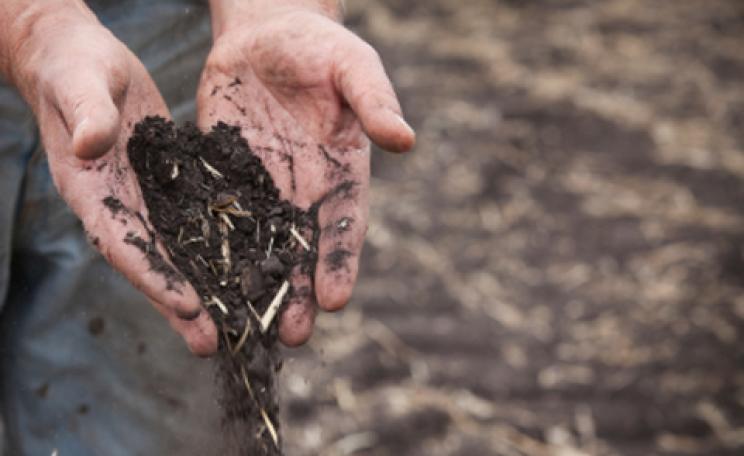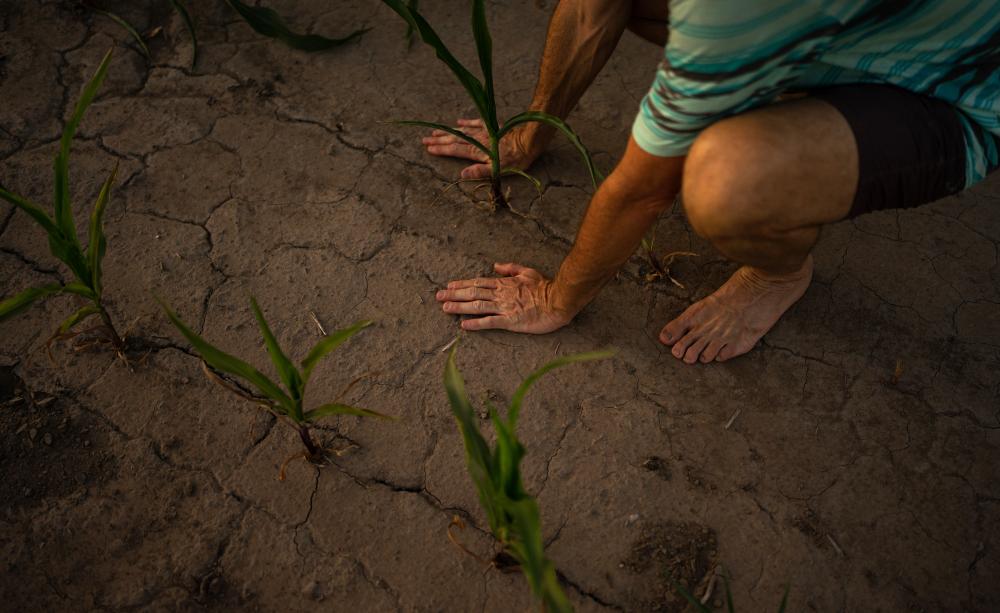
Farmers can control their farmland’s resilience - and that starts with microbial life.
The health of a nation's soils dictates the health of the nations’ stomachs. Agricultural restoration is not only a matter of national and economic security, but of public health. Soil is the nation’s stomach, and it’s beginning to rumble.
Gut health is in vogue, and rightly so. The microbes that we eat form an entire eco-system of individual, yet interdependent organisms in our stomach.
These work together to regulate our hormones, digest our food, support our water retention and protect against pathogens.
Protein
Our gut’s health is not governed by volume of bacteria, but diversity. The greater the variety of microbial bacteria found in our gut, the more effective that tiny eco-system becomes.
Yet microbial life behaves in similar ways, regardless of the host. Just as your stomach can't absorb the nutrients it needs without a working community of gut bacteria, a plant cannot absorb nitrogen, phosphorus or trace minerals from organic matter without a working community of soil microbes.
The plant pays its microbes in root sugars, while the microbes pay the plant in nutrients it could never reach alone.
This complex, underground system of trade governs the nutrient density of the food that soil produces. In short, the diet we feed our soil determines the diet that soil feeds us.
Research confirms this. Landmark research comparing United States nutrient data from 1950 to 1999 found measurable declines in the protein, calcium, phosphorus, iron and riboflavin content of 43 common crops.
Variety
The same trend is observed in Britain: one analysis found similar mineral losses in fruit and vegetables across the same decades.
This shouldn’t come as a surprise when we consider what we force our soils to consume.
Take glyphosate. This synthetic pesticide is chemically engineered to kill plants. It’s used in agriculture to clear weeds before planting, and then to dry our produce evenly before harvest.
Use of glyphosate has increased by near 1,000 per cent (or ten times) since 1990. In short, we poison our soils in the name of efficiency.
Much like our diet, our soils need variety. A greater variety of plants results in a more diverse - and therefore functional - soil microbiome.
Leaky
Different crops release different sugars and acids, which feed different microbial species. Long term monoculture leads to collapsing microbial diversity, reducing the soil’s ability to perform its most basic functions.
The nation’s soils are in bad shape. Carbon gets drawn into the soil when microbial networks thrive underfoot.
Farmers can control their farmland’s resilience - and that starts with microbial life.
The opposite is also true; some 40 per cent to 60 per cent of the UK’s arable soils have lost their organic carbon content, while research by Rothamstead shows that 38 per cent of arable soils in the UK are marked as ‘degraded’.
This has real implications for British families and farmers. This is most notably because of water. In your gut, a healthy microbiome maintains the mucosal lining and the tight junctions between intestinal cells.
This is the barrier that keeps what should stay in the gut in, and what shouldn't get through. When this barrier is compromised, ‘leaky gut’ ensues.
Absorb
The same applies to farmland. Soil has a microbial barrier too, built by arbuscular mycorrhizal fungi, whose hyphae physically bind particles together and coat them in a protein called glomalin. This is what gives soil its structure, and therefore, its ability to hold water..
Britain's farmland is heading into a dangerous cycle. The swing from drought to flood every year is getting more dramatic each year.
Weather patterns have become more erratic, while degraded microbiomes have undermined soil’s ability to act like a sponge, in periods of both drought and flood.
Just one per cent soil organic matter results in an extra 16,500 gallons of water-holding capacity per acre per foot of soil. Both drought and flood are symptoms of the same cause. It’s not that we don’t have enough water. It’s that our soils can’t absorb it when it comes.
Infiltration
Soil’s sponge-like property comes from its structure. When soil gets compacted, its microbial networks struggle to breathe, while roots struggle to grow deeper while water struggles to pass through it. Water then sits on top of the soil, or runs off into local rivers, carrying pesticides like glyphosate with it.
Almost four million hectares of soil in England and Wales are estimated to be at risk of compaction, which could result in a loss of agricultural productivity costing approximately £163 million every year.
However, research is starting to show that compaction is reversible. A new study conducted in Hampshire over 12 months has tested what happens when we treat soil with a combination of microbial soil treatment and mechancial aeration.
Across the trial year, the combination produced 26 per cent more grass dry matter than the untreated control.
Yet what was more striking was that the research recorded an 86 per cent improvement in water infiltration compared with the pre-aeration tests.
Biome
More research is needed, which is why new government-backed field trials into microbial and soil-improving approaches are important.
A new Department for Environment, Food and Rural Affairs ADOPT trial beginning this autumn will investigate how microbial approaches can help farmers reduce input costs, improve drought resilience and protect water quality.
Of course, the triage of challenges farmers face are complex. Farmers cannot control the wars abroad or the rain overhead or the price of milk. However, they can control their farmland’s resilience: and that starts with microbial life.
The public has woken up to the power of the microbial eco-system that lives in our gut. To protect that, we must start with the biome that lives under our feet.
This Author
Katie Ward is the managing director of probiotic company Microbz.