The basic eco-horror is a warning: don’t play with snakes, don’t swim with sharks. We learned to extend our notes of caution to people and to human-made environments.
28 Years After will be the film of this summer. At times scary, funny and gloriously weird, it is a story about nature and our fears of it. As such, it is worth asking what the wildness is in its story which threatens to overwhelm us?
The film is the third in a five-picture series. In the first movie, 28 Days Later (2002), Jim (Cillian Murphy) wakes up in a Britain taken over by monsters - “the infected”.
What audiences loved about the movie was the vision of a depopulated London: without cars or movement. Even money was abandoned in the streets. In the film’s second half, Jim’s practical view of the apocalypse – that it creates small moments of intimacy among the horror – clashes with the ideas of Major West (Christopher Eccleston).
Guessing
West offers Jim sanctuary and a mission of renewal: “Our real job is to rebuild. Start again. Down here is the wood-fired boiler that provides us with hot water. Our first step”.
In West’s reasoning, man has the capacity to rule the world because of his deeper obedience to something natural – the urge to reproduce.
The Major’s soldiers capture Jim’s two women companions (Naomie Harris and Megan Burns), dress them in red gowns, and propose to assault them. Their philosophy turns out to be a moral threat to Jim and his friends, worse even than the monsters with their merely physical harm.
The second film, 28 Weeks Later (2007), was a failure. It kept the monsters and the introspection - disaster returns because of one man’s cowardice - but the desire to spread the first British film to an American audience produced a by-numbers plot in which every turn was predictable.
In 28 Years After, by contrast, you are always guessing what will come next. The audience is left wondering whether we are watching Kes, or The Wicker Man or a British Apocalypse Now.
Surviving
It’s like being caught up in the middle of a shared Jenga game, the structure wobbles repeatedly and nearly falls. But it just about holds together - until the last two minutes anyway.
The part of 28 Years After which most viewers will share with their friends is the way the film experiments with its monsters. Unlike in the prequels, they must and can eat.
They have split into lower and higher forms, from slow-moving hulks which snail across the ground, to Alphas capable of organising their fellow monsters and surviving terrible damage.
More significant is what the film does with place. The most basic form of eco-horror is a warning: don’t play with snakes, don’t swim with sharks.
A very long time ago, we learned to extend our notes of caution to people and to human-made environments. We taught ourselves to feel fear of a combination, the natural blended with the human-made.
The basic eco-horror is a warning: don’t play with snakes, don’t swim with sharks. We learned to extend our notes of caution to people and to human-made environments.
Beauty
The classic English folk-myth is Jenny Greenteeth, a water creature with outsized hair and teeth who inhabits abandoned ditches. Her teeth are clotted with the duckweed which covers the water’s surface.
In the 1973, the Royal Society for the Prevention of Accidents film, ‘The Spirit of Dark and Lonely Water’, a male version of Jenny wanders through a world of construction sites and scrapyards, grinning at the risks to which careless children expose themselves: “the perfect place… for an accident”.
Our industrial towns do this to their residents, communicate on the cheap a constant horror of the cityscape, teach a fear of the city decaying into wildness.
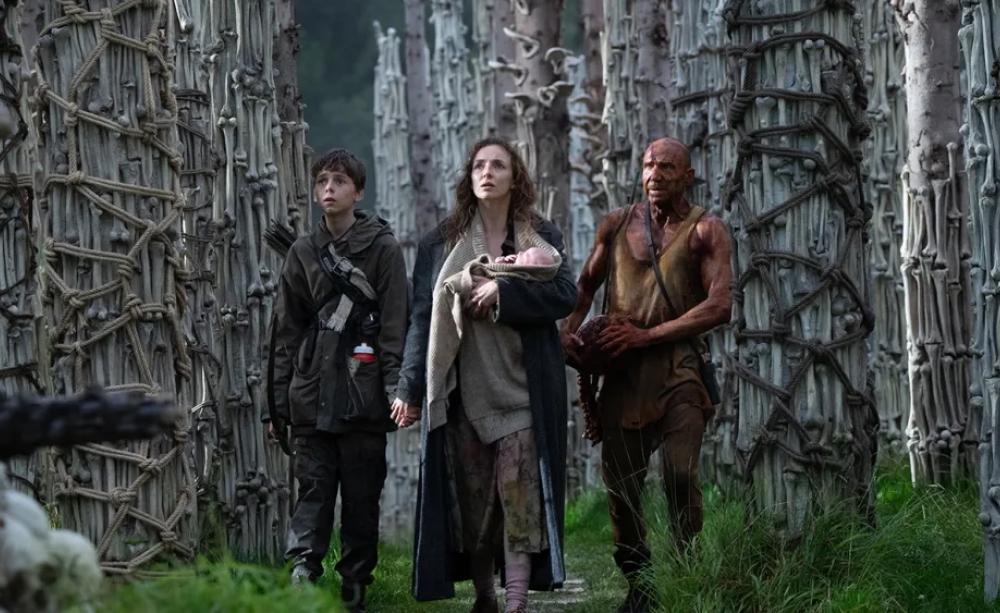
The subject of 28 Years After is a different kind of England – not the city but the countryside. The whole country is occupied by creatures, whose advanced was stopped at France. Enemy soldiers tour our shores, preventing entry or escape.
As throughout the series, the apocalypse is not without beauty. Man’s disappearance enables trees to grow, hides the cities, leaves the plains to be occupied by great herds of deer.
Souls
People survive on Holy Island in the Northeast. Their world is nostalgic: men and women do gendered tasks. Farming is hard work and necessary.
People aren’t re-building but surviving: the myths which hold them together are a vision of what England used to be – photographs of the Queen, Tom Jones songs, the archers of Agincourt.
The myths help people to survive, but their effect on the protagonist, 12-year-old Spike, is that he is surrounded by lies. His mother suffers memory loss, confusion, nosebleeds. His father denies that she is ill, refuses all opportunities for treatment, cheats on her.
This is England if Nigel Farage wins, if we permit our sense of shared sense of loss and diminished opportunity to enter our souls. If we let that happen, 28 Years After warns, we will suffer a moral sickness – a defeat worse than illness or loss of opportunity.
This Author
David Renton is a barrister, historian and novelist. His next book, The Story of Jenny Greenteeth, by one who knew her, is published in August 2025.