They enter the local cultural sector to really make sure that they have the social license to operate.
“The air conditioning unit, the speakers, the computers, the mobile phones, the chairs," Nãnashaira Medeiros Siqueira said, pointing around the room. "Oil touches many areas of our daily lives.”
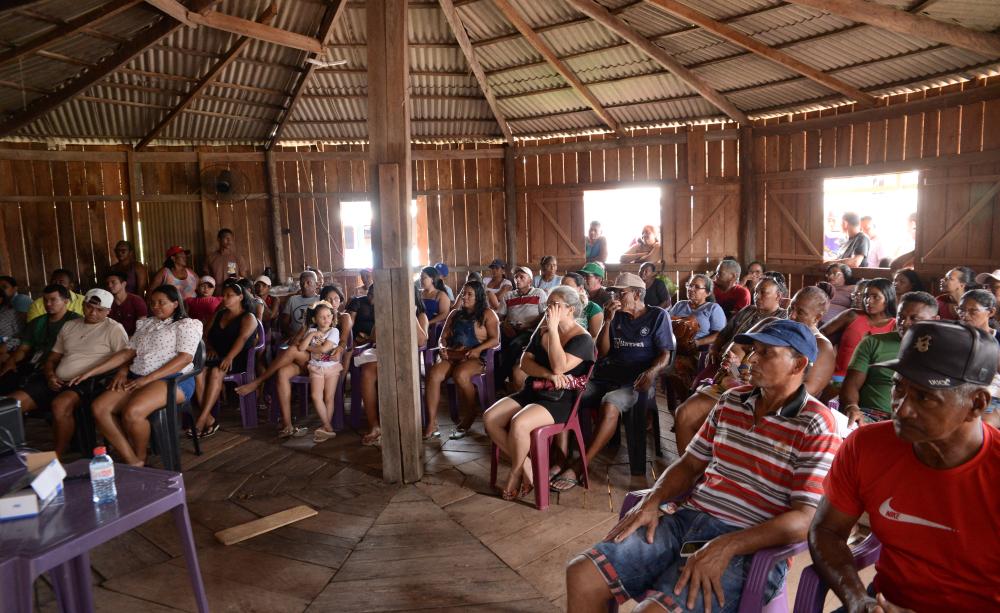
She stood next to a projector screen in a wooden hut on Marajó Island, northeastern Brazil, and pressed her clicker (see image). The slide read: “Produtos feitos com Petrol” ("Things made from oil").
Siqueira, a representative of Petrobras, Brazil’s national oil company, made a series of presentations to coastal communities on the Foz do Amazonas (Mouth of the Amazon) basin in November 2025.
Offshore
The company had just begun drilling an exploratory deepsea well in these waters — raising fears of an oil spill that could harm the mangroves and coral reefs on which local people depend.
Petrobras has embarked on a surge of public relations activity since it began to take sole ownership of drilling blocks in Foz do Amazonas in 2020: from running meetings, to hiring Gen-Z influencers, film stars and pop icons, to splashing its green, white and yellow logo on projects to conserve mangroves and humpback whales, an investigation by DeSmog in partnership with Brazilian magazine piauí published on Wednesday, 17 June 2026 shows.
Petrobras increased its spending on advertising and sponsorship five-fold between 2020 and 2025, according to public disclosures. Videos created by influencers on the company’s behalf racked up over 1.5 billion views in 2024 and 2025 — the equivalent to being viewed by eight times by each person in Brazil, a country of 213 million people.
IBAMA, Brazil’s environmental regulator, had repeatedly knocked back drilling applications, citing the risks to marine ecosystems.
But Petrobras nonetheless began drilling an exploratory deep sea well in Foz Do Amazonas in October, after winning a five-year licencing battle. This could open the door for the rest of the industry to begin developing offshore oil in the region.
Social license
Campaigners, academics and state prosecutors have accused Petrobras of misleading the public over the way it is presenting the project by playing down climate and environmental risks, and obscuring the true scale of their plans from local communities.
Petrobras tripled the number of social media influencers it hired between 2022 and 2024 to 72, working with social media stars from LGBTQ+ activists to biologists, according to company data obtained via FOI requests and shared with DeSmog by Greenpeace’s investigative unit Unearthed.
Petrobras also quadrupled the number of cultural and environmental projects it sponsors since 2020, its public disclosures show. Amanda Mota, a culture influencer, for example, dances at the Petrobras-sponsored Choro Jazz festival in Marajó, in a 2025 YouTube video now viewed over five million times.
They enter the local cultural sector to really make sure that they have the social license to operate.
Gertjan Plets, who researches oil and gas philanthropy at the Utrecht University in the Netherlands, said: “Fossil fuel companies are very afraid of local communities protesting because they can make it difficult on the ground.
"So they enter the local cultural sector, the local ecological preservation groups, to really make sure that they have the social license to operate.”
Sponsorship
The oil giant launched its “Transição Energética Justa” (“Fair Energy Transition”) campaign in July, which features film star Camila Pitanga explaining how Petrobras is “embracing new forms of energy”.
Critics have questioned whether this campaign reflects the reality of its business. Petrobras’ planned spending on exploring for and producing oil between now and 2030 increased last year, and makes up 72 percent of its overall investments, according to the company’s latest five-year plan. That’s compared to eight percent on “low carbon energy”, a drop of 1.7 percent from the previous plan.
Advertising agencies including New York-based Ogilvy, which has a five-year contracts with Petrobras worth over R$ 450 million ($87 million), according to Petrobras disclosures, play key roles in its advertising strategy. Ogilvy is owned by British advertising conglomerate WPP, which has a long history of working with the fossil fuel industry.
Petrobras said there was no “causal relationship” between its ambitions to drill in the Foz do Amazonas basin and its increase in spending on advertising, sponsorship and influencers, when responding to questions from DeSmog.
Drilling
The company said ad spending had been unusually low in 2019 and 2020 as it restructured, before it returned to “levels compatible with the scale, reach, and institutional responsibility of the largest company in Brazil” from 2023 under new management.
IBAMA requires Petrobras to organise “informational meetings” like the ones on Marajó as part of its exploration license. Petrobras representatives, including Siqueira, told audiences that there was no chance of oil reaching the coast in the event of a spill — an assessment that is being challenged by a group of NGOs in court.
The initial test site lies 175km off the coast of the Brazilian town of Oiapoque, on the border with French Guiana, and 500 km from Marajó. But success there could open the door to drilling at hundreds more blocks — many of which sit directly over coral reef — that stretch southwards towards the island.
The company representatives also said drilling would boost the local economy, listed 12 environmental projects the company is sponsoring in the area, and said Petrobras had never caused any environmental damage through offshore drilling. Climate change went unmentioned.
Assurances
Fernanda Pereira, a 23-year-old biology student, said after attending a meeting in Soure, on the east coast of Marajó: “In Marajó, some communities don't have this information. Or when it does arrives, it arrives in a completely distorted form.” Another attendee described Petrobras’ presentation as “a wonderful PR performance.”
In February, local state prosecutors from the Ministério Público Federal, Brazil’s public prosecutor, recommended that Petrobras’ licence be revoked on several grounds, including that the company was misleading the public in these presentations by failing to clearly explain it is planning to drill three further exploratory wells as part of its tests.
Just over a month after the Cachoeira do Arari meeting in November, on 4 January, 2026, 18,000 litres of drilling chemicals leaked from the test well into the ocean.
The devastating oil spill that many fear may not yet have arrived. But those opposing the project say the leak proves what they’ve been saying for years — that Petrobras’ assurances can’t be trusted.
These Authors
TJ Jordan is an investigative reporter at DeSmog. His work aims to reveal how polluting industries — and their hired consultants — delay climate action through advertising, public relations, and lobbying.
Maria Clara Parente is an environmental journalist and documentary filmmaker from Brazil. Since 2016, she has focused on climate justice, contributing to major media outlets and directing award-winning documentary projects.
Naira Hofmeister is an award-winning investigative journalist with 18 years of experience covering socio-environmental conflicts in Brazil.