This island paradise may soon disappear.
The monsoon has the Andaman and Nicobar Islands in its grip. From B-Quarry Beach, I watch a white-bellied sea eagle perched on a dark weathered rock just offshore from Great Nicobar, India’s southernmost island, in the eastern Indian Ocean. It is July 2026.
I raise my telephoto lens and bring her into focus; her eyes fixed on the restless sea. The ocean around the bird heaves relentlessly, each wave crashing against the black rocks before exploding into white spray and pulling back.
My mind drifts back to 2011, when I first arrived here as a researcher and fell under the spell of this remote island — its soaring rainforests, tranquil beaches, incredible wildlife, and the generosity of the Nicobarese who opened their doors to me.
Forgotten
What began as a field visit deepened into a long-term anthropological engagement.
Over time, the Nicobar archipelago — a protected tribal reserve and the ancestral homeland of the Shompen and the Nicobarese — became the centre of my research.
Living and working here taught me how deeply Indigenous lives are woven into the forests and seascapes, and how profoundly they are shaped by the expanding reach of the modern state.
The tropical sun is unforgiving. Beneath my UV-protection hoodie, my shirt is soaked with sweat. The sea roars beside me, leaving the taste of salt on my lips.
Weary, I lower my camera and sit on the trunk of an uprooted giant tree lying between the forest and the sea, stretching across the sand like the remains of a forgotten bridge.
Decaying
I retreat into the narrow strip of shade where the littoral forest meets the beach. A fallen pandanus lies half buried in the powder-white sand.
Nearby, green and orange fruit hang within reach. I wander toward the woods, the forest deciding my path. The roar of the sea fades to the voices of invisible birds.
And then the forest opens. I am standing next to a massive old-growth tree. Its huge buttress roots spread out like the walls of some ancient cathedral.
Screw pines rise on stilt-like prop roots all around it, as if they were learning to walk. I move slowly towards the giant, my footsteps swallowed by the thick carpet of fallen leaves, releasing a rich scent of damp earth and rot.
Nearby, a fallen tree has become a world unto itself. Wild mushrooms rise from its decaying trunk, some small, pale and translucent, others wide and leathery.
Liana
Patches of moss, like little forests, cover it and insects scamper across the rotting wood. What looked lifeless from a distance is teeming with life.
Other fallen trees throughout the forest are silently returning to the earth, feeding the insects and the next generation of trees. Here, death folds seamlessly into life.
I rest my palm on the buttress and wonder how old this tree is. How many cyclones has it been through? How many earthquakes has it survived? How many generations of reptiles have found shelter in these roots?
This island paradise may soon disappear.
Stepping back, I follow the trunk upward until it disappears into the canopy. Then I notice another giant. And another. They rise through the forest like pillars supporting an unseen roof.
Their trunks and branches host climbing vines, ferns, mosses, and other epiphytes. One of them has a giant liana winding up into the air and vanishing among the green above.
Bioluminescent
Standing among them, I realise that this littoral forest keeps its own time. Its clocks are buttress roots widening through decades, coral reefs building grain by grain, waves patiently reshaping the coast, and generations of human and more-than-human life enduring together.
For a fleeting moment, I no longer feel like an observer but a transient guest in a world shaped by time beyond human reckoning — a world that was ancient before I arrived and will endure long after I have disappeared. I stay a little longer than I meant to. Then I turn and walk back toward the open shore.
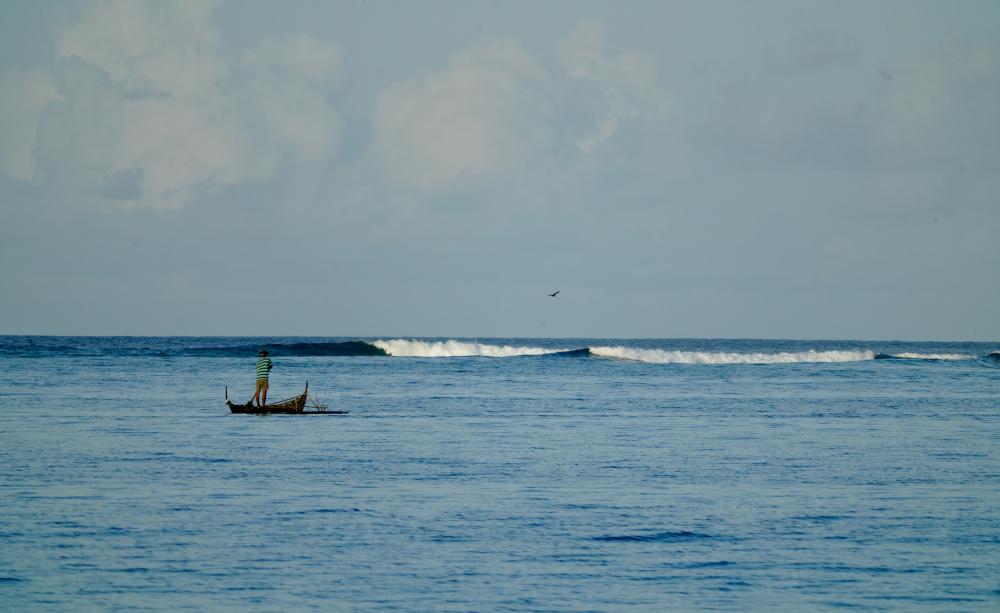
Two Nicobarese hodies, the traditional outrigger canoes, glide effortlessly in the blue sea, rising and falling with the swell. Along the shoreline, hermit crabs inch across the sand, each carrying a borrowed shell—both refuge and home.I lift my camera again.
After each day’s fieldwork, I long to return to this beach. I walk its length, sometimes pausing to sit on driftwood cast ashore by the sea. When darkness falls, I lie on the cool sand and look up.
The sky is thick with stars. Every step along the shore stirs a fleeting burst of light. Bioluminescent plankton glow around my feet for a moment, then fade back into the darkness.
Felled
Behind me, the forest is a single dark silhouette. Before me, the open sea merges with an unbroken horizon. A light breeze moves through the canopy.
Somewhere in the forest, a branch breaks and falls to the ground. And then, the silence returns, broken only by the steady lapping of the waves. I sit quietly, watching the sea breathe beneath the night sky.
In moments like these, Great Nicobar slips beyond the reach of language. Yet I cannot escape the thought that this island paradise may soon disappear. While the forest keeps its own ancient time, another future for this island is already being imagined elsewhere.
The government’s Great Nicobar megaproject envisions a transshipment port, an international airport, a new township, luxury enclave tourism, and the infrastructure to sustain them.
Yet its footprint extends far beyond engineering drawings. Millions of trees will be felled. Coral reefs will be dredged. Old-growth rainforests that shelter an extraordinary diversity of life will be cleared and fragmented. Nesting mounds of the Nicobar megapode will disappear.
Old-growth
The island’s extraordinary biodiversity — from the Nicobar long-tailed macaque to endemic reptiles, amphibians, flowering plants, fungi, and insects, including species yet to be described by science — faces an uncertain future.
For the Shompen and the Nicobarese, whose histories, livelihoods, and cosmologies are inseparable from these forests and seascapes, the megaproject threatens to devastate the living island they have long called home.
In the islanders’ worldview, humans, animals, forests, seas, ancestors, and spirits are woven into a single living, moral, and regenerative world.
To lose the land is therefore not simply to lose territory, but to unravel an entire way of being. As one Nicobarese man told me, the loss of the forest is the very “death of life.”
The island’s old-growth rainforests have survived earthquakes that lifted and submerged coastlines, tsunamis that redrew the shore, cyclones that splintered vast swathes of forests, and countless seasons beyond human memory.
Redrawn
They have witnessed kingdoms, empires, and governments come and go. Somewhere on the island, leatherback turtles still emerge from the sea to nest on its beach, following routes traced across millennia.
But their future is now being measured in project schedules, investment timelines, environmental clearances, and administrative deadlines.
This is a different kind of time altogether—not a faster version of the forest’s time, but its opposite: time emptied of memory, of rootedness, of return. How did we come to accept that a living island world, shaped over millennia, could be dismantled within the span of a few years?
Most evenings, I keep returning to the B-Quarry Beach. And each evening, I linger a little longer. Before the forest falls, I photograph what I can, knowing that these images may one day outlive the world they depict.
Tomorrow, the white-bellied sea eagle will return to the same weathered rock. The sea will rise and break around her, as it always has. She will wait for fish, unaware that the maps of her world have already been redrawn, and that another clock has begun to govern its future.
This Author
Ajay Saini is an anthropologist with extensive research experience in the Andaman and Nicobar Islands. He teaches at the Centre for Rural Development and Technology, Indian Institute of Technology Delhi.