There are good reasons to be sceptical about the deployment of significant SMR capacity -- or even modest SMR capacity -- by 2035. Or ever.
Claims that Big Tech is investing heavily in nuclear power are debunked in the latest report from the Australian Conservation Foundation, which also outlines six reasons why nuclear is no solution to the growing energy demand of data centres.
Data centres accounted for 1.5 percent of global electricity consumption in 2024 and the figure could reach three percent by 2030, according to a 2025 report by the International Energy Agency (IEA),
Renewables will supply nearly 50 percent of the growth in data centre electricity demand from 2024 to 2030 while new nuclear plants will supply almost none, in the IEA’s best prediction - or 'base case'.
Hurdles
And 320 gigawatts (GW) of additional capacity are installed to power data centres from 2024 to 2035 In the IEA’s estimate. Renewables would account for nearly two-thirds of this power, and nuclear just 20 GW or six percent.
More than 80 percent of that projected 20 GW of new nuclear capacity comes from small modular reactors (SMRs) in the US and China in the IEA’s scenario.
There are very good reasons to be sceptical about the deployment of significant or even modest - SMR capacity by 2035, however. Or, indeed, ever.
The IEA's own report notes than SMRs “remain to be demonstrated at scale”, that “high levelised costs and regulatory hurdles remain significant barriers to deployment”, and that “emerging challenges” exist such as “establishing supply chains for the higher-purity fuel needed for SMRs”.
Offtake
Technology companies have “plans to finance more than 20 GW of SMRs to date”, the IEA claims. But “plans” should not be confused with secure funding.
Several major technology companies, including Microsoft, Google, Amazon and Meta, have announced nuclear energy partnerships to support growing data-centre demand.
However, these commitments are largely non-binding agreements, power purchase arrangements, or modest investments in SMR wannabes rather than direct funding for reactor construction.
A Carnegie analysis notes that AI companies have preferred power purchase offtake agreements in which a buyer commits to a fixed-price, long-term contract with a power generator to buy electricity.
Contingent
They are much less keen on far more expensive and risky direct nuclear ownership or project development. Direct partnerships are most often with relatively new companies that are developing SMRs, and details are generally opaque.
There are good reasons to be sceptical about the deployment of significant SMR capacity -- or even modest SMR capacity -- by 2035. Or ever.
Alphabet, Amazon, Meta, Oracle and NVIDIA have agreements with SMR developers.
The Carnegie analysis notes that the terms of agreements are “largely undisclosed” but only include modest investments “structured to support early-stage SMR companies rather than fund construction directly.”
The analysis states: “Critically, these agreements are contingent on technologies that have not yet been commercialized.”
Investments
Dawn Stover, editor of the Bulletin of the Atomic Scientists, notes that “nuclear hype has flowed like champagne at a wedding reception” in relation to the growing energy demand of data centres.
However an analysis by Langabeer and Ramana, published in the Bulletin of the Atomic Scientists, argues that corporate press releases linking data centres to nuclear power “are all show, with little substance”.
Non-binding agreements and modest investment are no substitute for contractual agreements with clear funding commitments.
Nuclear funding commitments from Amazon and Google, Langabeer and Ramana note, “are just a fraction of one percent of their annual expenditures earmarked for building data centers”.
Those nuclear commitments, they argue, are “primarily meant as greenwashing, in order to divert attention from the negative environmental impacts of data center operations” including much larger fossil fuel investments.
Nuclear is no solution
Here is a non-exhaustive list of the reasons why nuclear power is unlikely to expand to meet data centre demand.
1. Nuclear power is unpopular, and so are data centres. An Australian poll found that just 20 percent of respondents would support a nuclear power plant being built in their area, even less than the 23 percent who would support a local data centre.
Langabeer and Ramana write in the Bulletin of the Atomic Scientists: “Opposition to data centers [in the US] springs from multiple concerns.
"A Gallup survey from March 2026 found that people opposed data centers because of their effects on resources, such as energy consumption and water usage; the effects on costs, especially utility bills; noise pollution; and concerns about quality of life and economic effects from loss of jobs.
"Some of these concerns would be accentuated if these data centers are powered by nuclear reactors, which could drive up the costs of electricity because of how expensive it is to build new nuclear plants. Using reactors will also increase the water demand.”
2. SMRs don’t exist. No SMRs exist worldwide and none are under construction using the standard definition of producing less than 300 megawatts, and with serial modular construction.
Using a loose definition - ignoring modular construction - there are two operating SMRs and five under construction. The combined capacity of those seven projects is 1.2 GW. Far more renewable energy capacity is added every single day.
The International Energy Agency expects the addition of nearly 4,800 GW of renewable capacity worldwide in the six years from 2026 to 2031, or 2.2 GW per day on average. SMR additions over that six-year period might or might not reach 1 GW.
3. Nuclear power is too slow. Based on overseas experience and expert analysis, it typically takes 10 years to plan a nuclear power project - securing licences, finance, contractors - then another 10 years for construction.
It can take much longer: for example reactors in France and Finland took 17 years to build, in addition to many years of planning. Nuclear is simply too slow to make a significant contribution to meeting growing data-centre demand.
SMR advocates claim three to five-year construction timelines, but the so-called SMRs in China and Russia took 11 to 12 years to build and around two decades from planning to operation.
4. Nuclear power is too expensive. Data-centre growth is already placing upward pressure on power prices in the US, Australia, and no doubt elsewhere. Nuclear would not ease these pressures.
Electricity from SMRs is far more expensive than renewable energy. A report by Australia’s leading government science agency gives these 2025 levelised cost estimates: SMR A$433-718 / megawatt-hour, large nuclear $200-328, solar PV $52-88, and onshore wind $78-129.
5. Nuclear accidents and attacks. In addition to the risk of catastrophic accidents, recent experience in Ukraine and the Middle East highlights the potential for nuclear catastrophe resulting from deliberate or accidental military strikes on nuclear plants.
6. Nuclear reactors - and data centres - are too thirsty. Nuclear reactors consume large volumes of water daily, and so do data centres. The IEA estimates that a typical 100 MW data centre consumes around two million litres of water per day.
Nuclear power would compound water constraints. Daily water consumption to operate a standard 1,000-megawatt reactor is typically 28-51 million litres of water per day. The water consumption for solar PV and wind power is far lower than the water consumption of coal or nuclear plants per unit of energy produced.
This Author
Dr Jim Green is the national nuclear campaigner with Friends of the Earth Australia and author of the Australian Conservation Foundation’s new report, ‘Phantom Energy: Small modular reactors and data centres’.
This Image
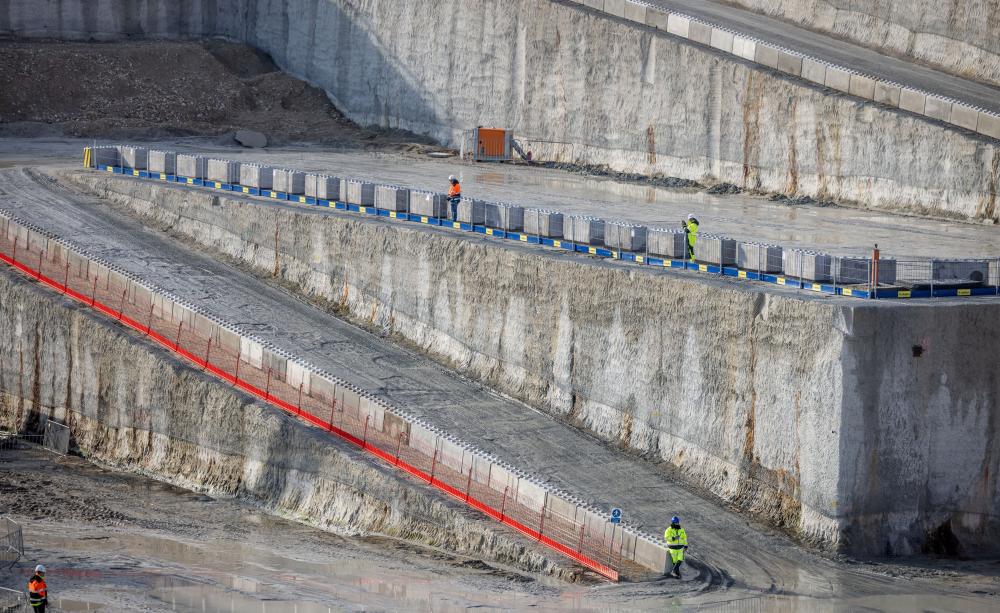
Workers prepare the lowest structural element of reactor block 5 on February 5, 2026 in Paks, Hungary. The pouring of the first concrete for the Unit 5 nuclear island of Paks 2 marks the official classification of the site as a nuclear power plant under construction, following years of controversy over the project. Last year, the European Court of Justice struck down the European Commission's approval of Hungary's state funding for Paks II, after the contract was awarded without a public tender process to the Russian state-owned nuclear corporation Rosatom, in violation of EU procurement rules. The addition of the two new VVER-1200 reactors, largely funded by a 10 billion Russian loan, has raised security concerns over the project's financial and strategic dependence on Russia, amid the ongoing war in Ukraine. Photo by Janos Kummer / Getty Images