









Cookies
What is a cookie ?
Cookies are small text files that are used to communicate with your computer while you are browsing a site. They are created every time you load a browser, and are retrieved with each visit to a web page. These cookies are used to provide information about you, such as your geographical location and whether or not you have been to a website before. They are most often used to improve and personalize your browsing experience.
Not all cookies are the same; different types perform different functions, and some sites contain more than others. When using www.theecologist.org, there are three types of cookies you should be aware of.
Innocuous ID Cookie
This is a cookie that is placed when you log into our site. This allows the site to remember who you are so that you can move from page to page without being signed out of the system. This cookie will only be set if you register with our site or become a subscriber.
Advertising Cookies
The Ecologist works with third parties to deliver targeted behavioral advertising. Through the use of these cookies, anonymous information about how you use other websites as well as our own will be used to place adverts about goods and services that are of interest to you. These cookies collect information for the third parties, not the Ecologist.
Google Analytics
Google Analytics is used to track the visitors of a site anonymously, meaning that none of this data is linked to you specifically. Google Analytics helps us to know the number of people who visit our site, what articles they read and where they are located in the world. This information is used internally to track the performance of articles and the sections on our site. It tells us how often you visit the website, how you use it and the route you used to arrive at it, for example whether you followed a linked on Facebook or did a Google search. There are three cookies set by Google Analytics, ‘__utma’ , ‘__utmb’, ‘__utmz’, that collect this data. To understand more about Google analytics follow this link: https://developers.google.com/analytics/resources/concepts/gaConceptsCookies#cookiesSet
For more information on cookies and how you can block them from being used on your computer, visit http://www.allaboutcookies.org/
A brief style guide
Introduction
Thank you for considering contributing to The Ecologist. Our website offers a platform to a range of thought leaders, academics and change makers from around the world who are each working in a number of different sectors and disciplines. This brief guide is intended to support you as you draft your article, and to ensure that everything we publish is clear and consistent.
For a comprehensive index of conventions regarding spelling and grammar, please refer to The Guardian’s style guide. If you have any further questions, please get in touch with the editor of the website, Brendan Montague, at [email protected].
Submission
If you’re emailing an article, please send it in Times New Roman, single-spaced, pt. 12, with no additional formatting. Please check through this guide before you submit your article. If you are uploading your piece directly to our website, please consult our step-by-step guide to the Content Management System (CMS).
Structuring the text
The headline should be short and unambiguous, 5-10 words. Please do not use capital letters apart from the first word and names etc.
Please provide a standfirst/summary that will appear at the top of the text in bold, approximately 20 words. This should follow-on from, and not repeat, the headline and end with a full stop. This should appear above the main body text in any emailed submission.
The total article should be approximately 600 to 1,500 words in length, with a preference for pieces around 1000 words. The body of the text should include short two-word subheadings: the first should appear roughly after the first three paragraphs, and thereafter every five paragraphs. These are intended to organise the text and keep the reader interested, they are not intended to encapsulate an argument.
The introductory three paragraphs should give a clear sense of what your article is about and signpost your line of argument.
Where possible, please include a high resolution photograph that you have permission to use or re-use, along with a short description (5 words), source and copyright information. This should not be a graphic. Climate Visuals is a good source. You can also check Flickr and Google Images - be sure to restrict your search to images that are free to use and share.
Each new article published on the website ends with This Author, followed by a short - less than 30 words - biography of the author. Job titles should be given in lower case. This is a good place to link to any book which has been published (the title should be italicised) and to also include a Twitter handle if the author so wishes.
Voice and tone
Remember that you are writing for an online format that will be read on a variety of digital devices, many of them handheld and less suitable for reading long, complex sentences and paragraphs. Ensure that paragraphs are concise, declarative and self-contained, and that the crux of the story appears at the very beginning.
Use an active voice, in which the subject of a sentence clearly completes an action:
Eg. ‘Campaigners have welcomed the promise of an Environment Bill.’
Scanning for words like ‘was’ and ‘by’ will help you to identify the passive voice, in which it takes longer to reach the subject of the sentence.
Eg. ‘The promise of an Environment Bill was welcomed by campaigners.’
Many of our articles are informal and accessible: it’s perfectly fine to use contractions: you’re, it’s, they’re etc.
Quotation
Use double quotation marks for reported speech and quoted writing. When quoting sources, place the attribution at the beginning:
Eg. Andy Gluckman, the chief executive, said: “Science is not like it once was.”
You can include hyperlinks to sources but please avoid footnotes or endnotes. Do be aware that with a hyperlink you are inviting your reader to abandon your article - at least momentarily - and focus their attention elsewhere. Where possible, please use a hyperlink to another story at The Ecologist.
Quotations of 50 words or more should be split into paragraphs with double quotation marks at the beginning of each paragraph and at the end of the final paragraph.
That/which
Sometimes it can be helpful to add ‘that’ after a verb:
Eg: ‘He argued that the evidence had been convincing”
A general rule, use ‘which’ for relative clauses that could be removed without affecting the meaning of the sentences (these clauses usually follow a comma), and ‘that’ for introducing essential information.
Spelling
Use ‘while’, not ‘whilst’; ‘among’, not ‘amongst’ etc.
In the case of news stories correct Americanisms, such as labor, color favor, center, toward, artifact, endeavor, fervor, maneuver, skeptic, pretense, ‘-ize’. If it is a comment article from a US author for a US audience these may be left in place.
Non-English words which have not passed into common English usage should be italicised.
‘Affect’ is a verb that signifies influence (eg. ‘The hot weather has really affected health’); ‘effect’ is a noun signifying the result of an influence (eg. ‘The pollution is having a disastrous effect on Londoners’).
US not U.S. etc.
Percent not %.
Commas
Use commas to separate clauses and ensure your sentences are easy to follow. An ‘Oxford comma’ is used before the final ‘and’ in lists. Where the sentence is straightforward, this isn’t necessary. In some cases, it can help the reader to determine the relationship between items in a list: it can be helpful to read sentences aloud to determine whether an Oxford comma would help.
Do include a colon after ‘said’ etc when presenting quotations. This would take the following form:
Alice Walker, the author, said: “The colour is purple.”
Hyphens
Do not use hyphens for compounds (eg. ‘thinktank’), unless you are using two or more words adjectivally (eg. ‘nineteenth-century ecology’). Hyphens can be used to avoid ambiguity (eg. ‘an animal-abusing corporation’) but often reorganising the sentence is the best solution (eg. ‘a corporation that abuses animals’).
Proofing
Use spell check software but don’t rely on it to proofread for you. Use the Find (‘ctrl + F’) function to search for common errors such as double spaces and spaces before commas/full stops.
Publication name
Capitalise the definite article in the title of the publication: 'The Ecologist', 'The Ecologist magazine' and 'The Ecologist Writers' Fund', as opposed to 'the Ecologist', 'the Ecologist magazine' and 'the Ecologist Writers' Fund'.
Terminology
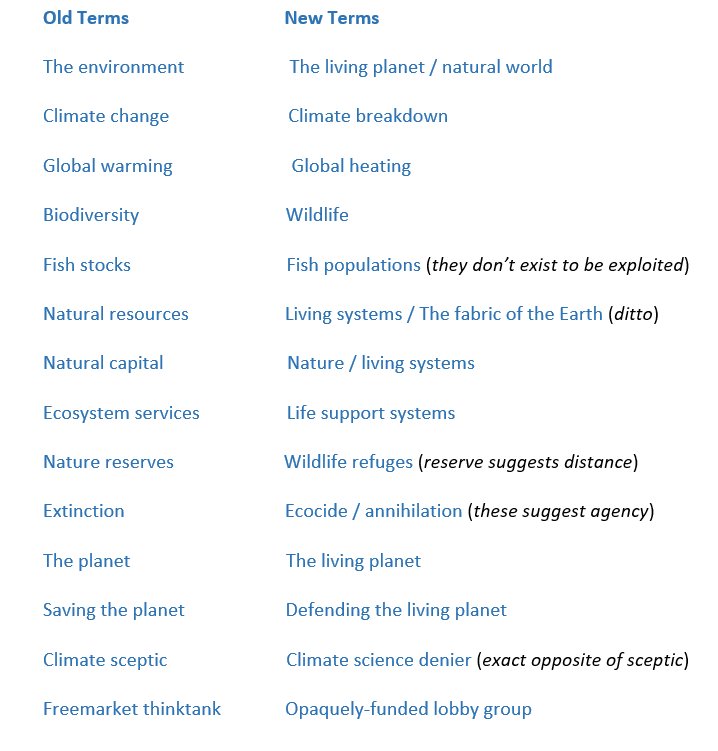
Please make use of these alternative terms suggested by George Monbiot.
Terms and Conditions
Contents
- Who are 'we'?
- Legal Information
- Copyright
- User-submitted Material
- Privacy Policy
- Overview
- What personal data do we collect?
- How we use your personal data
- Marketing communications
- Newsletters
- Essential communications
- Membership including renewal notifications and magazines
- Fundraising, donations and legacy pledges
- Retail sales and events management
- Research
- Profiling
- Updating your data and marketing preferences
- The Right to be Forgotten
- Your data protection rights (DPO)
- Accessing information we hold on you
- What to do if you’re not happy
- Keeping your information
- How we secure your data
- Disclosing and sharing information
- Storage of information
- CCTV
- Links to other websites
- Cookies
- Disclaimer
- Changes
- The Resurgence Trust
Who are 'we'?
In this document, whenever you see the words ‘we’, ‘us’, ‘our’, ‘Resurgence, it refers to The Resurgence Trust, a charity registered in England and Wales. Registered address: The Resurgence Centre, Fore Street, Hartland, Bideford, Devon EX39 6AB.
The Resurgence Trust (Reg. Charity number 1120414) is a charity that promotes ecological sustainability, social justice and spiritual values. The Resurgence Trust also carries on a number of trading activities to generate income for The Resurgence Trust including the sale of books and gifts from our online shop, income from partnerships including sponsorship, affinity marketing, events and advertising revenues.
If you have any questions in relation to these Terms & Conditions, or how we use your personal data they should be sent to [email protected] or addressed to the Data Protection Officer, The Resurgence Trust, The Resurgence Centre, Fore Street, Hartland, Bideford, Devon EX39 6AB.
Legal Information
Below are the Terms and Conditions which apply to information contained in the pages of thecologist.org, i.e., ‘the Ecologist website’ and to the ordering of any products from the website. By using this website and/or making a purchase through this website you agree to and accept our Terms and Conditions. All transactions undertaken through this website are governed by English Law.
Copyright
The contents of the website are copyright of the respective authors, photographers, illustrators and/or their agents. The reproduction, copying, downloading, printing, modification, storage, recording, broadcasting, retransmission or distribution of any part of the website is not permitted, except for making a single copy for personal use, or where articles are published under a Creative Commons licence and labelled as such, or where prior written permission has been obtained from The Resurgence Trust.
If you would like to reprint an article or use an image from the website please contact the editor to obtain permission: [email protected].
These terms apply to all issue and article downloads, including free sample issues or articles, issues or articles purchased individually, and downloads made by members of the Resurgence Trust. Action will be taken against any infringement of these terms.
User-Submitted Material
Unless specifically requested, we do not solicit nor do we wish to receive any confidential, secret or proprietary information or other material from you through the website, by email or in any other way. By submitting or sending any information, creative works, demos, ideas, suggestions, concepts, methods, systems, designs, plans, techniques or other materials to us, you agree:
- That the Submitted Materials are original to you, that no other party has any rights thereto.
- That The Resurgence Trust is not responsible for maintaining any submitted material that you provide us, and we may delete or destroy and such submitted material at any time.
- To grant The Resurgence Trust a perpetual, royalty-free, irrevocable, non-exclusive, sub-licensable right and license to use, reproduce, modify, adapt, publish, distribute, make available to the public, and exercise all copyright and publicity rights with respect to your material worldwide. By submitting your content you warrant that you have the right to grant this license. The license is capable of sub-license by The Resurgence Trust to other entities and to agents, suppliers and publications (in any media) of our choosing. If you do not want to grant The Resurgence Trust the rights set out above, please do not submit your material to The Ecologist.
Privacy Policy
The privacy and security of your personal information is extremely important to The Resurgence Trust. This privacy policy explains how and why we use your personal data, to make sure you stay informed and can be confident about giving us your information.
We’ll keep this policy updated to show you all the things we do with your personal data. This policy applies if you’re a supporter of the Resurgence Trust (member, donor, volunteer, contributor, tenant, customer, employee) or use any of our services, visit our website, use our mobile app, email, call or write to us.
Overview
The Resurgence Trust respects and protects the privacy of anyone who visits the Ecologist website. We’ll never sell your personal data.
- The Ecologist website includes links to other sites, not owned or managed by Resurgence. We cannot be held responsible for the privacy of data that may be collected by those websites.
- We may collect and record information in order for us to understand more about how our site is used and in turn to make sure that the site reflects your needs. In order to do this we may send cookies to your browser.
What personal data do we collect?
Your personal data (any information which identifies you, or which can be identified as relating to you personally for example, name, address, phone number, email address) will be collected and used by us. We collect the minimum personal data that we need to fulfil our responsibilities in connection with specific activities such as registration or membership requests, placing an order, booking an event, donations, volunteering, contributing articles, employment etc.
You can give us your personal data by filling in forms on our website, by registering to use our website, participating in an event, subscribing to receive emails on our website or other social media functions on our website, entering a promotion or survey or by corresponding with us (by phone, email or by joining as a member/supporter/customer).
This personal data you give us may include name, title, address, date of birth, age, gender, employment status, demographic information, email address, telephone numbers, personal description, photographs, usernames and passwords.
Personal data provided by you
This includes information you give when interacting with us, for example taking out a membership to The Resurgence Trust or registering on the Ecologist website, placing an order or communicating with us. For example:
- Personal details (name, date of birth, email, address, telephone, and so on) when you join as a member or supporter
- Financial information (payment information such as credit or debit card or direct debit details, and whether donations are gift-aided)
- Your opinions and attitudes about the Resurgence Trust, activities and interests, and your experiences of the Resurgence Trust.
- If you buy membership as a gift or are the parent of one of our readers or supporters, including volunteers, your details will be recorded and your association with that relationship will be recorded.
We may automatically collect the following information:
- Technical information, including the Internet protocol (IP) address used to connect your computer to the Internet, your login information, browser type and version, time zone setting, browser plug-in types and versions, operating system and platform and, if you access our website via your mobile device, we will collect your unique phone identifier.
- Information about your visit, including, but not limited to the full Uniform Resource Locators (URL) and query string, clickstream to, through and from our website (including date and time), products you viewed or searched for, page response times, download errors, length of visits to certain pages, page interaction information (such as but not limited to, scrolling, clicks, and mouse-overs), methods used to browse away from the page, and any phone number used to call our customer service number.
- Information about your purchases including but not limited to revenue figures, the types of products purchased, membership application ID, purchase ID, event booking ID, and Renewal ID.
- The terms that you use to search our website.
Please note that certain services on our website won’t be available to you until you’ve registered to use our website. Registration on theecologist.org website is only open to members of staff, and invited contributors.
Personal data created by your involvement with us
Your activities and involvement with us will result in personal data being created. This could include details of how you’ve helped us by volunteering, contributing an article or being involved with our events or activities. If you decide to donate to us then we’ll keep records of when and how much you give and whether this is for a particular project.
Information from third-parties
We do not buy anonymous external data (e.g. census data, Experian MOSAIC, TGI) or combine external data with your personal data to build profiles.
Sensitive personal data
At times we may collect sensitive personal data for Equal Opportunities monitoring, as well as researching whether we deliver good services for everyone, but this is only ever analysed at an aggregate level.
How we use your personal data
We’ll only use your personal data on relevant lawful grounds as permitted by the EU General Data Protection Regulation /UK Data Protection Act and Privacy of Electronic Communication Regulation.
Personal data provided to us will be used for the purpose or purposes outlined in any fair processing notice in a transparent manner at the time of collection or registration where appropriate, in accordance with any preferences you express. If asked by the police, or any other regulatory or government authority investigating suspected illegal activities, we may need to provide your personal data.
Your personal data may be collected and used to help us deliver our charitable activities, help us raise funds, or complete your order or request. Below are the main uses of your data which depend on the nature of our relationship with you and how you interact with our various services, websites and activities.
Marketing communications
Your privacy is important to us, so we’ll always keep your details secure. We’d like to use your details to keep in touch about things that may matter to you. If you choose to hear from us we may send you information based on what is most relevant to you. This might be about a Resurgence event, volunteering with us, membership, fundraising, or the Resurgence shop.
We’ll only send these to you if you agree to receive them and we will never share your information with other companies for inclusion in their marketing. If you agree to receive marketing information from us you can change your mind at any time. (However, if you tell us you don’t want to receive marketing communications, you may not hear about events or other work we do that may be of interest to you.)
Personal data provided to us may also be profiled to help us with advertising targeting. For example, your membership data may be used to ensure we don’t serve you online membership advertisements.
We may use third-parties to capture some of our data on our behalf, but only where we are confident that the third-party will treat your data securely, in accordance with our terms and in line with the requirements set out in the General Data Protection Regulation (GDPR).
Newsletters
We use Constant Contact as our marketing automation platform to send emails on our behalf to our supporters. When you opt in on our website to receive Ecologist newsletters you acknowledge that we will pass your name and email address to Constant Contact. Constant Contact will handle your data in accordance with their Privacy Policy and Terms.
You can opt out of these newsletters at any time by using the link at the bottom of any newsletter. If you have any queries please email [email protected]
Essential communications
There are some communications that we need to send. These are essential to fulfil our promises to you as a member, volunteer, contributor, donor or buyer of goods or services from the Resurgence Trust. Examples are:
- Transaction messaging, such as Direct Debit schedules, shop purchase confirmations and event booking confirmations.
- Membership-related mailings such as renewal reminders.
- Notification of new issues being released online.
Membership including renewal notifications and magazines
We use the personal data you provide as a member to service your membership. This includes sending renewal information to annual members by mail and email, sending Resurgence & Ecologist magazines and, where required, sending key information about the Resurgence Trust. It’s also used to verify you when you contact our Membership team or sign up for a My Resurgence account to manage your membership online.
Fundraising, donations and legacy pledges
Where we have your permission, we may invite you to support the work of The Resurgence Trust by making a donation, getting involved in fundraising activities or leaving a gift in your will.
Occasionally, we may invite some supporters to attend special events to find out more about the ways in which donations and gifts in wills can make a difference to specific projects and to our cause. We’ll also send you updates on the impact that you make by supporting us in this way, unless you tell us not to.
If you make a donation, we’ll use any personal information you give us to record the nature and amount of your gift, claim gift aid where you’ve told us you’re eligible and thank you for your gift. If you interact or have a conversation with us, we’ll note anything relevant and store this securely on our systems.
If you tell us you want to fundraise to support our cause, we’ll use the personal information you give us to record your plans and contact you to support your fundraising efforts.
If you’ve told us that you’re planning to, or thinking about, leaving us a gift in your will, we’ll use the information you give us to keep a record of this – including the purpose of your gift, if you let us know this.
If we have a conversation or interaction with you (or with someone who contacts us in relation to your will, for example your solicitor), we’ll note these interactions throughout your relationship with us, as this helps to ensure your gift is directed as you wanted.
Charity Commission rules require us to be assured of the provenance of funds and any conditions attached to them. We follow a due diligence process which involves researching the financial soundness, credibility, reputation and ethical principles of donors who’ve made, or are likely to make, a significant donation to The Resurgence Trust. As part of this process we’ll carry out research using publicly available information and professional resources. If this applies to you, we’ll remind you about the process when you make your donation.
Retail sales and events management
We process customer data in order to fulfil event bookings and retail activities. Your data will be used to communicate with you throughout the process, including to confirm we’ve received your order and payment, to confirm dispatch, to clarify where we might need more detail to fulfil an order or booking, or to resolve issues that might arise with your order or booking. We may pass your dietary requirements for an event to the event organisers or caterers.
Research
We carry out research with our supporters, customers, staff and volunteers to get feedback on their experience with us. We use this feedback to improve the experiences that we offer and ensure we know what is relevant and interesting to you.
If you choose to take part in research, we’ll tell you when you start what data we will collect, why and how we’ll use it. All the research we conduct is optional and you can choose not to take part. For some of our research we may ask you to provide sensitive personal data (e.g. ethnicity). You don’t have to provide this data and we also provide a ‘prefer not to say’ option. We only use it at an aggregate level for reporting (e.g. equal opportunities monitoring).
Profiling
We may use profiling and targeting to help us understand our supporters and make sure that:
- our communications (e.g. emails) and services (e.g. our website) are relevant, personalised and interesting to you
- our services meet the needs of our supporters
- we only ask for further support and help from you if it’s appropriate
- we use our resources responsibly and keep our costs down
To do this we may analyse how you interact with us (e.g. on our website, at our events, etc) and use both geographic and demographic information to let you know what’s happening in your local area and understand your interests.
We use specific tools to profile how you interact with us online. We use Google Analytics to collect information on the use of The Resurgence Trust website and the Ecologist website. Much of the information we collect is aggregated, however we may also collect some personal data for the use of personalising your experience, optimising our marketing campaigns, and to ensure the site is functioning as intended.
The personal information that is collected includes transactional information (i.e. order number) for Memberships, Donations, Renewals, Event Bookings and Online Shop Purchases. We also collect data on individual user activity when they log into their account.
If you’ve agreed that we can contact you for marketing purposes, we may also gather additional information about you from external sources, for example: updates to address and contact information, or publicly available information regarding your wealth, earnings and employment at an aggregate level. We may use this information to assess your capacity to support us and invite you to do so.
This analysis may be carried out by us or by third-party organisations working for us. We may also host secured personal data on third-party websites (e.g. social media platforms) to ensure that you only see relevant, personalised and interesting content from those organisations.
Updating your data and marketing preferences
We want you to remain in control of your personal data. If, at any time, you want to update or amend your personal data or preferences please contact us in one of the following ways:
- If you are registered on the Ecologist website, you can go to your Edit Profile page and change your details.
- Contact us, clearly stating the changes that you would like us to make, and including your full name and full address. If you are a member and receive the magazine by post, please also include your member number, which you can find in the line above your name and address on the wrapper that your magazine is sent in. You may contact us as follows:
- Telephone us: +44 (0) 44 1237 441293. The office is open 9.00am-5.00pm, Mon-Fri, excluding weekends & bank holidays.
- Email: [email protected]
- Write to: Data Controller, The Resurgence Trust, The Resurgence Centre, Fore Street, Hartland, Bideford, Devon EX39 6AB
Verification, updating or amendment of personal data will take place within 30 days of receipt of your request.
The Right to be Forgotten
Under the terms of GDPR you have the right to have your personal data erased. You can make the request verbally or in writing using the contact details above. We will respond to your request within one month. We will provide you with details of the data that we hold on you and the data that has been erased. The right to erasure is not absolute and only applies in certain circumstances. We will inform you if this is the case and explain why. We may request a reasonable fee to deal with your request for erasure.
Your data protection rights (DPO)
Where the Resurgence Trust is using your personal data on the basis of consent, you have the right to withdraw that consent at any time. You also have the right to ask the Resurgence Trust to stop using your personal data for direct marketing purposes. Tell us by contacting us using the details above.
Accessing information we hold on you
You have the right to access the data we hold on you. If you would like exercise your right to access the data we hold on you, please contact us using the contact details above. Please provide the following details:
- The personal information you want to access.
- Where it is likely to be held.
- The date range of the information you wish to access.
We will also need you to provide information that will help us confirm your identity. If we hold personal information about you, we will give you a copy of the information in an understandable format together with an explanation of why we hold and use it.
Once we have all the information necessary to respond to your request we’ll provide your information to you within one month. This timeframe may be extended by up to two months if your request is particularly complex.
What to do if you’re not happy
In the first instance, please talk to us directly so we can resolve any problem or query. Tel: +44 (0)1237 441293, email: [email protected]. You also have the right to contact the Information Commissions Office (ICO) if you have any questions about Data Protection. You can contact them using their help line 0303 123 113 or at www.ico.org.uk.
Keeping your information
We will only use and store your information for as long as it is required for the purposes it was collected for. How long it will be stored for depends on the information in question, what it is being used for and, sometimes, statutory legal requirements. For example:
- If you have made a purchase or donation we will keep your data for 7 years, as required by HMRC.
- If you have taken out a membership with The Resurgence Trust we will keep your data for as long as you remain a member, in order to service your membership. We will retain your data for 7 years after your membership lapses, as required by HMRC.
- If you have registered on our website but have not logged in for five years, your data will be deleted.
Note that when you take out membership, you gain access to certain resources on the website, such as magazine issues and articles. Your access to these resources persists even after your membership lapses. However, if your data is deleted because you have not logged in to the website for a long period, then you will loose access to these resources. Please log in to the website periodically if you wish to retain access to these resources.
How we secure your data
Information system and data security is imperative to us to ensure that we are keeping our customers, members, volunteers, employees and contractors safe. We operate a robust and thorough process for assessing, managing and protecting new and existing systems to ensure that they are up to date and secure against the ever-changing threat landscape.
Our staff complete information security and data protection training to reinforce responsibilities and requirements set out in our information security policies. When you trust us with your data we will always keep your information secure to maintain your confidentiality.
Data travelling to and from our website uses a secure (https/ssl) connection. By utilising strong encryption when your information is in transit we minimize the risk of unauthorized access or disclosure. When entering information on our website, you can check this by right-clicking on the padlock icon in the address bar. Data sent by email is not encrypted. Personal data is not encrypted whilst in storage, but there are strict controls over who has access to the data.
Disclosing and sharing information
We do not sell, rent or barter your personal information for use by other organisations.
Personal data collected and processed by us may be shared with the following groups where necessary:
- The Resurgence Trust employees and volunteers
- Third-party cloud hosting and IT infrastructure providers who host the website and provide IT support in respect of the website.
Also, under strictly controlled conditions:
- Contractors
- Service Providers providing services to us
- Advisors
- Agents
When we allow third-parties acting on behalf of The Resurgence Trust to access to your information, we will have complete control of what they see, how long they see it for and what they are allowed to do with it.
We may also disclose your personal information to third-parties if we are under a duty to disclose or share your personal data in order to comply with any legal obligation, or in order to enforce or apply our terms of use or cookie policy and other agreements; or to protect the rights, property, or safety of The Resurgence Trust, our members, supporters and participants at our events. This includes exchanging information with other companies and organisations for the purposes of fraud detection and prevention.
Storage of information
The Resurgence Trust operations are based in the UK and we store most of our data within the European Union (EU). Some organisations which provide services to us may transfer data outside the European Economic Area but we’ll only allow this if your data is adequately protected. Some of our systems are provided by US companies and whilst it is our policy that we prefer data hosting and processing to remain on EU-based solutions, it may be that using their products results in data transfer to the US. However we only allow this when we are certain it will be adequately protected.
CCTV
Some of the venues where we hold Resurgence Trust events have Closed Circuit Television (CCTV) and you may be recorded when you participate in an event. CCTV is used to provide security and protect the public and the Resurgence Trust. CCTV will be only be viewed when necessary (e.g. to detect or prevent crime) and footage is stored for set period of time after which it is recorded over. The Resurgence Trust complies with the Information Commissioner’s Office CCTV Code of Practice and we put up notices so you know when CCTV is used.
Links to other websites
Our website contains links to other websites, not limited to our partner networks, advertisers and affiliates. If you follow a link to any of these websites, please note that these websites have their own privacy policies and that we do not accept any responsibility or liability for these policies. Please check these policies before you submit any personal data to these websites. This privacy policy applies solely to the personal data collected by The Resurgence Trust.
Cookies
Cookies are small packets of information which are sent by a web server, stored within a user's web browser, and later sent back again to the server. The Ecologist website uses cookies for a number of purposes:
- To uniquely identify your session, after you have logged in to the site.
- If you were referred to our site by a partner organisation, to keep track of that organisation.
- To store analytical information, to enable us to better understand your use of the site.
These cookies are completely safe and secure and do not contain any sensitive information.
You can adjust the settings in your browser, if you wish, to delete or disallow the storage of cookies. However, this is likely to impact your experience of using the website. If you use the Ecologist website we will assume that you are happy to receive all cookies sent by the site.
Disclaimer
The Resurgence Trust makes every effort to ensure the accuracy of the information on this website. The Resurgence Trust cannot accept responsibility for any inconvenience, loss or damage caused as a result of inaccurate information on these pages.
The Resurgence Trust does not give any warranty or other assurance as to the operation, quality or functionality of the website or its fitness for any particular purpose. Access to the website at any time may be interrupted, restricted or delayed for reasons beyond The Resurgence Trust’s control. The Resurgence Trust does not give any warranty or other assurance with respect to any of the material appearing on the website, its accuracy, completeness, timeliness or fitness for any particular purpose.
To the full extent permissible at law, The Resurgence Trust disclaims all responsibility for any claims, damages or losses (including, without limitation, financial loss, damages for business loss, loss of profits or other consequential losses) arising in contract, tort or otherwise from the use of or inability to use the web site or any material appearing on the web site, or from any action taken as a result of using the site or any such material.
The Resurgence Trust shall not be liable for the contents of any advertisement on this site. Where this site is hyper-linked to a site operated by a third party, we accept no responsibility or liability for access to, or arising in respect of any content on such site nor shall the presence of such links be deemed to be a recommendation or endorsement of such site by The Resurgence Trust.
Advertisers and third parties providing advertisements or links to other web sites shall be solely responsible for ensuring that such advertising material and such other web sites comply with all relevant laws and regulations. To the full extent permissible, The Resurgence Trust disclaims all responsibility for any error, omission or inaccuracy in such material or its failure to comply with the relevant laws or regulations.
This Agreement constitutes the entire understanding of the parties with respect to the subject matter hereof and supersedes all prior and contemporaneous agreements, understandings, negotiations and discussions, whether oral or written, of the parties and there are no warranties, representations or other agreements between the parties in connection with the subject matter of this Agreement except as specifically set forth herein.
Changes
We regularly review our Terms and Conditions to ensure that they are up to date and compliant with any new legislation. They are subject to change at any time without prior notice. The latest version will always be posted on our website. At no point do these Terms and Conditions affect your statutory rights.
These Terms and Conditions were last updated on 10 January 2023.
The Resurgence Trust
This website is owned and operated by The Resurgence Trust. The Resurgence Trust is a Limited Company registered in England and Wales. Company number 5821436. VAT number: 4562 12953. The Resurgence Trust is a charity registered in England and Wales. Charity number 1120414. Registered Office: The Resurgence Centre, Fore Street, Hartland, Bideford, Devon EX39 6AB. Telephone 01237 441 293, Fax 01237 441 203. www.resurgence.org
About Us
THE TEAM
The Ecologist online has a small Editorial Team of currently 1.5 FTE. The Editorial Team also benefits from the support and advice of colleagues across the Resurgence Trust, as explained below.
Editorial
Eleanor Penny is a journalist, broadcaster and multi-award-winning writer. Her work has appeared in outlets such as the New Statesman, the Independent, Verso Books, Novara Media, In These Times, Ambit Magazine and Poetry London. She's a co-founder of Planet B Productions, and she teaches creative writing at City Lit, The Poetry School and Goldsmiths University.
Brendan Montague is the full-time editor and programme manager for The Ecologist online. Brendan has 30 years experience in the newspaper industry, including a decade editing campaigning and investigative websites specialising in environmental justice.
Catherine Early is a freelance environmental journalist and chief reporter for The Ecologist. Find her on Bluesky @catearly.bsky.social.
Operations
Satish Kumar is editor emeritus of Resurgence & Ecologist and The Ecologist online, and a member of the Management Team of the Resurgence Trust (owner and publisher of The Ecologist online).
Angie Burke is the trust manager at The Resurgence Trust. She has mainly worked in the charitable sector and is passionate about environmental education.
Mark Gough is the finance and operations manager at The Resurgence Trust.
Professor Herbert Girardet is a trustee of the Resurgence Trust and a broadcast journalist and author with decades of experience.
ABOUT US
The Ecologist is an environmental news and analysis website with a focus on ecological, social and economic justice. We publish daily, bringing the latest news, comment, features and reviews to your screens - for free. You will find news about successful environmental campaigns, stories about advances in academic ecology and discursive articles touching on theoretical approaches that help us understand nature and the impact of our societies on the natural environment.
The Ecologist online is read and enjoyed by people all around the world, with hundreds of thousands of readers from across the UK and the United States. The website was launched in 2005 and since then more than 13 million people have visited our site, with 27 million hits accessing more than 10,000 articles. Our most popular article - Ten Alternatives to Cow’s Milk - has received more than 357,000 hits - and counting.
The Ecologist began life as a print magazine in 1970, with the aim of raising public awareness of the impact our society was having on the natural environment - and what the outcomes might be for our society in turn. We’re really proud that we have been publishing environmental news and discussion for more than 50 years and this remains core to our work.
Since 2012, The Ecologist has been owned and published by the Resurgence Trust, an educational charity working across the fields of environment, social justice, activism, spirituality and the arts. The Trust publishes the Resurgence & Ecologist print magazine six times a year. This has been dubbed the “spiritual and ecological flagship of the environmental movement” by The Guardian.
The Ecologist has played a crucial role in diagnosing the environmental crises which have only worsened in the intervening half-century. Now we’re increasingly focusing on how we find solutions. And we are keen to work more closely with our contributors and readers to ensure that understanding and respecting our ecology becomes second nature in the half-century to come.
STRATEGY 2023/6
EXECUTIVE SUMMARY
The Ecologist online is a news and analysis website focussed on environmental, social and economic justice. The Ecologist was founded in 1970 and has earned brand recognition and trust across the environmental movement in the UK by advocating systemic change and delivering hard-hitting investigative journalism. The Ecologist is today owned and managed by the Resurgence Trust, a registered educational charity, and has a dedicated programme staff of 1.5 full time equivalent (FTE). The editor leads the Programme Team and reports to the Management Team.
The Ecologist online publishes daily news and analysis, raising awareness of a broad range of environmental and social justice concerns, and amplifying the voices of environmental campaigners and advocates, including those representing or from marginalised communities. The Ecologist is celebrating its 50th anniversary and wants to take this opportunity to launch a new economics project – challenging the current economic growth paradigm that is driving climate breakdown, conflict and biodiversity collapse and promoting alternative sustainable and regenerative economic theories and policy initiatives. The Ecologist online programme currently has a budget of £74,000 a year - met mostly through income from syndication, royalties, advertising and support from the Resurgence Trust. We aim to raise an additional £150,000 across three years, restricted to funding our new environmental economics project.
“Without social justice there can be no ecological justice.”
Satish Kumar, Resurgence Trust founder, Resurgence & Ecologist, 2020
"To avoid a climate and earth systems breakdown, a Green New Deal chancellor must mobilise large sums from both the public and private sectors to finance the transformation of the British economy away from its dependence on fossil fuels."
Ann Pettifor, author, IPPR, 2019
“We wanted to build a diverse [climate] movement to put justice – social, ecological, racial and gender – at its heart, and be a powerful voice to hold rich countries to account for causing the crisis.”
Asad Rehman, War on Want, The Guardian, 2021
“I majored in economics, philosophy, and politics at Oxford, but I gradually became disillusioned with economic theory and the lack of discussion of topics that I really wished to pursue, such as ecological integrity and social justice.”
Kate Raworth, author, Great Transition Initiative, 2019
“Climate activists are sometimes depicted as dangerous radicals, but the truly dangerous radicals are the countries that are increasing the production of fossil fuels.”
António Guterres, United Nations Secretary-General, Twitter, 2022
Aim
The aim of The Ecologist is to educate members of the public concerned about environmental crises about the need for a radical transformation of our global economies.
Mission
The Ecologist has for 50 years warned about the impact of industrial societies on the biosphere, and presented radical solutions that meet human needs as well as protecting and restoring the natural environment. The Ecologist from the beginning adopted systems theory and extended the work of the Club of Rome to develop a vision of a sustainable world, with its Blueprint for Survival selling more than 600,000 copies worldwide. This mission continues today, learning from contemporary discussions centred on environmental, social and economic justice. The Ecologist aims to serve the entire environmentalist community, adding value by providing free educational materials about systems theory, thermodynamic economics, the fossil fuel economy and regenerative alternatives from degrowth to the Green New Deal. The environment movement has, because of climate breakdown, become increasingly aware and concerned about the impacts of the fossil fuel economy globally and its impact on society and nature. The Ecologist provides information that is vital to the campaigns attempting to end the fossil fuel economy and usher in an era of renewable energy, regenerative economies and happier lives.
Values
Justice. Integrity. Empathy.
Vision
We look forward to a future where human societies design and develop economies that are inherently just. We demand that those in power – in corporations and in government – demonstrate integrity. We see the possibility of developing economic systems that free human beings from what William Morris described as “useless toil” while also having a positive impact on the biosphere. We see a future with no fossil fuel economy – with no exploitation and no colonialism. We in turn demonstrate our own commitment to justice, integrity and empathy in our journalism and organisational practice.
Objectives
To educate the public about:
- The successes of the frontline activism, advocacy and campaigns currently taking place to stop the direct harms from the fossil fuel economy.
- The visions and proposals moving us towards a “post-fossil fuel economy”.
- The impacts of the fossil fuel economy on our societies and the global biosphere.
- The different economic theories that exist, and how the adoption or neglect of these theories determines our social impact on the natural environment.
- Systems theory as a useful analytical tool for understanding a wide variety of environmental concerns.
- The history of the evolution of the current global fossil fuel economy.
Theory of Change
We propose a simple, causal explanation of how our work can have a significant impact on the world.
- We develop and publish strategically useful educational materials about the fossil fuel economy, and its context.
- We work to ensure that activists read and engage with this material, and people become activists as a result of engaging with this material.
- Activists make even better strategic decisions about how to influence policymakers, corporate executives, energy workers and communities.
- Activists take more impactful action.
- We amplify the voices and successes of activists, campaigners and advocates.
- The environment movement together moves towards helping to create a world that is safe, and just.
Need
The impacts of unregulated capitalist economies on the natural environment globally are devastating, representing an existential threat to the existence of human societies and life itself in the medium to long term. These economies have proved to be entirely dependent on the unlimited use of fossil fuels, driving climate breakdown with the harms and risks as set out in the latest IPCC report.
The ‘cost of living crisis’ will leave one third of the UK population in absolute poverty, with inflation running at eight percent. Hardship is set to get worse, year on year. The environment movement will be confronted with a series of new problems as a result: climate breakdown and other ecological concerns will be relegated down the news agenda; environmental policies are and will be blamed for the economic crisis; corporations will increase the volume on the ‘environment or jobs’ narrative.
The transition to post-fossil fuel – and indeed post-neoliberal or even post-capitalist – societies is a gargantuan task. All the evidence from current geopolitical events – from the lack of progress at the Conference of the Parties (COP) taking place annually to the war in Ukraine and the failure to manage the coronavirus pandemic – suggest that political leaders are not going to meet the challenge.
The alternative is international mass participatory action from millions of ordinary people. The problem remains, however, that the change we need is significant and the time we have is extremely limited. The Editorial Team of The Ecologist online has a small if potentially important role to play in this moment.
The Ecologist, as set out in our objectives, can identify, develop and publish the most strategically useful information about the fossil fuel economy, including how it can be understood with the tools of systems theory, radical economics and as a physical object that exists in our society. We also want to provide hope by shining a light on activists and their campaigns and on the many alternative economic policies and proposals that have already been developed, and by curating a vision for the future after the fossil fuel era has come to an end: a future in which people are freed from hard manual labour through technological development but also our economies regenerate rather than degrade our natural environment.
Method
The main method used to meet our objectives is publishing high quality content on our website in the form of news and analysis, making these educational materials available free of charge and then using newsletters, social media and public events to ensure that the public are aware of them, as well as supporting them in engaging with these texts. We will signpost our community to the best analysis publicly available, such as books by authoritative writers, reports from leading think tanks, and articles published by other environmental websites. We will work to platform and amplify a diversity of authors representing and highlighting the experiences of communities that are often marginalised and ignored by the mainstream media and wider culture. This includes, but is not limited to, Black, Asian and Minority Ethnic (BAME) and Black, Indigtenous and People of Colour (BIPOC) communities, LGBTQIA+ communities and intellectual currents within the social and environmental justice movements.
Activity
The Ecologist aims to expand its team to three full-time equivalent (FTE) staff: an editor, an economics editor and a socials editor. The doubling in capacity will take place over three years. The larger team will create content – news and analysis articles – and publish it on our website and in The Ecologist section of Resurgence & Ecologist magazine. The online articles will be augmented with video, podcasts and social media posts. We want to find where discussion about fossil fuel economy – and more precisely its impacts such as the wars in Ukraine, Syria and beyond, the cost of living crisis and climate breakdown – is taking place and make sure the best educational materials are available in those online and real world spaces.
Environmental Economics Project
The Ecologist aims to create a new economics editor role and expand its small Editorial Team, meeting the additional costs in the first three years by applying for grants from trusts and foundations. The economics editor will be responsible for producing authoritative and informative articles. These will tend to have a news hook – such as reporting on the UK Government’s energy strategy – while also introducing broader economic concepts and themes, such as ‘trickle down’ or ‘externalities’. Further, the economics editor will educate colleagues so that their content is accurate and informative from an economics perspective.
Content
The content of The Ecologist online for the duration of this strategy will be the product of five streams of work:
- News and analysis highlighting the best positive proposals for alternatives to the fossil fuel industry.
- News items about the economy, and in particular the fossil fuel economy.
- An investigation into the UK fossil fuel economy, including discussion of the UK energy infrastructure and also the overseas countries, economies and corporations that extract and export energy to the UK.
- A series of papers authored by Professor Herbert Girardet, titled Megamorphosis: A guide to regenerative planet change, examining the crises impacting the biosphere.
- A series of articles presenting a philosophical study of energy through systems theory to help explain climate science, human societies, economics, and organisational change at an institutional level.
Outputs
Weekly
The Ecologist online will publish five articles each week for 51 weeks a year, excluding only the Christmas and New Year holiday week.
Special Issues: Digital
The publication schedule will include a number of monthly special issues, including from the series produced by Brendan Montague and Professor Herbert Girardet. (Delivered).
Special Issue: Print, Resurgence & Ecologist
The editor of The Ecologist online will work with the editor of the Resurgence & Ecologist magazine to produce a special themed issue of the print magazine focussed on energy. (Delivered).
Events
The Ecologist online will host an event in Bristol in partnership with other organisations. The event will be structured around the thesis, antithesis and synthesis structure of logical inference. The events will be aimed at activists with a high knowledge of and engagement with environmental issues and concerns. The Editorial Team of The Ecologist will design the content of the events and will work with the Management Team and Events Team to deliver the event. (Delivered).
Outcomes
The Ecologist online programme and publications will educate environmental activists, giving them the tools they need to meet these challenges. We want to skill up and train activists with economically sound facts, theories and systems. This will in the first instance allow them to work within their communities (geographically, or for example in campaign settings) by presenting an optimistic vision for the future, based on sound economic arguments and proposals. Secondly, this work should help ‘noculate’ the public against political spin oil industry disinformation about job creation or the trickle-down benefits of deregulation.
Capacity
The Team
The Ecologist online has a small Editorial Team of currently 1.5 FTE. The Editorial Team also benefits from the support and advice of colleagues across the Resurgence Trust, as explained below.
Editorial
Eleanor Penny is a journalist, broadcaster and multi-award-winning writer. Her work has appeared in outlets such as the New Statesman, the Independent, Verso Books, Novara Media, In These Times, Ambit Magazine and Poetry London. She's a co-founder of Planet B Productions, and she teaches creative writing at City Lit, The Poetry School and Goldsmiths University.
Brendan Montague is the full-time editor and programme manager for The Ecologist online. Brendan has 30 years experience in the newspaper industry, including a decade editing campaigning and investigative websites specialising in environmental justice.
Operations
Satish Kumar is editor emeritus of Resurgence & Ecologist and The Ecologist online, and a member of the Management Team of the Resurgence Trust (owner and publisher of The Ecologist online).
Angie Burke is the trust manager at The Resurgence Trust. She has mainly worked in the charitable sector and is passionate about environmental education.
Mark Gough is the finance and operations manager at The Resurgence Trust.
Professor Herbert Girardet is a trustee of the Resurgence Trust and a broadcast journalist and author with decades of experience.
Conclusion
The Ecologist online has a formidable reputation for advocating for systemic change and delivering hard-hitting investigative journalism. It also has a dedicated and talented team. The need for The Ecologist as a platform for community activists, academics and third sector professionals has never been greater. This proposed strategy will reignite The Ecologist’s long history of educating the public about systems theory – a theory that advances our understanding of the ecosystem, our economic systems, and the huge potential to create new economies that regenerate our ecology. The website should also focus its systems expertise on the single most important issue of our time: the need for a just transition from a systematic dependence on the fossil fuel economy to a renewable, sustainable and fair future. The emphasis for The Ecologist in the coming years is on serving the environment movement –- having impact by publishing high- quality educational materials. The Ecologist online team is perfectly placed to deliver this new strategic focus within the framework of the Resurgence Trust.
History
The Ecologist was founded by Edward “Teddy” Goldsmith in 1970 who developed a keen interest in the then cutting edge systems theory. The magazine shot to fame in 1972 for devoting an entire issue to its Blueprint for Survival, a radical manifesto for change that proposed - amongst other reforms - the formation of a movement for survival.
This in turn led to the creation of the People Party, now known as the Green party. The Blueprint for Survival went on to sell more than 750,000 copies in paperback, and you can read the original edition online by looking in 1972 in the archive.
The magazine continued to break new ground in the environmental debate in the years that followed, notably by pointing to global climate change during the African droughts of the mid-1970s, and exposing the extent of the slash-and-burn operations ravaging the Amazon rainforest during the early 1980s. It went on to unveil the fallacy of plentiful nuclear energy during the era in which the technology’s future was thought to herald electricity ‘too cheap to meter’.
During the last ten years The Ecologist has continued to highlight the contradictions of economic globalisation, the health effects of everyday toxins, and the huge environmental cost of industrial agriculture. Its continued coverage has pushed many of these issues into the political mainstream.
To reach a wider, global audience, the magazine launched its website in 2005 and then went online only in 2009. It continues to provide a mix of in-depth analysis, environmental news and practical advice that appeals to a growing community of individuals committed to social and environmental change.
Remaining true to its roots in ecological ‘systems’ thinking, The Ecologist strives to point out the links between issues as diverse as war, pharmaceuticals, corporate fraud, or the power of mass media. Above all, The Ecologist hopes to encourage its readers to challenge conventional thinking, and tackle global issues at a local level.
Timeline
1970: The Ecologist is launched by Teddy Goldsmith, editor from 1970-1990. Teddy has a keen interest in systems theory, which informs the content of the journal.
1972: Volume 1 of that year includes A Blueprint for Survival, later published as a ground-breaking book that went on to sell 750,000 copies. Friends of the Earth’s first newsletter is distributed with The Ecologist.
1973: The Green party - initially known as the People party, then the Ecology party - formed in UK by writers at The Ecologist inspired by the Blueprint for Survival.
1986: The Ecologist leads the way in collecting three million signatures asking for an emergency meeting of the United Nations Security Council on global deforestation. Teddy Goldsmith and twenty campaigners take the signatures in wheelbarrows to the UN in New York, followed two days later by a meeting with a group of US senators headed by Al Gore.
1998: Zac Goldsmith is appointed editor of The Ecologist and broadens its appeal by moving away from its roots as an academic journal and towards a news-stand magazine. Zac dedicates an entire edition to examining the environmental record of the highly litigious biotech giant, Monsanto. The edition was a response to adverts posted by Monsanto in magazines and papers throughout Europe. The issue went on to become the biggest seller in the magazine’s history, translated into six different languages.
2005: The Ecologist launches its website at www.theecologist.org and the following year releases its first digital edition of the magazine. The final print edition of the stand-alone magazine hits the shelves on 19 June 2009.
2012: The Ecologist is bought by The Resurgence Trust and merges with Resurgence magazine on 1 June. The print magazine is retitled Resurgence & Ecologist and every issue since has included a dedicated Ecologist section. Susan Clark, editor of Resurgence & Ecologist magazine, is appointed as editor of The Ecologist before handing over to Oliver Tickell.
2013: Oliver Tickell is appointed as Editor of the Ecologist. Oliver Tickell is an environmental writer and journalist. His influential report, International Law and Marine Plastic Pollution - Holding Offenders Accountable, was published in 2018.
2014: Greg Neale is appointed editor of Resurgence & Ecologist. He is promoted to editor-in-chief of the Resurgence Trust, including Resurgence & Ecologist and The Ecologist online following the retirement of Satish Kumar from the role.
2016: Susan Clark returns as editor from March 2016 to August 2018.
2017: Brendan Montague is recruited as contributing editor of The Ecologist website. He is then promoted to acting editor, and then editor. Brendan is the founding editor of DeSmog.uk, founder and director of Request Initiative and co-author of Impact of Market Forces on Addictive Substances and Behaviours: The web of influence of addictive industries (Oxford University Press). During the months June, July and August 2018 The Ecologist enjoyed a 32 percent increase in users and 40 percent increase in page views compared to the same period in the previous year.
2018: The Ecologist launched its redesigned website and significantly increased the amount of content published each day. The environmental news website almost doubled its traffic year on year, and also doubled its newsletter subscribers. It also launched a daily newsletter.
2023: The Ecologist launched a new strategy, with a focus on environmental, social and economic justice. The core strategy has been delivered, including the publication of the Megamorphosis series from Professor Herbert Girardet and the delivery of a major event - Small is Beautiful - in Bristol. The rest of the year will include a focus on developing our content about the philosophy of nature, and the nature of the UK oil industry. The Ecologist online now has one member of staff.
2025: Eleanor Penny joins The Ecologist online editorial team.