This will be driven by economics, not subsidies, as our analysis suggests that solar will be fully competitive with other power sources by 2020.
Bloomberg New Energy Finance (BNEF) predicts that, as declining costs make renewable energy more competitive, $5.1 trillion of a predicted $7.7 trillion of global energy investment could be spent on renewables.
About half of the investment will be in Asia, where power capacity will grow the most - Asia will account for $2.5 trillion of the $5.1 billion investment.
BNEF expects the Americas to invest $816 billion, and Europe $967 billion, while the Middle East and Africa will invest another $818 billion.
Annual investment in technologies such as solar, wind and hydropower surpassed fossil fuels for the first time in 2011, the advisory board said.
CO2 emissions to peak by 2020
The report predicts that global carbon dioxide emissions will peak by the end of next decade, before declining thanks to renewable use.
"What we are seeing is global CO2 emissions on track to stop growing by the end of next decade, with the peak only pushed back because of fast-growing developing countries, which continue adding fossil fuel capacity as well as renewables", said Michael Liebreich, chairman of BNEF's advisory board.
Fossil fuels' share of power generation will shrink to 46% by 2030 from 64 per cent now, BNEF said. It estimates 5,000 gigawatts of power generation capacity will be added globally. Coal, gas and oil-fired plants will only account for about 1,073 gigawatts, with much of that put in developing countries where power demand is growing most.
Solar will be the number one choice
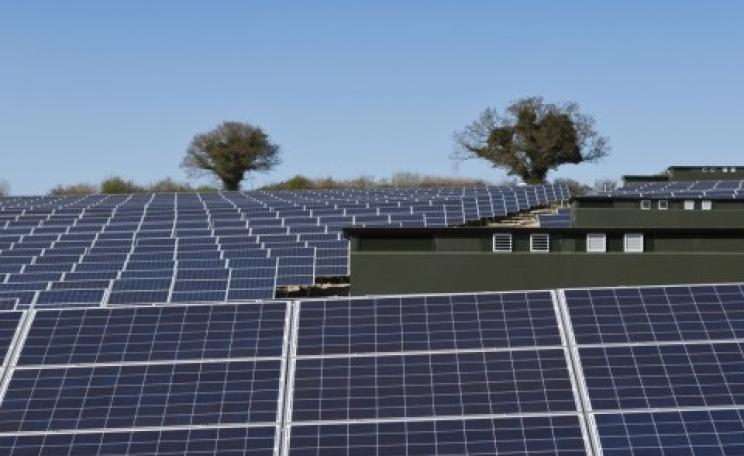
The report predicted that solar power would be the most popular form of clean energy to be installed in the next decade and a half. Capacity will expand the most in Asia, where new solar sites will exceed gas and coal combined.
"The period to 2030 is going to see spectacular growth in solar in this region, with nearly 800 gigawatts of rooftop and utility-scale PV added", Milo Sjardin, BNEF's head of Asia Pacific, said in the report.
"This will be driven by economics, not subsidies, as our analysis suggests that solar will be fully competitive with other power sources by 2020."
Overall, solar and wind power will increase their combined share of global generation to 16% in 2030 compared with 3% last year. Large-scale hydropower has the biggest share of power generation among non-polluting sources.
This article was originally published by Trillion Fund.