These are dark times, but there is strength and hope in numbers.
John Steinbeck's The Grapes of Wrath (1939) offers lessons on how to survive and flourish amidst ecological and economic disaster almost a century later.
The novel opens in Oklahoma with drought and deadly dust storms, known as the Dust Bowl, and closes in California with a devastating flood.
Dust and debt displace the Joad family from their farm, so they join a mass migration on Route 66 heading to the agricultural valleys of California, where they hope to find jobs, food, and a new home. They don’t have much luck finding any of those things.
Mud
As it moves across the country, the novel documents the traumatic impact of ecological disasters on “dust bowl refugees,” as Woody Guthrie sang, and migrant farmworkers who are unhoused and hungry while being terrorised by fascist vigilantes. Sound familiar?
“Clear parallels between the social and ecological crises of the 1930s and those we confront today mean the Dust Bowl has become a major historical referent of the climate change era,” writes Hannah Holleman in Dust Bowls of Empire.
But as I watch the suffering and destruction caused by tropical cyclones Melissa in the Caribbean, Kalmaegi (Tino) in the South China Sea, Ditwah in the North Indian Ocean, along with the catastrophic flooding in the Pacific Northwest, I think about the Joad family’s struggle to survive flood and starvation at the end of the novel.
The Joads are barely existing in a makeshift migrant farmworker camp composed of twelve railroad boxcars with the wheels removed. Two families live in each boxcar and hang a sheet down the middle to create a little privacy.
Winter is approaching and rain has been pouring down for several days. Water from a nearby stream is flowing into the camp and turning everything to mud.
Vulnerable
As the water rises, it floods the boxcars. The Joads have no dry clothes and just a few potatoes to eat. Their cars engines are soaked and won’t start.
The migrant workers face a hard decision, one that vulnerable communities around the world are struggling with as they confront climate-driven super storms, drought, wildfires, war and genocide: should they stay, or should they go?
Many people in South and Southeast Asia are faced with this question right now as extraordinarily intense monsoons and cyclones have displaced millions and killed thousands of people.
How many more “most powerful storm ever to hit” headlines can vulnerable communities in the Global South withstand before people decide it’s time to leave?
Thugs
Gaia Vince writes in Nomad Century: “The number of migrants has doubled globally over the past decade, and the issue of what to do about rapidly increasing populations of displaced people will only become greater and more urgent as the planet heats.”
These are dark times, but there is strength and hope in numbers.
The Grapes of Wrath is a novel about the struggles of displaced people. The last chapter was inspired by heavy rain and flooding in Visalia, California, in the winter of late 1937. Four thousand migrant worker families were flooded out of their tents and starving while smallpox spread through the camps.
In his biography of Steinbeck, Mad at the World, William Souder writes: “Word was that thousands of families were starving. But what enraged Steinbeck were the active efforts of the growers and their allies to block relief efforts.”
Several years before the Visalia disaster, the growers and their allies formed a union, the Associated Farmers (AF), which controlled the agricultural valleys of California with the assistance of vigilante armies that beat and killed farmworkers.
Charles Cunningham explained: “Whenever a strike broke out or worker unrest seemed to be on the rise, the AF could quickly mobilise managers, thugs, and hostile townspeople into an armed force.”
Dystopian
In Factories in the Field, Carey McWilliams called this “farm fascism.” Today, elements of the AF have reappeared under a different acronym: ICE.
Steinbeck planned to use any money he earned from writing about the disaster on supplies for the migrant workers. He and Tom Collins, the manager of a migrant camp in Kern County who inspired the character Jim Rawley, spent several days in the flooded camps bringing aid to people buried in the mud.
In the novel, the matriarch of the family, Ma Joad, decides they need to evacuate the camp and find some place dry. They walk along the highway and come across a barn where they plan to squat until the rain stops.
In the barn, “there were two figures in the gloom; a man who lay on his back, and a boy sitting beside him, his eyes wide, staring at the newcomers.” The father hasn’t eaten for six days and is close to death. His son humbly begs the Joads for some food.
This dystopian chapter might be labelled 'disaster porn' except that it ends with a strangely beautiful image (I don’t want to spoil it), one that encapsulates the spirit of mutual aid that saturates the novel.
Authoritarian
From beginning to end, the sharing of food, shelter, tools, skills, quilts, and care enable dust bowl refugees and migrant workers to survive, and at times flourish, amidst ecological and economic disaster.
In A Paradise Built in Hell, Rebecca Solnit reveals that disaster often brings out the best, not worst, in us.
“But what if paradise flashed up among us from time to time—at the worst of times? What if we glimpsed it in the jaws of hell? These flashes give us … a glimpse of who else we ourselves may be and what else our society could become.”
Ma Joad and her daughter Rose build a brief paradise amidst the hell of farm fascism when they offer nourishment to the starving man, an act of kindness and generosity that reminds me of the proliferation of anarchist-inspired mutual aid networks that “have arisen after nearly every major natural disaster in the United States since Katrina,” as Rhiannon Firth details in Disaster Anarchy.
Mutual aid disaster relief is going to be critical in the coming years as the suffering and destruction caused by climate disasters are intensified by authoritarian neoliberalism aka Trumpism.
Uprisings
There are 42 million people in the United States who depend on food assistance (SNAP), many of whom are children, the elderly, and people with disabilities. They were recently put at risk of starvation by the government shutdown. Meanwhile, the Trump administration held a Gatsby-themed party.
As I write this, Winter Storm Byron is flooding makeshift displacement camps in Gaza while Israel continues to restrict the entrance of shelter materials and other forms of humanitarian aid. Freezing winter weather isn’t the backdrop, but a weapon that is battering and killing people who’ve been subjected to genocidal bombardment for over two years.
These are dark times, but there is strength and hope in numbers, as Ma Joad reminds her son, and us readers. “Tommy, I got to thinkin’ an’ dreamin’ an’ wonderin’. They say there’s a hun’erd thousand of us shoved out. If we was all mad the same way, Tommy–they wouldn’t hunt nobody down–”
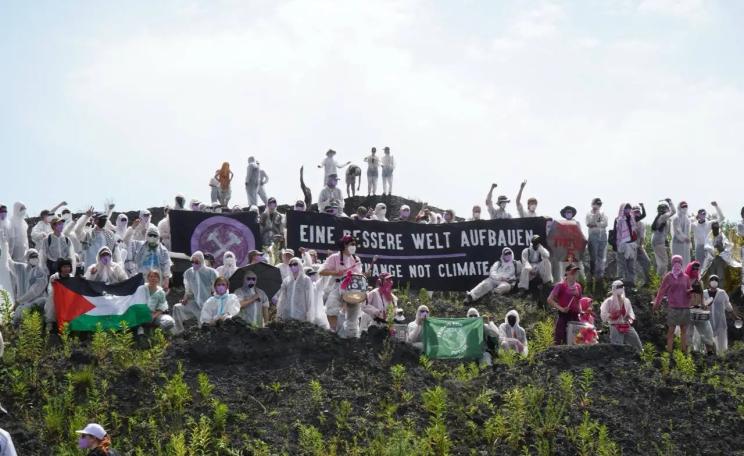
I’ve been thinking a lot about Ma Joad lately. I look around and see many people getting mad, from the No Kings protests to the Mamdani victory, from student encampments for Palestine to the Indigenous occupation of COP30, from Filipinos suing Big Oil to Global South Gen Z uprisings.
And from all the Straw Hat Pirate flags waving around the world, it looks like people might be starting to all get mad in similar ways.
This Author
John R. Eperjesi is a Professor in the Department of English Linguistics and Literature at Kyung Hee University in Seoul and works in the environmental humanities.
This article is adapted from a journal article titled, 'Each’ll help each: Imagining Mutual Aid in The Grapes of Wrath' published with the Journal of American Studies Association of Korea, 2024.