There’s new energy behind our binational community.
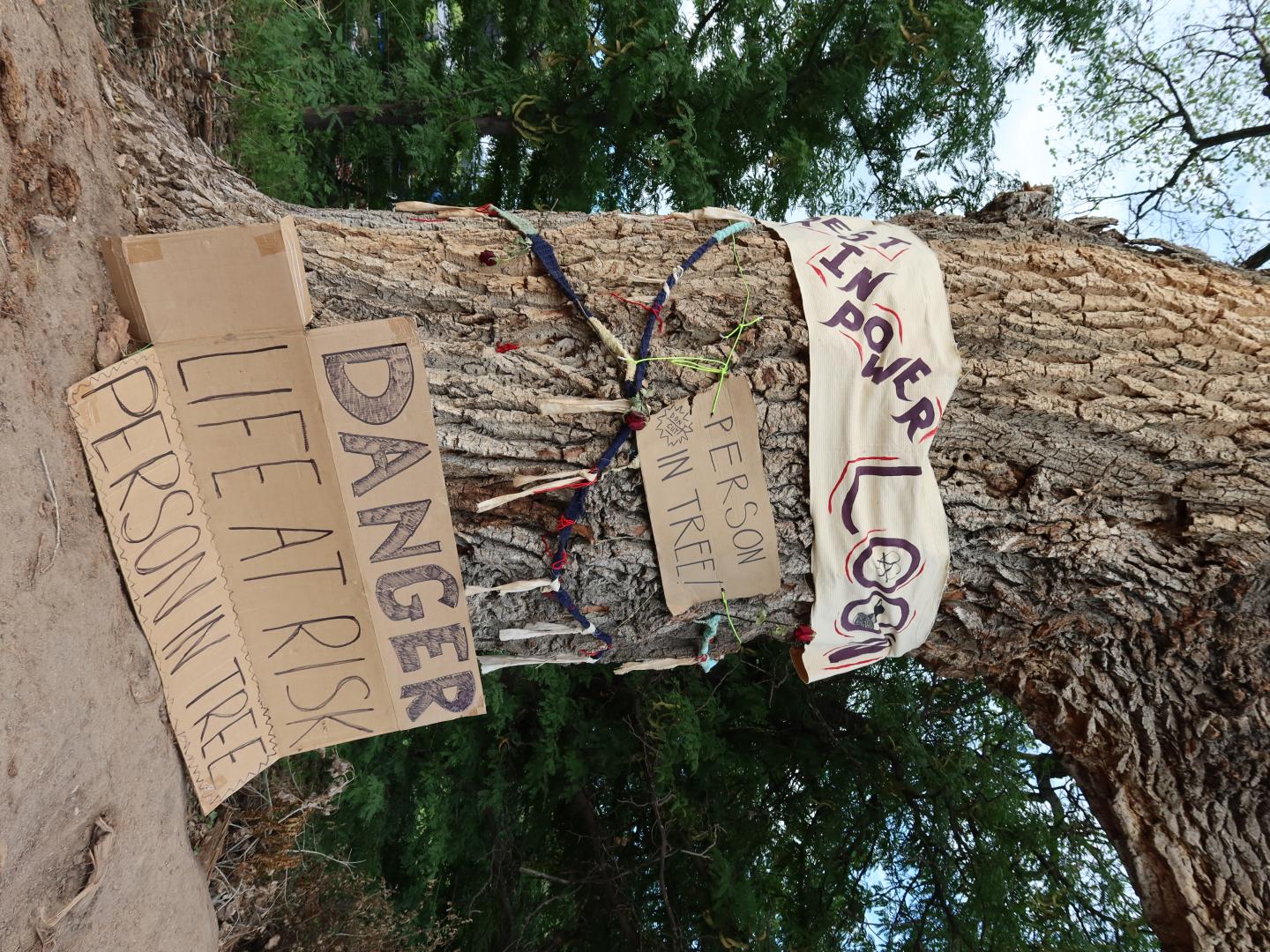
A group of protestors in the small border town of Lochiel, Arizona, in the United States, are fighting to save a 200-year-old cottonwood tree by stopping government contractors from building the border wall.
One of these activists has lived in the tree continuously for over a month, preventing construction workers from cutting down the tree.
An intergenerational group, led primarily by women, queer, and femme people, are using direct action to halt border wall construction and protect the grandmother tree–what activists describe as a tree “sit-in.”
Encampment
The person camping in the tree lives on a platform in the upper branches of an ancient tree that locals refer to as 'grandmother'. These activists in the supporting encampment adjacent to the tree use pulleys to bring the person in the tree food and water.
I drove four hours from Tucson, Arizona to San Rafael Valley and through Coronado National Forest to camp alongside these activists on remote private land adjacent to the border in support of the tree sit-in. The encampment was established with the permission of the local land owner.
On July 27, the construction workers cut down three of the cottonwood trees. I learned that one of these trees touched a cottonwood tree across the border in Mexico and was considered a symbol of international friendship for the local community.
A protester was arrested for blocking construction equipment by standing in front of the trees, but was released the same day without being charged. Since then, helicopters, drones, Border Patrol, and local law enforcement has been surveilling the area.
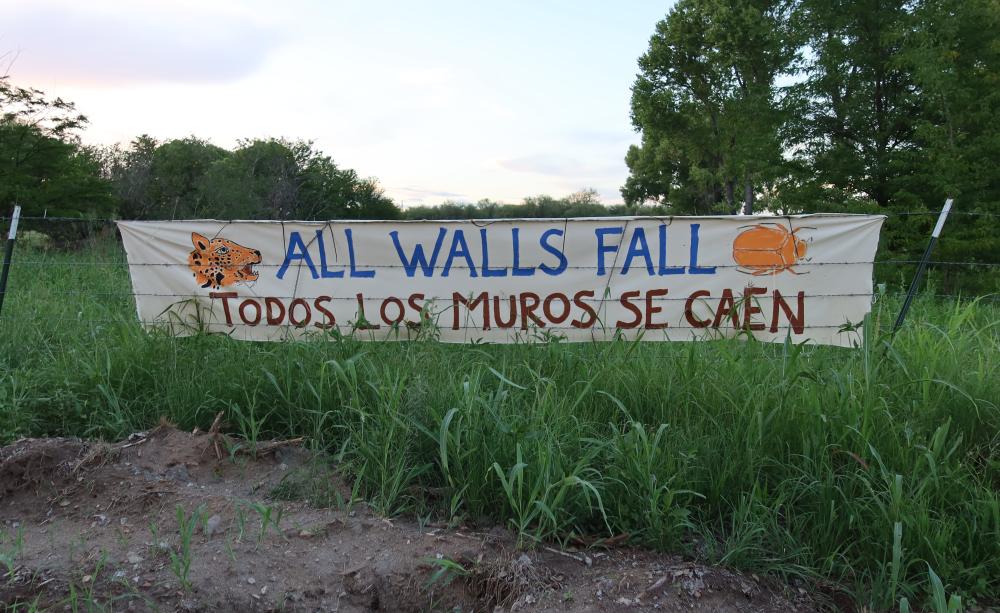
The following day, the tree occupation started in the fourth cottonwood tree and the encampment relocated to be under the grandmother tree. In solidarity, Mexican activists put up protest signs across the border in Mexico in support of the tree sit-in protest in the US.
Sharp
A week later, the tree sit-in became binational, with a Mexican environmental activist occupying one of the cottonwoods in Sonora, Mexico, with a supporting group of activists in an adjacent encampment.
The tree sit-in in Mexico blocks the proposed path of the first border wall, and the tree sit-in in the US blocks the path of the second border wall.
There’s new energy behind our binational community.
The construction of Trump’s double border wall cannot proceed without the removal of the people from the trees. Border Patrol has had an extensive presence since the protestors on the Mexican side of the fence joined the protest.
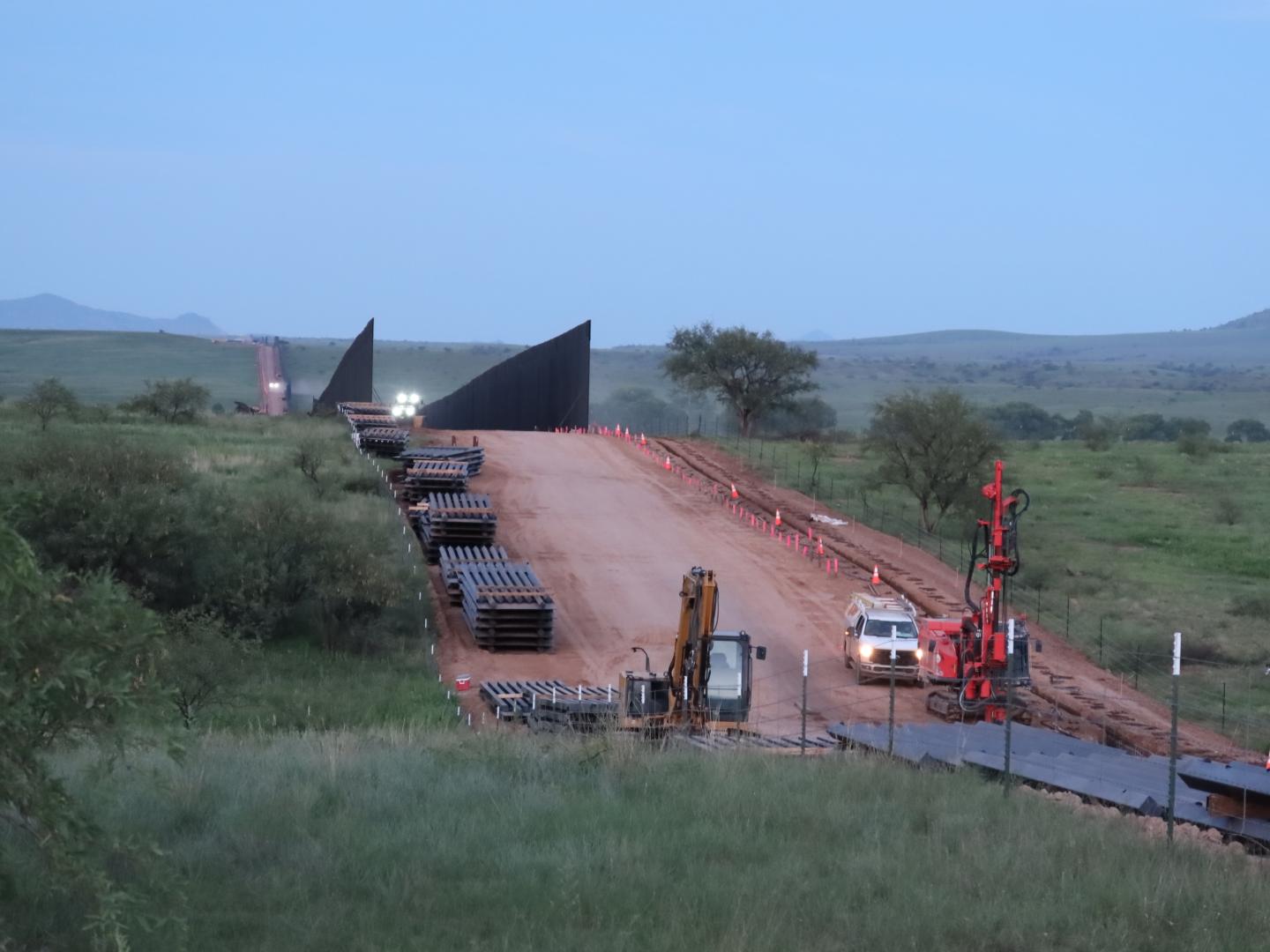
The double wall which is under construction along Arizona’s border is a 30 feet high steel wall which runs parallel to another wall and a 60 foot buffer zone between them.
As I observed, the barriers in the area around Lochiel, Arizona used to be primarily vehicle barriers and/or barbed wire fencing. This was in sharp contrast to the double wall construction which was already underway adjacent to the encampment.
Cuckoo
This grassroots movement is supported by members of environmental groups, including advocates from the Sierra Club, Sky Island Alliance, and the Madrean Archipelago Wildlife Center.
According to environmental activist Kate Scott, the San Rafael Valley is known to be an important corridor for wildlife who cross the border, including jaguars, ocelots, and many more, whose movement across borders would be blocked by a double wall.
Border Patrol promised in a letter dated 18 June to avoid removing the cottonwoods if any migratory birds were found nesting in them.
Erick Meza from the Sierra Club reports that he saw birds nesting in the tree shortly before the trees were removed. While I was at the encampment, I heard a yellow billed cuckoo in the US calling to another yellow billed cuckoo who responded from the Mexican side of the border.
Federally-protected
This bird is a migratory endangered species, which Kate Scott told me had also been seen directly in the grandmother tree.
Federal contractors are exempt from complying with dozens of federal laws, including the Endangered Species Act, which normally would protect species such as the yellow billed cuckoo.
The Real ID Act gives the Department of Homeland Security the ability to waive human rights and environmental protections to expedite the construction of border infrastructure. This also allows the double wall to be constructed through public lands, including national parks and wildlife refuges.
The Lochiel protest is near where the former Arizona governor built a border wall made from shipping containers in federally-protected forest in 2022.
Outcry
After legal battles, the state of Arizona was forced to remove the shipping containers in 2023. Several of the activists who advocated for the removal of the shipping containers are also involved in the Lochiel protest.
Many of the activists I met at the Lochiel protest are also volunteers with No More Deaths, a humanitarian group which provides water and aid to migrants crossing the U.S.-Mexico border in the desert.
The US-Mexico border wall is also of concern to human rights activists as border wall construction has funnelled undocumented migration through remote wilderness areas, which drastically increased rates of death for migrants crossing the border.
The Lochiel protest continues alongside several other protests against the construction of the border wall, including public outcry over Big Bend National Park and activism contesting construction at Quitobaquito Springs in Organ Pipe Cactus National Monument.
Solidarity
The Tohono O’odham people are also actively fighting border wall construction on their land, issuing a “no trespassing order” for any nontribal members aimed at stopping construction.
Most recently, the Tohono O’odham people and the activists at the Lochiel encampment have collaborated, including inviting one another to some of each other’s community meetings and ceremonies.
As Zach Palma, a resident of both Sonora and Arizona and organizer with Sky Island Alliance said in a press release: “This resistance isn’t new, but there’s new energy behind our binational community.”
In both Arizona and Texas, binational solidarity and coalition-building across communities impacted by border wall construction have reignited environmentalist opposition to the ecological devastation caused by border militarization.
This Author
Dr Meg Perret is an assistant professor in the department of global languages and cultures and an affiliate with the Women’s and Gender Studies Programme at Texas A&M University. Her research examines how narratives about nature shape our collective futures.