They’re very sensitive. They’re very emotional animals.
Black cliffs rose around Klettsvík Bay and grass covered their slopes. Below, 32,000 square metres of ocean were enclosed for two belugas.
The water was blue-green, startlingly clear. Fish swam beneath the surface. The bay, to me, looked beautiful. Little Grey and Little White were not there.
Nothing about the site suggested lack of effort. Two sea-care pools had been built, along with the Halo, a 2,000-square-metre intermediate habitat to give the whales another step between the care pools and the wider bay.
Sceptical
There were pontoons, nets, a concrete windbreak to protect the belugas against harsh weather. Everywhere was evidence of careful planning, engineering, expense. Little Grey and Little White were not there.
When I visited in September, the two belugas were several kilometres away, inside a concrete grey building in Vestmannaeyjar.
They’d left their aquarium in Shanghai seven years ago. They’d come to Iceland for sanctuary seven years ago. And for much of those seven years, they had remained behind concrete, while the bay built for them stood empty.
What then did it mean to say they had been brought to a sanctuary? Why were they not outside?
There were plenty of theories among locals in Vestmannaeyjar, many of them sceptical. “I think they make more money from the tours when the whales are inside,” one local told me.
Curiously
Others wondered if insurance was more expensive in the bay, or if keeping the whales indoors was easier for staff.
I went inside to see the whales myself. It was quiet. There was no music, no performance. There was a public viewing area, but visitors could not crowd the glass, could not touch the glass.
The sanctuary’s general manager, Jennifer Byfleet, showed me the seawater filtration system. The pools, she explained, contained fresh seawater, filtered and chlorine-free.
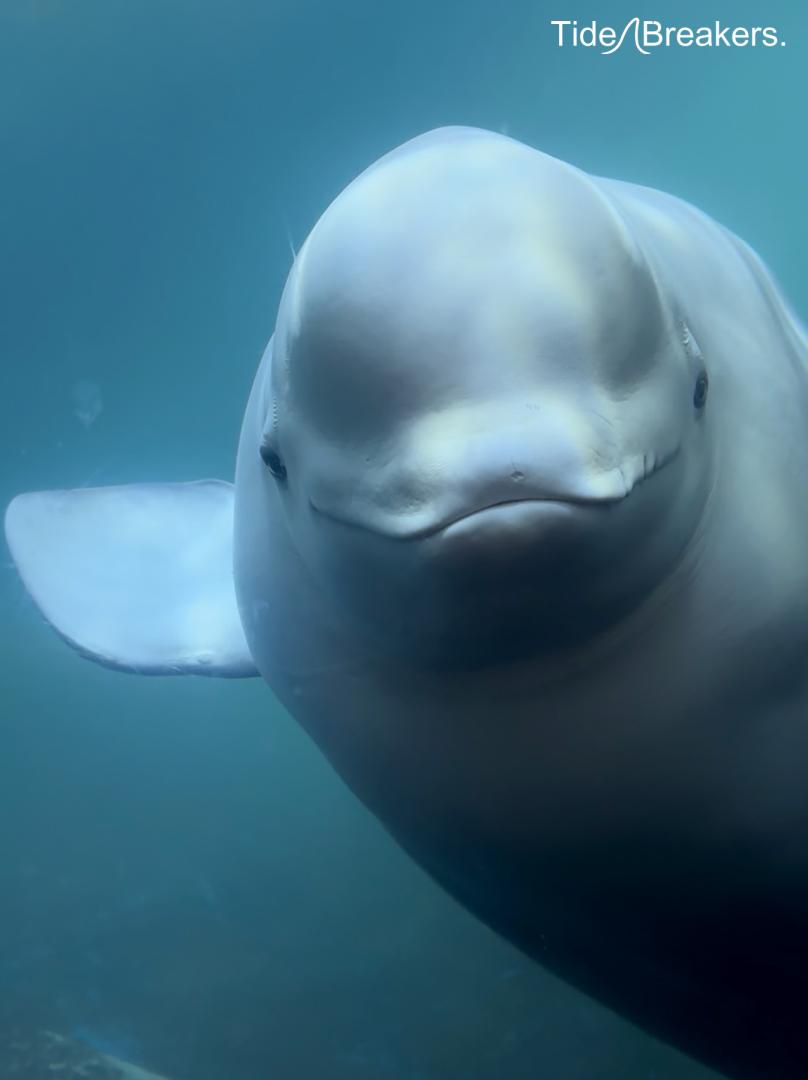
Little Grey and Little White moved through it. Upon seeing the two belugas, I was struck by how large they looked, how well-fed they looked, how they came curiously towards people they knew.
Byfleet and I sat by their pool and talked for more than an hour.
Sounds
“Do you think they’re happier here?” It was not the question I had intended to begin with. It came out because a contradiction now seemed in front of me. To say that the bay was beautiful and the concrete building was ugly was true. But this could not tell me which one was kinder.
“Happiness might not be the right word,” she said. Happiness is difficult to measure. She told me that the beluga’s movements through the pools were tracked, including when nobody was there to watch them.
They’re very sensitive. They’re very emotional animals.
The team could see which parts of the pool they used, whether any stereotypic or stress patterns appeared overnight. None did. Both whales had healthy appetites, engaged well with the care team. Recent veterinary checks found them to be in good health.
“You just see them here swimming around,” Byfleet said. “But being here is like boot camp for the whales.”
The lighting inside their pool followed the Icelandic day. Recordings from beneath the water at Kletsvik bay - waves, birds, boats, seals - were played quietly inside the facility, giving the whales those sounds before the sounds were suddenly all around them.
Sanctuary
Rain was simulated, at first introduced for short periods, then gradually increased. Byfleet told me the whales used to respond to rain and hail by making longer dives. Now the artificial rain no longer seemed to trouble them.
They were asked to do exercises, to make large movements and jumps. “No-one can see it,’ Byfleet told me. “It’s not a show. It’s to build up their muscles.”
Pieces of fire hose stood in for kelp; floating blocks could be pulled beneath the surface like ice. “The work is helping Little Grey and Little White to relearn how to behave like belugas.”
Relearn how to behave like belugas. That was the problem the sanctuary was trying to solve.
How did they get here?
After being captured from Russian waters when they were calves, Little Grey and Little White spent years performing at Changfeng Ocean World in Shanghai, China.
When the aquarium came under the ownership of Merlin Entertainments - whose policy was not to display cetaceans - the company worked with Whale and Dolphin Conservation to find another future for them.
In 2019, the belugas were flown to Iceland, the first residents of a pioneering project intended to show what might come after captivity. From the beginning, the intention was not to release them into the wild.
Rob Lott, the captivity lead at Whale and Dolphin Conservation, told me that this was a retirement project: no more performances, greater choice, and as naturalistic a life as possible for two animals expected to remain under human care for decades.
The first years, he said, were complicated by unforeseen events. Covid arrived less than a year after the whales, delaying specialist staff, construction and equipment.
Comfort
Despite this, Little Grey and Little White spent four months in Klettsvík bay that year. Lott remembers that period positively, describing them as “delighted” by rain, currents, tides and the living seabed.
But also, later, came signs of strain. During another period in the sanctuary, the whales went off their food - “probably from stress”, Lott admitted - and were returned the landside facility. Stomach ulcers in Little Grey were found.
“They’re very sensitive,” Byfleet told me. “They’re very emotional animals.”
The whales were also not interchangeable. Little Grey was the bolder of the two, Little White more cautious.
Lott described the managed pool to me as like a “comfort blanket” for them: an enclosed environment might look impoverished to us, while containing the feeling of safety and routine that an animal had learned to understand.
Control and choice
I spoke to Heather Hill, a comparative psychologist who has studied beluga behaviour and welfare for more than two decades.
She cautioned against assuming an animal’s behaviour in one environment would predict how it responded to another. A beluga might appear bold in a familiar pool, she said, then react very differently when moved somewhere new.
The difficult question was related to how ordinary acclimatisation became something more serious. “It’s the question of acute stress versus chronic stress,” Hill told me.
A short period of stress could be tolerated. But if an animal stopped eating, its behaviour changed and signs of physiological stress appeared, continuing to expose it to the same conditions would compromise its welfare.
At that point, she said, are you persisting because the animal is likely to adapt, or because you want to prove the sanctuary model?
Relating
Hill argued that welfare might depend not only on what a habitat was, but on what it allowed an animal to do: whether it could choose where to go, what and who to engage with, when to approach and when to withdraw.
Byfleet repeatedly expressed the importance of consent while describing the whales’ welfare. If a fin needed examining, she said, the whale was asked to present it, rather than being forced to.
This might seem like a small thing. But captivity is by definition a life in which many of the largest choices have been removed.
Giving back smaller acts of agency - whether to participate, whether to move away, which part of an enclosure to use, whether to approach a trainer - could reduce stress and improve quality of life.
Sanctuary, in this telling, was less a place and more a way of relating to an animal, of giving them back control and choice in their life.
Pressure
From the beginning, Little Grey and Little White represented a changing future. “We knew the world was watching,” Rob Lott told me. “We knew the industry was watching, waiting for us to fail.”
If Little Grey and Little White flourished in Klettsvík Bay, other captive cetaceans might follow them. Sanctuaries might become the new model. If the project failed, its captivity opponents would have their argument.
So, what happens if the needs of an individual whale and the success of the sea sanctuary model do not align?
There is evidence that the team in Iceland were willing to tolerate that difficulty. In July this year, SEA LIFE Trust announced that Little Grey and Little White would remain in the landside facility for the rest of 2026. The earliest target has now become 2027.
Refuge
Byfleet told me that everything on the human side could be ready - the boats, the infrastructure, the staff - but if Little Grey and Little White were not ready, “it’s not going to happen." He added: "That’s on them.”
For an organisation built around the world’s first open-water beluga sanctuary, that could hardly have been the easier story.
But Little Grey and Little White are not a verdict on every whale still in captivity. Another beluga might thrive in the same waters these two find overwhelming.
And if Little Grey and Little White never adapt, what becomes of Kletsvik bay? Will it offer refuge to other whales, or will the project end with its first two residents?
The least harm
To conclude that little Grey and Little White may fair better in a man-made facility does not condone captivity or make it harmless. Nor does it suggest that humans should continue creating captive cetaceans. It may suggest the opposite.
“Reversing captivity is extraordinarily difficult,” Lott said. “We didn’t create any of this. We were just trying to make it better.”
That distinction matters. What we owe animals already living in captivity is not the same as what we owe those not yet born into it.
For the first, the answer may have to be individual: sea sanctuary for some, where it improves welfare; high-quality managed care in a man-made facility where a cetacean cannot safely make that transition.
For the second, the answer is much simpler: stop creating the problem. Stop breeding and stop ocean capture of cetaceans. The difficulty of undoing captivity cannot become an argument for continuing it.
Certainty
Little Grey and Little White were brought to Iceland partly to show the world what might come after the aquarium. Perhaps they are doing exactly that, just not in the way anybody expected.
The bay does not become a failure if these two whales cannot live there permanently. Nor does the landside facility become a sanctuary because they appear comfortable inside it.
When I left Klettsvík, the bay was still beautiful: blue-green water beneath black cliffs, grass above it, fulmars in the sky.
Nothing about the bay had changed. What had changed was my certainty about what it meant.
This Author
Dr Rebecca Gaston is a writer and animal-welfare advocate working with international NGOs on marine-freedom campaigns.