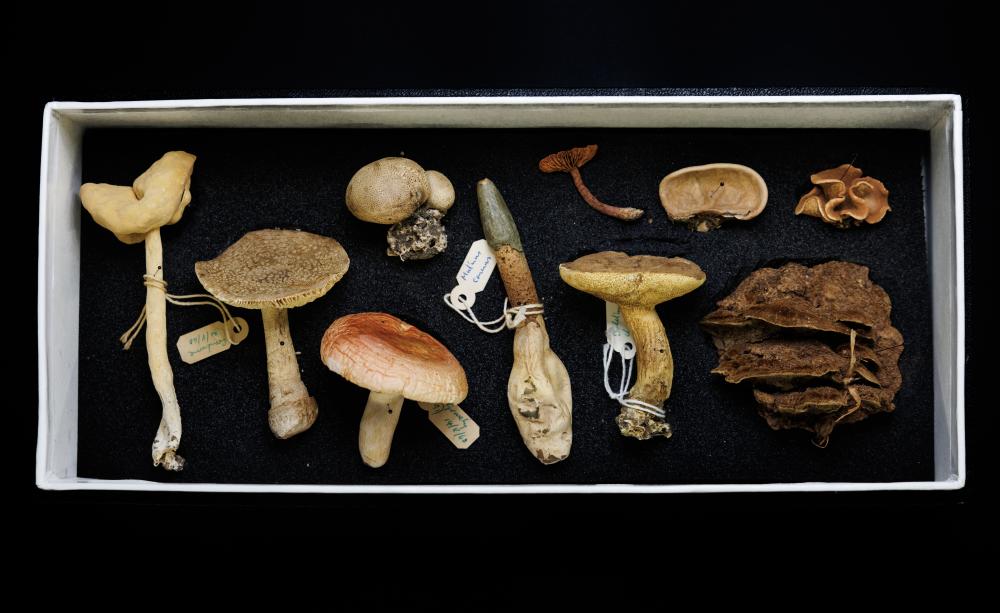
An entire kingdom one step closer to being seen, valued, and protected.
Conservation language has referred only to “flora and fauna” for decades.
The omission of fungi has rendered it effectively invisible in education, policy debate and conservation frameworks, according to non-profit the Fungi Foundation.
But scientists argue that fungi are critical to life on Earth. They are key players in carbon sequestration, soil regeneration, and biodiversity.
Funga
Without them, ecosystems will collapse, climate change will intensify, and soils will deteriorate. Yet, some 90 per cent of the world’s most diverse underground fungal systems are unprotected.
To reverse this, the foundation has been driving a global movement to recognise funga as a distinct kingdom of life, alongside fauna and flora, under the 3F Proposal (Flora, Fauna, Funga).
The fungi experts want data on fungi to be urgently incorporated into global conservation plans. In July, the movement hailed “a historic milestone” when ‘funga’ was added to the Cambridge Dictionary for the first time.
The dictionary’s definition reads: “Funga: all the fungi (= organisms that usually grow on and get their food from decaying material or other living things) that grow in a particular area or at a particular period in time.”
Colin McIntosh, the chief editor of the Cambridge Dictionary, explained that its editors have noticed ‘extensive evidence’ for the use of ‘funga’ both in real life as well as in academic discourse.
Science
“We are big fans of fungi at Cambridge and were very pleased to welcome a new fungal addition to the dictionary,” he said.
The Fungi Foundation said: “One new word in the dictionary. An entire kingdom one step closer to being seen, valued, and protected.”
Its addition confirms that the term has moved beyond advocacy circles and into mainstream, global use, it said.
In August, Australia’s ruling Labor party explicitly recognised fungi alongside flora and fauna, following a campaign by non-profit citizen-science organisation Fungimap Inc and Planet Fungi.
Australia is home to an estimated 250,000 fungal species, but only around 12,000 have been formally described by science.
Talks
“When fungi are unnamed, they are unmeasured. When they are unmeasured, they are under-protected,” said Stephen Axford, fungi photographer, and co-creator of documentary Planet Fungi.
And in Brazil, the ministry of the environment and climate change has published the first Official National List of Threatened Fungal Species, recognising 24 fungal species as threatened for the first time.
An entire kingdom one step closer to being seen, valued, and protected.
Mycologists argue that unless fungi are recognised explicitly in legal and policy language, the groundbreaking data emerging from their research risks being left out of biodiversity legislation, conservation strategies and environmental measures that could protect it.
Their call has been backed by the governments of the UK and Chile, which launched the Fungal Conservation Pledge at the last UN biodiversity talks in Colombia in 2024.
Footing
Governments signing this pledge to recognise fungi as an independent kingdom of life in national and international legislation, policies and agreements, and adopt concrete measures to protect the benefits of fungi to ecosystems and people, and promote mycology as an essential science.
Dr Toby Kiers, an evolutionary biologist at Vrije Universiteit Amsterdam, this year won the Tyler Prize for Environmental Achievement.
The award was for her work on mycorrhizal networks, including a programme by her not-for-profit, the Society for the Protection of Underground Networks (SPUN), to equip scientists with legal tools to protect fungal biodiversity.
“The pledge is a big deal because what countries signing it are saying is that they think that fungi should be on equal footing with plants and animals, and that they’re going to adopt that by saying ‘flora, fauna, and funga’,” she said.
Recognition
“That adoption means that they’re going to put more resources into understanding what's there, and advocating for its protection, and are developing mechanisms whereby our data can be useful,” she said.
The Fungal Pledge has been signed by 14 countries so far: the UK, Chile, Colombia, Benin, Spain, Mexico, Costa Rica, Peru, Ecuador, Cambodia. Guinea, Germany, Ethiopia and Armenia.
In Britain, the government is funding work at the Royal Botanic Gardens in Kew to sequence the genomes of fungi, allowing scientists to better understand fungal diversity and function, and to unlock their potential for medicine, agriculture, and environmental restoration.
The work is recognition that the 160,000 known species of fungi is just a tiny fraction of the 2.5 million species estimated to exist.
The movement is now working to achieve formal recognition of the role of fungal biodiversity at the forthcoming UN Biodiversity Conference (COP17), hosted by Armenia in October.
Advocacy
During technical meetings in the run-up to the talks, references to fungal biodiversity were including in recommendations for agenda items on biodiversity and agriculture and forest biodiversity, according to the Fungi Foundation.
The campaign is pushing for fungal biodiversity to be recognised as an integral component of sustainable wildlife management, for ecological processes underground to be included in work on protected areas, and for areas supporting belowground ecological networks of particular importance for biodiversity, ecosystem functions and ecosystem services to be identified and prioritised.
Giuliana Furci, founding director of the Fungi Foundation, said: “The innovative proposal of the 3Fs - fauna, flora, funga - means fungi are no longer as neglected as they once were.
“Happily, more and more organisations are working to give fungi the recognition they deserve. Science and advocacy are advancing hand in hand, influencing conservation efforts, art, education, and public awareness,” she said.
This Author
Catherine Early is the chief reporter for The Ecologist and a freelance writer and editor specialising in the environment and sustainability.