Are universities leading the way when it comes to producing their own energy - and if so, which university is top of the table? INDIA BENJAMIN investigates.
New, decentralised forms of energy are taking shape. Will these new forms be a stepping stone to replicating the developed world's centralised power systems, or will they be a leapfrog to a new model of energy provision?. ANDREW J CONWAY reports.
Britain will become 'world leaders in decarbonising our economy' claims John McDonnell at his speech to the Labour Party conference in Brighton today. And with Labour still ahead of the polls, his radical agenda for renewable energy could become government policy, reports BRENDAN MONTAGUE
Narendra Modi, Prime Minister of India, has been inconsistent at best about climate change. Now the country has massive nuclear expansion plans, which he claims is a solution. The apparent desire to appease energy companies and the violent oppression of nuclear opponents are a cause for serious concern. KUMAR SUNDARAM investigates
The advancement in technology and recent UK government policy announcements both point towards the successful take over of the electric car, even where other energy innovations have failed. Dr Christian Jardine assesses the latest developments
Environmental campaigning groups including Greenpeace and WWF publish a joint report today calling on the UK Government to bring forward the proposed ban on petrol and electric cars to 2030.
JOE WARE reports
We’re 55 million years too late for hydraulic fracturing to work in the UK, claims Professor John Underhill, the chief scientist at Heriot-Watt University. BRENDAN MONTAGUE reports
A collapse in the price of uranium has not yet stopped Australian mining company GME from trying to press ahead with a massive open-pit uranium mine on an Arctic mountain in southern Greenland, writes Bill Williams - just returned from the small coastal town of Narsaq where local people and Inuit campaigners are driving the growing resistance to the ruinous project.
Forum for the Future, an international sustainability non-profit, has published a report in which former energy bosses, ministers and civil servants advise the Big Six energy companies to back renewables, reports BRENDAN MONTAGUE
Theresa May's government may have come to a grinding halt on environmental regulation but businesses still have a responsibility - and with it huge opportunities - to go green, argues JASON SMITH
The cyclists of the Tour de France may not set off until next week but in Kenya a group of young people have taken to their bikes to raise awareness about the power of sustainable energy ahead of the country's general election on August 8.
JOE WARE reports
The winner of the 2017 Ashden Award for Sustainable Energy and Water - announced today (12th June, 2017) - is Futurepump, which manufactures an affordable, highly efficient and portable solar irrigation pump aimed at the millions of smallholder farmers in Kenya and around the world, writes CHHAVI SHARMA
With growing evidence of harm to physical and mental health caused by continuous pulsed em radiation from 'smart' electricity meters, Lynne Wycherley asks: have we underestimated risks to heart function and the nervous system? And of interference with embedded medical devices, such as cardiac pacemakers? It's time to switch to over-wire or fibre communications to bring the 'smart green grid' of the future to electrosmog-free reality.
When Prime Minister Theresa May went to Brussels to hand in her 'Article 50' Brexit notice, she was also pursuing a separate, covert objective, writes Zachary Davies Boren. Leaked papers show that the UK was lobbying to gut new EU rules and targets on renewable energy and energy efficiency - even though they will only come into force after Brexit.
After years of pro-nuclear bombast from the Conservative Party, its 2017 manifesto hasn't got a single word to say about nuclear power, write Oliver Tickell & Ian Fairlie. Instead it announces a renewed focus on cutting energy costs, and a big boost for increasingly low-cost wind power; while both Labour and Libdems offer only weak, highly qualified support for new nuclear build. And so the great British 'nuclear renaissance' reaches its timely end.
A huge raft of environmental reforms is promised in the Labour Party's draft manifesto, writes Oliver Tickell. Among the highlights: a ban on fracking; a clean energy policy based on renewables and efficiency; no commitment to new nuclear power; to meet our Paris Agreement obligations on climate; to give companies a legal obligation to protect the environment; to retain all EU environment laws post-Brexit; and multilateral nuclear disarmament.
Mexico's oil looks set to run out within a decade, writes Jeremy Leggett, and it can hardly rely on Trump's America to make up the difference. But Mexico enjoys abundant sunshine, and the cost of solar power generation is falling fast. Let Trump tie America's economy to debt-financed fossil fuels. Mexico's future prosperity will come from harnessing its inexhaustible solar riches.
Nuclear power was originally sold on a lie, writes Dave Elliott. While we were being told it would make electricity 'too cheap to meter', insiders knew it cost at least 50% more than conventional generation. Since then nuclear costs have only risen, while renewable energy prices are on a steep decline. And now the nuclear behemoths are crumbling ... not a moment too soon.
'Smart meters' looked like a great idea, writes Lynne Wycherley, giving us more control over our energy use. The downside? They emit as many as 14,000 short bursts of intense microwave radiation a day, disrupting cellular electrochemistry and causing health symptoms from migraine to tinnitus, insomnia, dizziness, anxiety, chest pain, palpitations and memory loss. Now a growing number of 'electro-sensitives' have had enough!
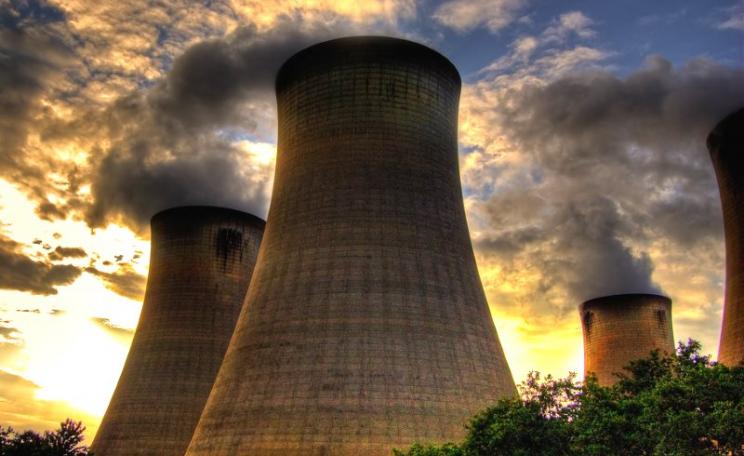
The Drax power station in Yorkshire is the UK's biggest CO2 emitter, burns more wood each year than the entire UK timber harvest, and is a major importer of coal from strife-stricken regions of Colombia, writes Frances Howe. This Thursday campaigners will target the company's AGM to highlight its impacts on forests, biodiversity, climate and communities, in the face of Drax's PR offensive to make biomass appear 'sustainable'.
British firms lie deep at the heart of the Dakota Access Pipeline controversy, writes Amy Hall. Barclays, HSBC and the Royal Bank of Scotland have lent $800m to Energy Transfer Partners and its subsidaries, London-based Commercial Bank of China has loaned $120m, and RBS $250m, while HSBC and Barclays own over $110m worth of shares in project partner Phillips 66.
The whole idea of North Sea oil was to make Britain rich, writes Simon Evans. At least that's how it all began. But now ... it cost UK taxpayers a massive £396 million a year in tax breaks and subsidies to keep the industry alive last year. And there's no reason to think that's going to turn around any time soon.