Premature, unprofessional and inappropriate measures would lead to unsuccessful restoration.
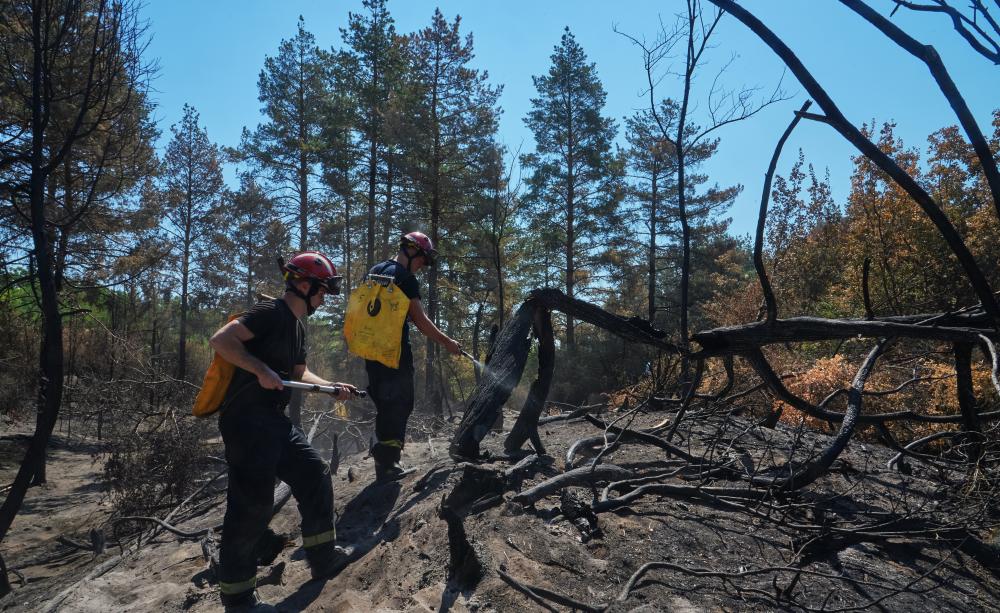
The wildfire in Deliblato Sands was declared extinguished by Serbia’s ministry of internal affairs on Wednesday, 23 September this year.
The scale of the ecological damage is still unknown. Preliminary estimates suggest that the fire affected more than 10,000 hectares—roughly a third of the reserve.
Deliblato Sands is not simply a forest. The reserve in northern Serbia is a mosaic of woodland, forest-steppe, steppe and sandy habitats built on wind-blown deposits.
Replant
The fire was first detected in Deliblato Sands on 21 July and was brought under control several times before spreading again in extreme weather. A major flare-up near the village of Šumarak on 2 August developed into the blaze that continued for 52 days.
One of Serbia’s most difficult recent wildfire responses involved hundreds of firefighters, volunteers, forestry workers and international teams.
Officials stress that not all land within that area burned. Now that the fire is out, detailed field mapping can establish the extent and severity of the damage.
The Provincial Institute for Nature Conservation has said the area supports more than 900 plant species, subspecies and varieties, alongside rare animals associated with open steppe habitats.
What comes next cannot be reduced to a question of how many trees to replant.
Habitats
A rehabilitation plan must be adopted within three months of the fire being extinguished, under Serbia’s Forest Law.
JP Vojvodinašume, the public forestry enterprise that manages the reserve, has said the formal rehabilitation plan can only be prepared once the affected area has been surveyed.
Drone orthophotos, GPS field data and ecological surveys are expected to be used to map damage to forests, vegetation, priority habitats, flora, fauna and soil.
Dr Marko Marinković, executive director for forestry, ecology and development at Vojvodinašume, said that the plan will not be limited to forest stands. Other habitats and fauna will also be included.
That distinction is important. Forest restoration and the recovery of open grassland and steppe habitats may require different approaches.
Resilient
Dr Jovana Devetaković, associate professor at the University of Belgrade Faculty of Forestry, argued that natural regeneration should be assessed during the next growing season, when experts can determine where recovery is sufficient and where intervention is needed.
She said: “Premature, unprofessional and inappropriate measures would lead to unsuccessful restoration.”
Devetaković explained that active restoration is important for damaged forest land, especially where vegetation helps stabilise sand and exposed burned surfaces could become vulnerable to erosion.
Premature, unprofessional and inappropriate measures would lead to unsuccessful restoration.
But she also expects meadows and pastures to recover more readily through natural processes. The challenge, she said, is to maintain the balance between forest and open habitats in this forest-steppe ecosystem.
In August, the Ministry of Environmental Protection announced a proposed restoration programme for 2027–2031 intended to make the reserve more resilient to high temperatures and the effects of climate breakdown.
Protection
The fire has also coincided with a change in Serbian planning law that has raised questions about the future legal status of burned forest land.
Amendments to Article 88 of the Law on Planning and Construction, published in August, state that forest land damaged or destroyed by fire retains its previous planning designation and that the fire itself cannot be used as a basis for converting it into construction land. But there are exceptions.
A change of land use can be permitted where necessary for a project for which public interest has been established under law, for public infrastructure, or where the change follows from the protection and management regime of a protected area.
Any such conversion must be carried out through an amendment to the relevant planning document.
Cautioned
Dragomir Ristanović of the Renewables and Environmental Regulatory Institute (RERI) has stressed that these provisions apply specifically to land legally classified as forest land, not automatically to every burned steppe, grassland, wetland or sandy habitat within the reserve.
RERI has identified several legal risks in the new wording, including the absence of a fixed period during which burned forest land cannot be converted and the breadth of some exceptions.
Ristanović also cautioned against treating those risks as proof of a planned development. RERI says it has no information that a specific infrastructure project has been formally proposed for the burned part of Deliblato Sands on the basis of the new Article 88 provisions.
The next question is how much of the restoration process the public will be able to see.
Transparency
Marinković explained that Vojvodinašume is not legally required to put its rehabilitation plan through a formal public consultation.
However, he said the company would consider proposals from experts and the wider public, respond to questions and could organise a round table or other form of discussion.
The company has not routinely published full rehabilitation plans online in the past, but Marinković said it may publish the Deliblato Sands plan because of the unusually high public interest.
Transparency matters because the first decisions after a major fire can shape the landscape for decades.
Grasslands
These decisions include: what damaged material is removed, where natural regeneration is allowed to proceed, where planting takes place, which species are used, and how open habitats are protected from being treated as failed forest.
The fire is over, but the ecological consequences are only beginning to be measured.
The next growing season will reveal which parts of Deliblato Sands can recover on their own and where intervention is necessary.
The more immediate test is whether restoration can respond to the reserve as it actually exists: not as a single burned forest, but as a complex protected landscape in which forests, grasslands, steppe and sandy habitats depend on one another.
This Author
Milica Arsić is an independent science and environmental writer based in Serbia, with a background in environmental science and experience writing about biology and ecology.