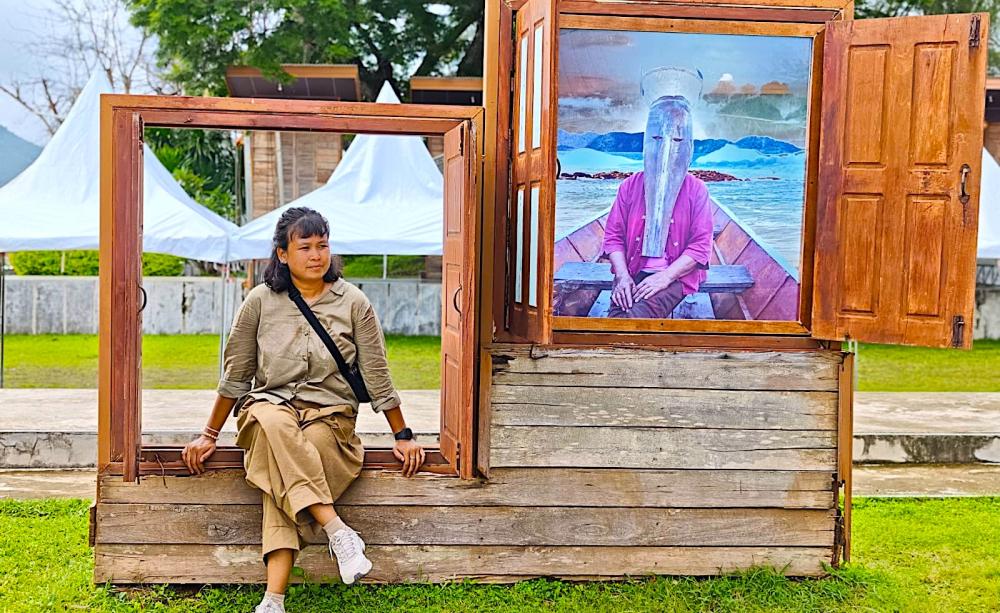
These works uncover intimate relationships between land and body, exile and refuge, destruction and regeneration.
The works of women artists from eight different conflict-affected countries are being brought together in a new exhibition exploring memory, place and looking to the future.
The Atrium Gallery at the London School of Economics will host 'Women Artists in Conflict Zones (WACZ) – Imagination as an Act of Resistance' from Wednesday 28 October 2026.
The international exhibition has been commissioned by Artists Project Earth (APE UK) and co-hosted with the LSE Centre for Women, Peace and Security.
Catalyst
The exhibition will foreground women who are creating amid war, displacement, dispossession and exile and will include works from Myanmar, the Democratic Republic of the Congo, Sudan, Syria, Iran, Palestine, Ukraine and Venezuela.
Dr May East is the exhibition and a trustee of Artists Project Earth. She told The Ecologist: “As witnesses, storytellers and future-makers, these artists reveal bio-cultural-spatial landscapes that peace agreements, political treaties and official reconstruction plans alone can never capture.
"Their works uncover intimate relationships between land and body, exile and refuge, destruction and regeneration.
"They remind us that imagination is an act of resistance and a catalyst for bringing vitality back to places profoundly affected by conflict.”
Brighter
She explained that rebuilding cannot be understood through infrastructure, finance and governance alone - it also involves regenerating the memories, relationships, identities and imagination that make a place worth calling home.
The exhibition is the result of a wider enquiry into the role of women's knowledge and creativity in peacebuilding and reconstruction.
Women emerge from the artworks as protagonists of new storylines that sustain memory, navigate uncertainty and open windows of possibility beyond the conditions of the present, May explained.
The artists speak from very different contexts yet share an insistence on creative agency.
Amna Elhassan, a Sudanese artist and architect, describes her work as "the relentless pursuit of a brighter horizon".
Justice
Sarah Ndele, a Congolese artist, describes art as a way ‘"to heal, to tell stories’" and carry forward the strength of women who came before.
Khin Thethtar Latt, a Myanmar artist, refuses to use people's suffering simply as artistic material, instead drawing on cultural traditions to affirm dignity and inner liberation.
APE UK is a registered charity working at the intersection of art, environmental action and social change. APE has supported contributions from internationally renowned musicians and artists supporting more than 480 climate action and disaster and war relief projects worldwide.
The LSE Centre for Women, Peace and Security, is an academic space bringing together scholars, practitioners, activists, policymakers and students to advance justice, human rights and women's participation in conflict-affected situations around the world.
Exhibition details
Dates: 5.30pm on Wednesday 28 October 2026 through to Friday, 4 December 2026; Opening hours: 10am–5pm; Venue: Atrium Gallery, Old Building, London School of Economics and Political Science, Houghton Street, London WC2A 2AE.
This Author
Brendan Montague is an editor of The Ecologist online. This article is based on a press release from Artists Project Earth.