Having a major fossil fuel insurance company at a climate science conference is utter madness.
The new Climate and Environment Institute was launched today by the University of Exeter to "harness the full extent" of the academic institution's "world-leading expertise" to solve the biggest crisis facing the planet.
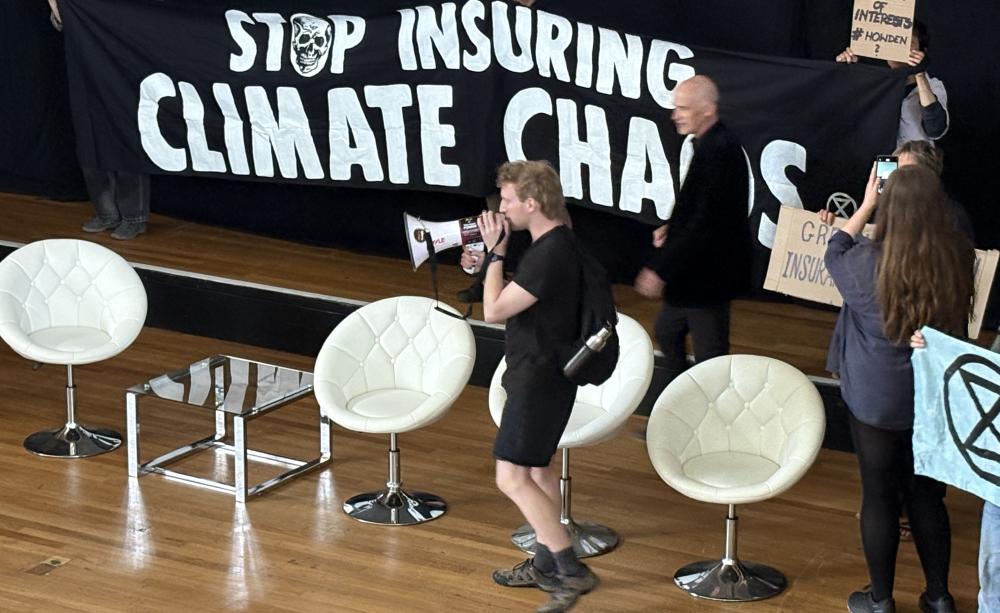
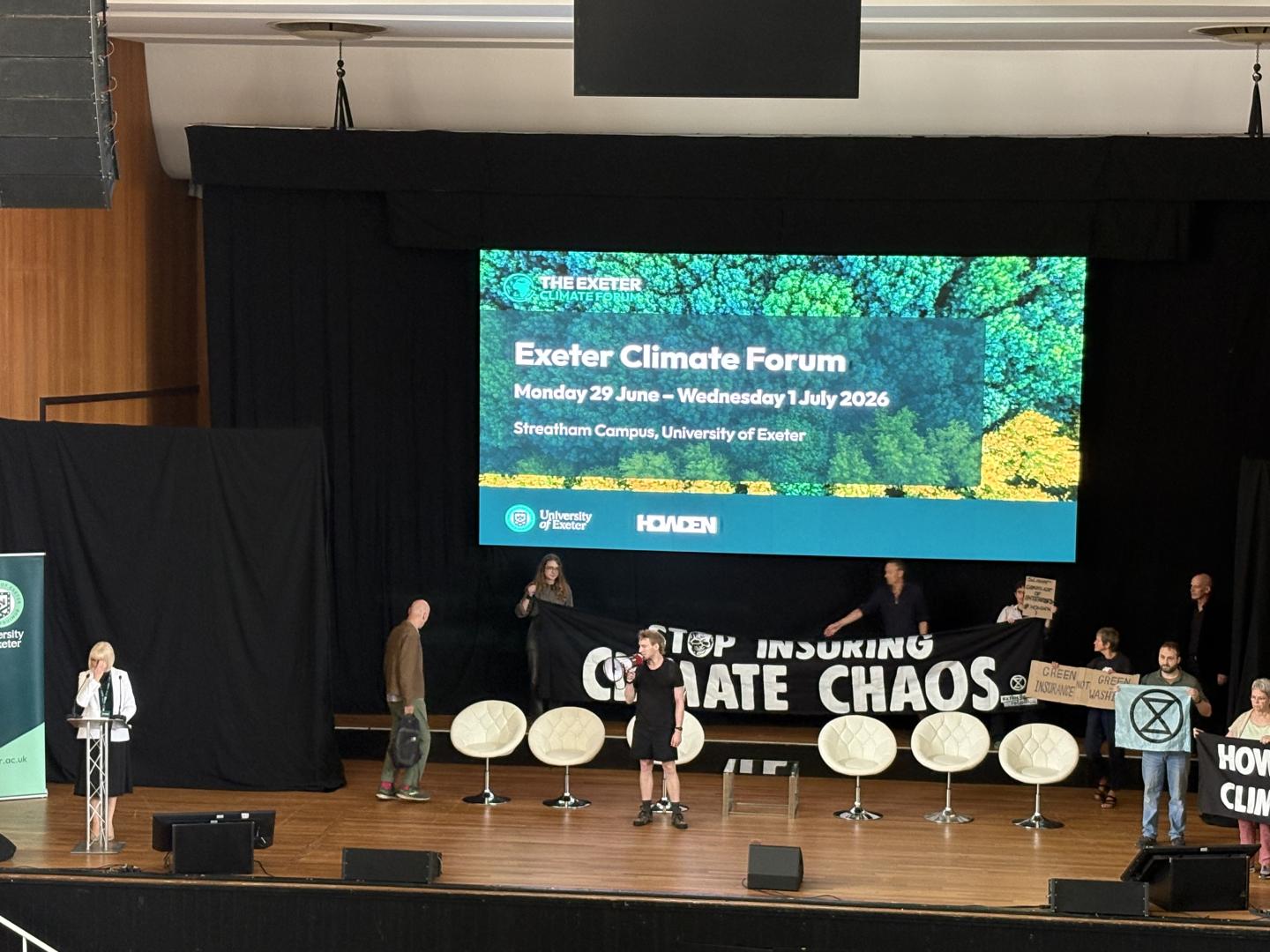
The event was interrupted by climate activists from Extinction Rebellion (XR) protesting the sponsorship from the insurance group Howden (pictured). The insurance firm has been repeatedly targeted by XR local groups for "enabling climate-wrecking fossil fuel projects by brokering insurance for oil drilling, coal mining, and oil infrastructure."
Howden clients include what it describes as “multinational mega-corporations” - including oil, gas, petrochemical and shale gas companies. It has more than 100 branches across the UK for home and car insurance.
Shameless
Jonathan Parker, who is studying a Global Sustainability MSc at the University of Exeter, led the stage occupation. He told The Ecologist: "Having a major fossil fuel insurance company at a climate science conference is utter madness.
"After one of the worst heatwaves the UK has ever seen, it should be clearer than ever that we need radical action to ensure a livable future. There should be no place for dirty money in a conference that is serious about real climate action."
Jonathon Porritt, the veteran environmentalist, supported the protest. He said: “The lack of leadership in the insurance industry is despicable. Its shareholders should be rising up in revolt.
“Failing that, citizens should be spearheading that revolt – and why not start with Howden Insurance, and the shameless decision by Exeter University to use some of Howden’s dirty money to sponsor a conference about climate change.”
Sarah Finch, awarded the 2026 Goldman Environmental Prize which honors the achievements and leadership of grassroots environmental activists from around the world, voiced her support for the action.
She said: "Insurers like Howden know the risks associated with burning oil and gas better than anyone. So why are they still underwriting new fossil fuel projects? This is literally driving the climate crisis. Allowing Howden to sponsor the Exeter Climate Forum gives them an undeserved green veneer and is completely inappropriate."
Policymakers
The new institute launch followed London Climate Action Week and fell within a month of record-breaking temperatures across Britain and Europe.
Professor Patrick Devine-Wright, director of the Advancing Capacity in Climate and Environment Social Science project and Professor in Human Geography at the University of Exeter will lead the new institute.
Having a major fossil fuel insurance company at a climate science conference is utter madness.
Professor Devine-Wright said: “This is an exciting moment as we renew our environment and climate-facing research capabilities with an ambition that matches the scale of the crises we face. The new institute will be oriented towards courageous, interdisciplinary collaborations and inclusive, engaged research in partnership with our stakeholders.
"Together, we can conduct research of the highest quality, contributing positively to tackling environmental problems in an increasingly divided world.”
Professor Lisa Roberts, president and vice chancellor of the University of Exeter, said: “The climate emergency is the greatest challenge facing humanity today, so it is vital that we bring to bear the power of our collective efforts to address these challenges with the boldest of actions.
"The wide variety of delegates here today – drawn from policymakers, business leaders, civil society and researchers – show us just how important it is to engage everybody in this fight.
Meaningful
“Here at the University of Exeter, we are incredibly proud to be playing our part in driving meaningful action on climate change, whether through engaging global policymakers with the latest science; discovering sustainable methods for extracting the critical minerals needed for a low-carbon future; or by interrogating the potential health impacts of a changing climate."
She added: “Together we have come so far in the fight for our planet. And I remain confident that if we continue to engage with each other, and learn from each other, that we will make a real and lasting impact in our quest to turn the tide on climate change.”
The institute was launched at the Exeter Climate Forum, which includes the Exeter Climate Conference and will explore cross-cutting themes shaping global climate strategy, including the carbon cycle, positive tipping points, climate and health, and extreme weather and modelling.
Stuart Brocklehurst, deputy vice chancellor for Business Engagement and Innovation at the University of Exeter said: "Meaningful action on climate change requires those who make decisions to engage with the latest research, and for those doing that research to understand what those decision makers need to know.
"The Exeter Climate Forum creates an environment for collaboration and for reflection, with some hard-nosed working sessions addressing practical issues raised by governments. It's great to welcome guests from across the world to Devon, and to play our part on this most vital issue."
Transition
The Exeter Climate Forum is taking place at the university’s Streatham Campus in Exeter and is sponsored by Howden. The Howden website confirms it insures companies working in the fossil fuel industry. "Our natural resources practice brings together insurance specialists across a full spectrum of energy, power and mining risks that span conventional and transition technologies," it boasts.
Isabelle Cadignan, climate co-lead at Howden, said: “Climate risk is evolving rapidly, and building resilience depends on the best available science being translated into practical action. We’re proud to continue supporting excellence in climate science through the Exeter Climate Forum and the launch of the university’s new climate and environment institute."
Insurers are increasingly refusing to insure properties that are located in flood-prone areas while rising insurance premiums in flood-risk areas mean many people are unable to afford cover. Earlier this year, XR disrupted an insurance industry conference which was being hosted at Howden’s London headquarters.
This Author
Brendan Montague is an editor of The Ecologist.