There is now a big shift coming. But many of these projects are stuck in the queue waiting to connect.
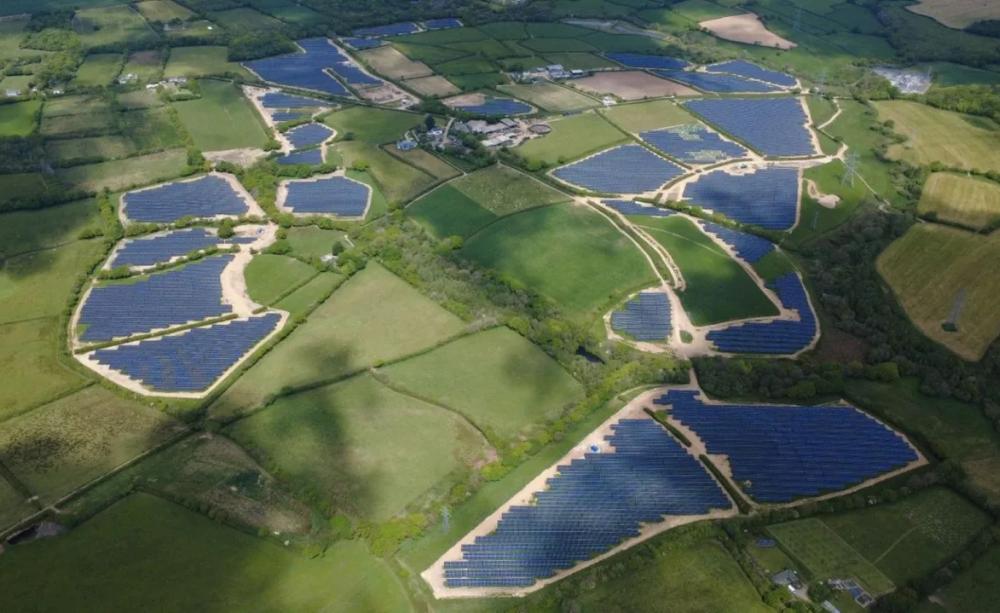
Britain’s largest community-owned solar project is struggling for survival after the local grid company stopped it from generating electricity for four months.
The shutdown over the summer – blamed by National Grid Electricity Distribution (NGED) on technical problems – has left the Derril Water solar farm in north Devon, owned by a 9500-member co-op, in a perilous financial state.
READ: THE FULL INVESTIGATION
The shutdown highlights electricity network companies’ failure to adapt quickly enough to renewable generation. This endangers efforts to move away from fossil fuels, researchers say. Community energy is especially vulnerable.
Overload
The threat of shutdowns at solar farms connected to electricity distribution grids could intensify, a joint investigation by The Ecologist and People & Nature has concluded.
NEGD curtailed the 40 megawatt (MW) Derril Water project’s output in May, without warning, due to a technical problem at the nearby Alverdiscott substation, where the high-voltage transmission network that binds together the national grid connects to the local low-voltage distribution network.
A super grid transformer that joins the two networks was switched off, on instruction from the National Energy System Operator (NESO) that oversees electricity and gas networks.
NESO was concerned that extra solar and wind power, and lower demand, over the summer would cause unsustainable voltage increases on the transmission network.
Without the transformer, NGED faced the risk of thermal overload on its power line between Alverdiscott and Indian Queens, Cornwall.
Informed
The distribution network’s back-up system was not ready. Langage power station, on which Devon’s network depends for voltage support, was off line for maintenance, and equipment earmarked to replace it was not delivered on time.
The shutdown order went to Derril Water and several other solar farms.
A message from Communities for Renewables, which operates Derril Water, told the co-op members in July: “The distribution and transmission network operators have been aware of the potential voltage issues on the North Devon network since 2023.”
Jake Burnyeat of Communities for Renewables said: “Network upgrades are behind where they are supposed to be, and for Derril Water this could not have come at a worse time.
“There is also a communication issue. They should have informed us ahead of time, but they didn’t.”
Shutdown
Frank Hodgson, demand and flexibility lead at Regen, the research group, told The Ecologist: “The voltage issues in the south west show what can happen when we underinvest in our energy system, and rely on ageing fossil fuel plants to provide critical system services.
There is now a big shift coming. But many of these projects are stuck in the queue waiting to connect.
“There is now a big shift coming, with new clean technologies like batteries and synchronous compensators able to provide grid system services reliably, at low cost and without relying on fossil fuels.
“But many of these projects are stuck in the queue waiting to connect. If they’re going to support the system, NESO and the monopoly network owners need to treat them as a priority and get them connected now.
"For clean energy projects in the south west, things might get worse before they get better.”
NESO and NGED could have explored alternatives to a total shutdown, industry sources say.
Constraints
A spokesperson for Ecotricity, which had its Galsworthy Wind Farm and Bulkworthy Solar farm curtailed, asked: “Did they exhaust all technical options available before they turned us off?”
An NGED spokesperson said options assessed were “not considered suitable within the relevant timeframe”.
The financial blow to Derril Water is more severe than for larger corporates, who are cushioned from the effect of the shutdown by other generation assets.
When larger renewables projects connected directly to the transmission grid are curtailed, they are paid compensation, but smaller generators connected to distribution grids are not.
These "constraints payments", mostly to Scotland’s big wind farms, are eye-watering: a total of £2.7 billion for the financial year from April 2024 alone.
Challenge
These payments, the curtailment of distribution-connected solar farms, and the years-long queues for connections to both transmission and distribution networks, are all part of the same problem.
Electricity companies have failed to invest fast enough to facilitate renewable generation, and government regulators have failed to make sure they do.
In the twentieth century the grid sent electricity out to users from large, centralised power stations. In the twenty-first, the system needs to become a two-way process that gathers electricity from a much larger number of much smaller generators, and facilitates local sharing and use efficiencies.
This has become more pressing as the climate crisis has deepened. And big up-front investments are needed.
As for the low-voltage distribution networks, a report by the MCS Foundation and Regen argued that upgrading them to prepare for increased demand is a “major challenge”. The distribution companies’ business plans for 2023-28 are not good enough, the report warned.
Connections
The government’s own National Infrastructure Commission last year warned that “a step change in the approach” to electricity distribution reform is needed.
Distribution grids would need £37 billion to £50 billion of investment between 2025 and 2050, double the rate envisaged by Ofgem, the electricity regulator.
Things are changing – but not fast enough. By carving NESO out of National Grid in 2024, the government took a first step to reversing decades of privatisation driven by neo-liberal dogma.
It implicitly recognised that electricity grid reform could not be left to profiteering private companies.
NESO last year tackled one of the biggest scandals, by reforming the queue for grid connections. But we are still a long way from a grid that can deal with the climate emergency.
Perilous
The regulators and companies talk about community energy projects being part of the solution, but don’t act as though they are.
Matt Vickers of Community Energy England said that the problems at Derril Water showed how far there is to go. “Grid companies need not only to provide connections, but to treat communities as strategic partners.”
The more that communities take electricity provision in to their own hands, the better. Derril Water shows that leaving it to profiteers and too-timid regulators is perilous.
The full text of this investigation is on People & Nature.
This Author
Dr Simon Pirani is honorary professor at the University of Durham, a life member of the National Union of Journalists, and author of books on energy systems, Russia and Ukraine. He is a regular contributor to The Ecologist and writes a blog at peoplenature.org.