We are no closer now than we were in 2017 to decarbonisation of our electricity grid.
The new Data Centre Covenant announced by the British Government alongside its 2026 Budget will "throw our climate commitments under the bus", a leading campaigner has warned.
Kat Jones of Action to Protect Rural Scotland, which is coordinating anti-data centre campaigns across Scotland, told The Ecologist that the covenant was "completely lacking in teeth".
"Where other countries are sounding the alarm and cracking down on the liberties that hyperscale data centres are taking with their resources and energy, the UK is rolling out the red carpet", she explained.
Curtailments
The covenant sets out five "tests" which "strategic data centres" must meet to qualify for support from a "ministerial control centre" which "will use the power of the state to accelerate time to power and speed up the planning process".
This includes reserving grid connections and allocating additional power capacity for data centres, as well as allowing on site generation to "bridge the gap to grid connections."
In return, data centres are meant show that they are contributing to lower electricity bills, investing in local communities, adhering to environmental standards, creating jobs and strengthening national security.
Scotland has been targeted by hyperscale data centre developers, with at least 6 GW of prospective data centre projects planned or announced.
Energy system operators and the government have previously suggested that siting data centres there could help reduce curtailments - payments to renewable generators such as wind farms, which currently generate more electricity can be used locally.
Consumption
Fintan Slye, head of grid operator NESO told an industry conference in May: "If in the audience you have a big data centre and you want to go to Scotland, please come talk to me, we will help you. It is actually helpful to the system to do that."
NESO expanded on Slye's remarks with a press release stating that "up to 20 per cent of future data centre demand could be located in Scotland, helping to reduce network constraints".
A source at NESO clarified to The Ecologist, however, that the "future data centre demand" estimate was not based on the current planning pipeline, but rather long-term scenarios which suggested that "data centres could account for around four to six GW of connected capacity by 2030 and six to 15 GW by 2050 across Great Britain, with annual electricity consumption potentially reaching 30 to 71 TWh by 2050."
We are no closer now than we were in 2017 to decarbonisation of our electricity grid.
The source said "the 20 per cent figure should not be interpreted as a forecast, target or allocation for Scotland".
The grid operator has not published any specific forecasts for data centre electricity consumption for Scotland, they added. "Locating electricity demand closer to areas with significant renewable generation can help reduce transmission constraints and system costs."
Gobbled
Ireland's experience over more than two decades of hyperscale developments provides evidence that data centre demand can also have the opposite effect on the grid, Irish parliamentarians told The Ecologist.
Brid Smith, then an elected member of the Dail (TD) for People Before Profit, introduced a bill targeting hyperscale data centres' climate impact five years ago. The 2021 bill was a response to the accelerating climate emergency, Smith explained.
"As well as banning new data centres, it also proposed banning LNG terminals and any new fossil fuel infrastructure.
"At the time our main concern was climate, and the impact data centres were having on the state's climate targets.
"We'd had a number of substantial reports from state bodies and research institutes which were pointing out that any increase in the supply of renewable energy from wind and solar was simply being gobbled up by the proliferation of new data centres, especially around Dublin."
Decarbonisation
Data centres consumed around 15 percent of Ireland's electricity at the time, a figure which rose to 23 percent by 2025.
The launch of ChatGPT in 2022 supercharged the rate of data centre expansion, Smith says, unleashing "a tsunami of AI slop and deepfakes" and accelerating the use the wide-scale use of gas turbines as data centre demand for grid connections outstripped supply.
Paul Murphy, People Before Profit-Solidarity TD, is a member of the Irish parliament's AI Committee. He explained that investments in renewables and upgrades to the grid have not made bills cheaper for household consumers, nor made the business of electricity generation greener.
"Since 2017, every extra bit of renewable capacity that has been added to the grid has been taken over by data centres. We are no closer now than we were in 2017 to decarbonisation of our electricity grid. It has all been gobbled up by data centres."
Burning
The scale of data centre demand created long queues to access the electricity grid and led to a temporary moratorium on data centre connections in the Dublin area.
But this is simply pushed data centre operators towards creating "islanded" sites which relied on gas turbines for power. Irish utility regulators are worried that the gas grid can no longer cope with the level of data centre demand, Murphy added.
"The Commission for Regulating Utilities (CRU) is now proposing that new connections for data centres may be able to sign up for a discounted tariff in exchange for being interruptible gas supplies," he told The Ecologist. "So at moments of high usage, the gas would be turned off for the data centres.
"The problem in terms of the environment is that the data centre in all likelihood will not go inactive at that moment. Instead it will shift onto its secondary supply, which would be burning diesel, which obviously is even worse in terms of carbon emissions."
Queue
The CRU said that as the consultation process on these contracts is ongoing, the commission "was unable to comment on specific matters at this stage."
Is Britain now heading down the same road? Several major data centre projects in the planning queue including sites near Slough, Buckinghamshire, Bedfordshire and Cardiff are actively looking at on-site gas turbines to power their operations, according to the BBC.
A British Government spokesperson said that data centres were "a vital part of our economy and our everyday lives, helping us interact with the services we need, while driving growth and renewal."
They added: "We firmly expect them to make the most of our clean, homegrown power and there will be exceptions only in extremely limited circumstances."
Commitments
Jones believes that the Data Centre Covenant risks repeating the mistakes made in Ireland at a time when other countries, such as Denmark, are pushing data centres to the back of the grid connection queue.
"We are extremely concerned that the UK government says they will be prioritising connections grid connections for data centres and so should any other power users in the economy," she said.
"This will severely impact other businesses especially house builders, manufacturing or any industry transitioning to low carbon operations.
"Especially alarming is the plan to allow access to temporary on-site power - which means gas power stations."
She added: "The government plans to throw our climate commitments under the bus to enable US AI companies to train their large language models, which they are telling us are going to decimate employment. Where on earth is the upside?"
This Author
Anne Alexander is a journalist and researcher. She is working currently working on a project with Watershed Investigations looking at the impact of data centres and the AI industry on the living planet.
This Image
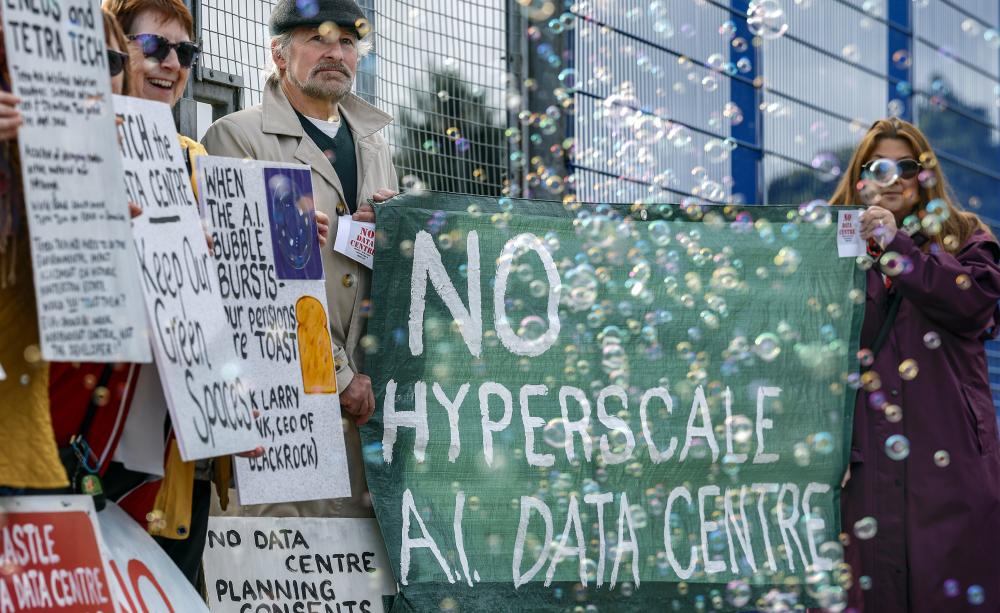
Community campaigners demonstrating against a proposed large-scale data centre rally outside the Park Hotel, where a B2B event attended by representatives from Eneus Energy is taking place on September 30, 2026 in Kilmarnock, Scotland. Demonstrators from the Reject Hunterston Data Centre Campaign Group and the Hurlford Rufus Data Centre Group are protesting Eneus Energy's proposal to build a large-scale data centre campus in Hunterston, North Ayrshire, raising concerns over the development's potential impact on the local environment and resources. Photo by Jeff J Mitchell / Getty Images.