It’s fair to say that we have our share of robust discussions in this office. Opinions get aired, fingers get pointed, occasionally voices get raised. It’s all in a good cause. Setting the world to rights isn’t always a civilised tea party.
Don’t be afraid of the recession, says Andrew Simms , it may just be the lucky break we need to get our heads around a more sane economy and a better quality of life
Economist Herman E Daly argues that our future depends on a new economic model, one that needs to be defined by the dynamic balance – the steady state – of the natural world upon which it depends.
The corporate market has become the institutional equivalent of a compulsive eater. It has a built-in hunger that cannot be filled, and it is hard to stop the damage within the framework of its own game.
It’s the battle of the century. In one corner, the Economy – big, bloated, greedy and growing. In the other, the planet Earth – fragile, finite and fighting back.
Environmentalists had waited with baited breath for the Chancellor's 2007 Budget. Gordon Brown had intimated that it would be the 'greenest ever'. In fact, it was a resounding disappointment.
A global capitalist economy obsessed with economic growth has plenty of faults, but chances are it's here to stay. Fortunately, there are other types of organisations out there to prove that the limited liability or plc company is not the only way to get business done.
Gordon Brown's Budget was disappointing. But not just because of its economic niceties. It fails to address key issues which have become taboo amongst economists - money, debt and economic growth. Molly Scott Cato, a green economist and Senior Lecturer in Social Economy at the Cardiff School of Management, addresses all three...
'A common price for carbon' has become the soundbite of the forward-looking 'green' politician. It pleases everyone, not least business, which can plan ahead by looking at the carbon 'market'. But is it the best way to proceed?
Environmentalists held their breath in expectation of Gordon Brown's 'green' budget. Was it worth the wait? Miriam Kennet, a director of the Green Economics Institute, looks at where the Chancellor went awry...
Wednesday’s Budget is expected to increase taxes on the most polluting cars, but only by £200, some £1,400 short of recommendations made by Friends of the Earth.
The publication of the government's draft Climate Change Bill this week signalled the latest round of the escalating competition between David Cameron and Tony Blair to take the title of climate change champion of the world. Following hard on the EU measures, the government's bill set out more radical targets than before and promises to deliver them – a promise that will be reinforced by a new committee of independent auditors.
The European Commission has set out plans to keep global temperatures from increasing more than 2 degrees. The authors said that limiting global warming to 2ºC is both technically feasible and economically affordable if the international community acts swiftly.
The Chancellor's pre-budget report on Wednesday 6th December was a green-washed shambles. Paul Kingsnorth gives Gordon a helping hand with the re-write
Stephan Harding, coordinator of the MSc in Holistic Science at the Schumacher College, explains why standard economic growth is not the answer, and why personal Tradable Energy Quotas are...
Death is rarely something to be celebrated, but I can’t say I shed a tear last week when I heard that Milton Friedman, the father of neoliberal economics, had gone to the great free market in the sky.
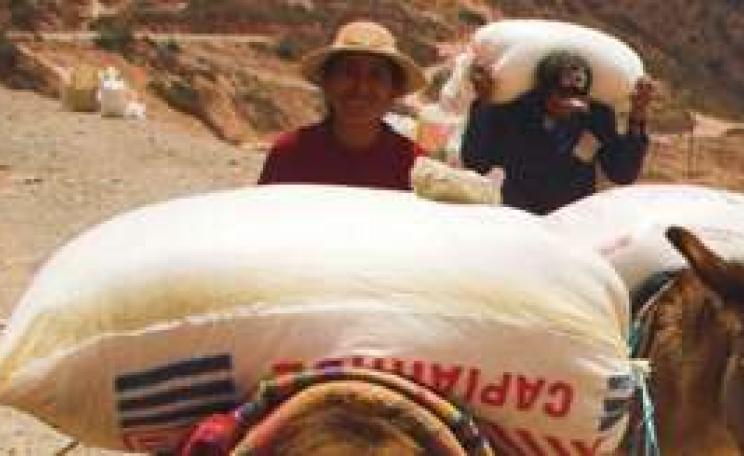
Half way between Cusco and the lost city of Machu Picchu lies the ancient artery of Inca trade and production - the salt terraces. For over 1,000 years little has changed for the salt farmers of Maras. Now, thanks to a clumsy, unnecessary and potentially dangerous attempt at mass medication, this traditional livelihood is at risk. By James Frankham.
‘Religion is the opium of the people’ is one of Marx’s best-known aphorisms. It is memorable because it tells us so much about the manipulation of faith in the industrial era
Our sick society and stupid economics are dragging the planet to the edge of apocalypse. Earth’s survival depends on a completely new way of thinking. By Kirkpatrick Sale