Australian governments have long waged a one-sided war on the continent's Aboriginal peoples, writes John Pilger. And now a new weapon has come into play: the starvation of the most remote, culturally intact communities. It's all part of a multi-faceted program of physical and cultural annihilation. And yet the world is silent.
There are many good reasons to criticise Donald Trump, writes John McMurtry. But none of these matter to the US media, political and corporate powers determined to keep him out of the White House. With his radical talk of halving military spending, controlling Big Pharma and exiting 'free trade' agreements, Trump is a direct threat to the parasite capitalism that's destroying America.
The global pesticide and bioscience giant Monsanto is a byword for evil for millions of campaigners and concerned citizens, writes JP Sottile. But that has never stopped it getting its way with the people that matter - politicians and regulators. And now the company is on the verge of biggest victory ever - winning clearance to spray biologically active RNA sequences on US crops.
France's energy minister Ségolène Royal has backed union demands for the EDF's Hinkley C project in Somerset to be re-examined, write Angelique Chrisafis & Chris Johnston - adding that the project must not go ahead if it would 'dry out' funds needed for EDF's renewable energy program.
Never mind Cameron's mealy mouthed denials that he or his family benefit from tax havens, writes Donnachadh McCarthy. The real problem is systemic: Britain's entire political establishment has long been owned by tax haven wealth. Finally a senior politician, Jeremy Corbyn, has the courage to stand up to the unaccountable super-rich.
In trying to evaluate charitable interventions in 'value for money' terms, the movement for 'Effective Altruism' has lost its moral compass, Sam Earle & Rupert Read. The real changes the world needs are profound, systemic and political. There is no better example than the refugee crisis: the problem is not insufficient aid, but structural inequality, too many weapons, and too much war.
The rights of nature and of indigenous communities are enshrined in Ecuador's constitution, writes Kevin Koenig. But down in the Amazon the government is going full speed ahead with oil extraction on indigenous territories whose owners are committed to keeping their forests and waters pollution-free. A mighty battle is brewing that looks certain to come to a head this year.
Campaigners are celebrating after defeating plans to build America’s largest open pit coal mine, writes Nick Engelfriend. In an epic 'David and Goliath' battle, Montana activists challenged the project, and all the politicians and businessmen that supported it, with fierce opposition, protests and demonstrations. The outcome spells hope for all in the fight against dirty energy.
The Green Party is the only national party in Westminster to be denied a Party Political Broadcast by the BBC, write Bennet Francis and Rupert Read. The decision reveals a massive failure of impartiality against which there is no right of independent appeal - save to the court of public opinion.
MPs today grilled EDF Energy supremo Vincent de Rivaz over the troubled Hinkley C nuclear plant in Somerset. He insisted that the project was definitely going ahead - but refused to say when the 'final investment decision' was due. Confused? Bewildered? Frustrated? So were the MPs.
The world is in the grip of a massive wave of militarism of which most of us are blissfully ignorant, writes John Pilger. When did mainstream media last tell you about the US's $1 trillion nuclear weapon renewal? NATO's massive build up of military power on Russia's eastern frontier? The encirclement of China by nuclear-armed US bases? The world is at war. Pass it on!
The small state of Vermont is changing the face of US food as companies hasten to comply with its GMO labeling rule which comes into effect in July 2016. Mars and General Mills - and now Kelloggs and ConAgra - are the latest companies to announce their labels will comply with Vermont law US-wide - and many more are sure to follow.
After a succession of the hottest years and months ever recorded, climate is a hot topic, writes Liz Hutchins. But BBC1's 'Big Questions' climate change debate last Sunday completely missed the point. Instead of debating the only real question - how should we respond? - the BBC ran yet another repeat of the so-over 'believers versus deniers' ding-dong. Why do they still not get it?
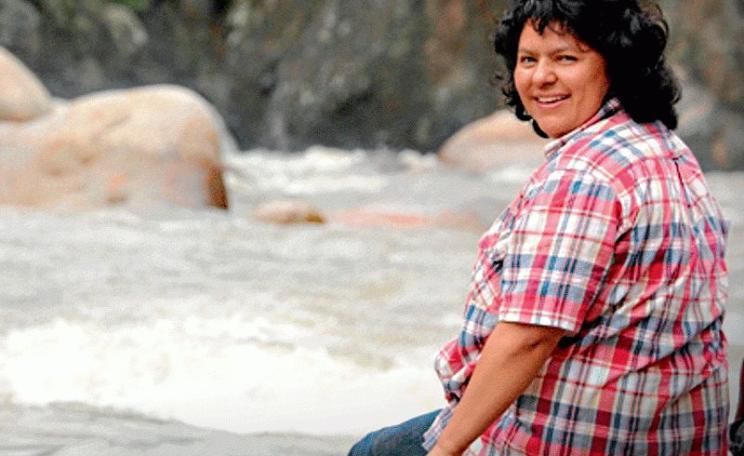
Since the Obama-Clinton coup in Honduras the murder of eco-defenders and other activists has become a routine instrument of government, writes Dan Beeton. We must demand an end to the killings, the restoration of political freedom, and a halt to the tide of corporate megaprojects - beginning with the Agua Zarca dam.
Last month must go down as one of the worst ever in the annals of climate change, writes James Dyke, with parts of the Arctic 16C hotter than usual and the 'safe' warming level of 2C breached across the Northern hemisphere. But even worse is the near-total lack of reaction from business, politicians and media.
The Chancellor's 'sport not sugar' move to tax sugary drinks was extremely welcome, writes Simon Bullock. But we need a similar Treasury approach to protect people from other threats too. So how about tackling the air pollution that's killing tens of thousands of Britons a year?
Koide Hiroaki has spent his entire career as a nuclear engineer, and has become a central figure in Japan's movement for the abolition of nuclear power plants. He met with Katsuya Hirano and Hirotaka Kasai to discuss the catastrophic nuclear meltdowns at Fukushima Daaichi in March 2011, and the crimes and cover-ups committed both before and after the event.
Cancer is just one of of the outcomes of the genetic damage inflicted by nuclear radiation, writes Chris Busby, and perhaps one of the least important. Of far greater long term significance is the broad-scale mutation of the human genome, and those of other species, and the resulting genomic instability that causes cascades of heritable mutations through the generations.
Is the UK sinking into authoritarian rule? That's how it looks, writes Jonathon Porritt, as the government joins with right wing media and fossil fuel companies to attack local democracy and environmental campaigners. Is this 'merger of state and corporate power' a sign of more, and worse, to come?
Barring a miracle Marco Rubio is set to be Trumped in the Republican primary tomorrow in Florida, his home state, putting an effective end to his campaign. But it's not for want of support from one of the US's biggest frackers, Devon energy, and its politically active CEO Larry Nichols. And with or without Rubio, Nichols's influence on the red states' energy policy is only going to get bigger.
To understand how technology is used in the real world we must appreciate who owns and controls it, writes Colin Todhunter: whose interests it serves, and how it works in an economic system driven by profit, geopolitics and the compulsion to capture and control markets - while the monopolists proclaim a noble ideology of 'free choice' and 'democracy'.
What was NATO's violent intervention in Libya really all about? Now we know, writes Ellen Brown, thanks to Hillary Clinton's recently published emails. It was to prevent the creation of an independent hard currency in Africa that would free the continent from economic bondage under the dollar, the IMF and the French African franc, shaking off the last heavy chains of colonial exploitation.
Low Emissions Zones have their place in cleaning up the UK's worst air pollution hotspots, writes Richard Howard. But we also need to adopt fiscal measures to encourage a shift away from diesel vehicles, at once delivering cleaner air, increased tax revenues, and lower carbon emissions.
The US Constitution guarantees the rights of future generations, not just current ones, writes James E. Hansen. But those rights are being betrayed, knowingly and deliberately, by governments and politicians who are standing by and allowing climate change to wreak long term havoc on the planet. Today, this legal principle is being asserted in a Federal Court in Oregon.