A joint project run by The Royal Institute of British Architects (RIBA), the Institution of Civil Engineers (ICE) and the thinktank Building Futures, has said that straight-forward engineering defences are no longer sustainable or affordable in defending UK coastlines.
A report produced by the group says that the only viable options for coastal protection are to retreat inland, create habitable defence structures or build out into the sea.
Focusing on Kingston upon Hull and Portsmouth, two of the UK’s highest flood risk areas, the research presented six scenarios and proposed solutions based on a trio of briefings.
Extreme situation
RIBA President Ruth Reed said:
‘The scenarios we have created are extreme, but it is an extreme threat we are facing.
‘Approximately 10 million people live in flood risk areas in England and Wales, with 2.6 million properties directly at risk of flooding from rivers or the sea.’
The report said that the 12,000 kilometers of coastline in the UK was now much more densely populated, increasing the possible scale of disaster.
However, Reed offered a solution:
‘If we act now, we can adapt in such a way that will prevent mass disruption and allow coastal communities to continue to prosper.’
Three solutions
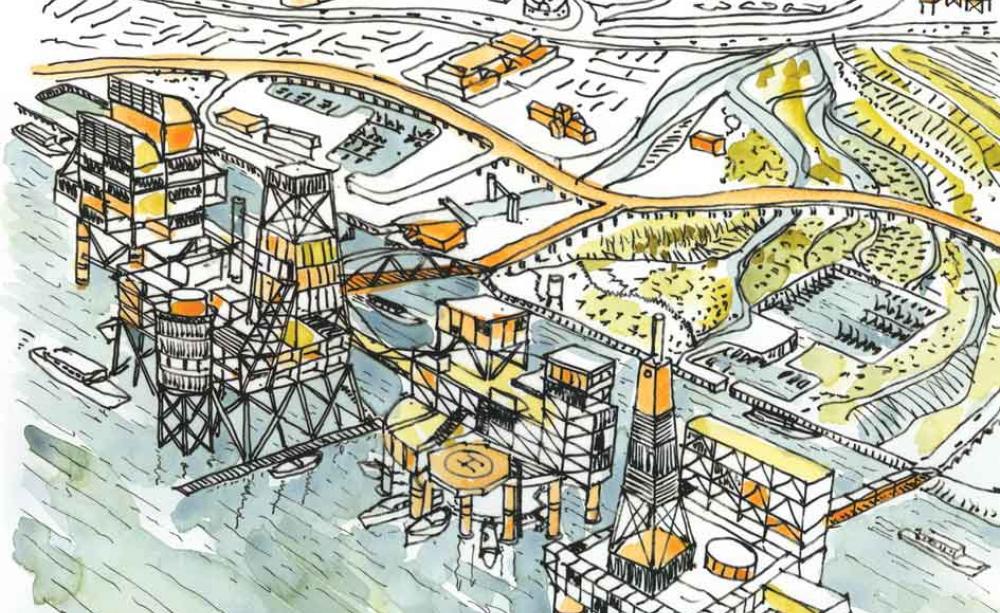
The proposed solutions came under three headings: retreat, defend or attack.
1. Retreat involves moving the line of coastal defence inland, allowing flood water to occupy previously protected urban areas.
2. In terms of defence, the benefits of preventing water entering existing cities were said to outweigh the costs, but the report claims that there is currently a deficit in costal flood defences, caused by a lack of Government funding.
3. 'Attacking' the sea has been a proven success overseas, and due to the high demand for space, the public and private sector are both willing to invest in expanding seaward.
Urgent change
The report was designed to provoke longer-term thinking across a wider audience: from government and policy-makers, to planners, architects and importantly, the general public.
Chair of the Institution of Civil Engineers (ICE) steering group, Ben Hamer, said:
‘The UK must urgently change the way it plans, builds and designs at-risk communities.’
Useful links
The full project will be exhibited at the Building Centre, London 6th Jan – 29th Jan 2010, before traveling to Portsmouth 15th - 27th February and Kingston upon Hull 15th – 28th April

| READ MORE... | |
 |
HOW TO MAKE A DIFFERENCE Forget eco-towns - real green house-building is already happening Cambridge University's expansion plans could change the face of sustainable building in the UK. In 2012, construction begins on the greenest development of its size and scope in the UK |
 |
HOW TO MAKE A DIFFERENCE PHOTO GALLERY: Visionary architect unveils eco designs An exhibition in Beijing reveals architect Paolo Soleri's latest radical green city concept |
 |
HOW TO MAKE A DIFFERENCE PHOTO GALLERY: Homes for a changing climate In an extract from his new book Homes for a Changing Climate, Will Anderson makes the case for building 21st century homes that can withstand the effects of climate change and help usher in a low-carbon revolution |
 |
COMMENT We need a citizens' housing revolution Self-builders are no longer a niche segment of society: they are industrious, skilled, innovative individuals who should be helped to create vital, sustainable communities |
 |
VIDEO Why we need a right to build our homes Rather than depend on a corporate oligopoly to build our homes for us, why not introduce a 'right to build' for everyone... |