The nuclear industry has had a disappointing COP21, writes Jim Green. Lobbyists were there en masse desperately trying to get pro-nuclear wording into the Paris Agreement, and they failed. The word does not occur even once in the entire document. But we must prepare for the next battle: keeping nuclear power out of the $100 billion a year Green Climate Fund.
Energy Secretary Amber Rudd's plan to deliver the UK's emissions reductions promised in COP21 rely on nuclear power as the main 'low carbon' energy source, writes Paul Flynn. But the high cost of nuclear, and the ruinous track record of current technologies, show that this path leads only to massive failure at public expense.
The impact of the Paris Agreement on leading rating agency Moody's assessment of the world's fossil fuel companies is ... nothing at all. The one change is in Europe, where thermal generators have a worsening outlook, and renewables are 'credit positive'.
The Paris climate agreement contains plenty enough to get fossil fuel companies and exporters worried about their future, writes Kumi Naidoo. But it is lacking is in the mechanisms to deliver its aspirations. That's why the global climate movement has to escalate its fight against the carbon bullies, and for climate justice.
What's not to like about the promise of billions of dollars for clean energy R&D? It's that we need to get the global energy transition moving right now, writes Ambuj D Sagar, not ten years hence. The billions should go into the immediate global deployment of the renewable technologies we have already got.
Campaigners at COP21 in Paris are calling for a new 'upstream' carbon tax to be levied on fossil fuel producers, writes Henner Weithoener, and so send a clear market signal and finance poor countries' compensation for 'loss and damage' caused by climate change.
Coal prices are in terminal decline, writes Kyla Mandel, oil giant Statoil is calling for the strongest possible agreement, and the world's energy bosses are planning for a decarbonised future. COP21 is marking the definitive tipping point in the demise of fossil fuels.
As COP21 reaches its endgame, there are plans to build 2,440 coal-fired power plants around the world, write Mowdud Rahman & Greig Aitken. Their completion would send global temperatures, and sea levels, soaring. Yet Bangladesh, the world's most 'climate vulnerable' large country, has plans for a 1.3GW coal power plant on the fringes of its World Heritage coastal wetlands.
ITER, the elusive and multi-million dollar fusion fantasy, was yet another nuclear chimera introduced at the Paris COP21 climate talks as a 'solution' to our climate crisis, writes Linda Pentz Gunter. But the idea is pure fantasy: long before it can be made to work, if it ever can, it will have been made obsolete by harnessing the power of our giant fusion reactor in the sky: the Sun.
In this joint statement to COP21 Amnesty International and Greenpeace International call on all governments to protect human rights by including making respect for human rights an explicit purpose of any agreement, while agreeing to phase out fossil fuels and deliver 100% renewables for all by 2050.
Investigative reporters working for Greenpeace UK's Energydesk have uncovered a nexus of senior academics willing to accept large sums of money from fossil fuel companies to write reports and newspaper articles published under their own names and university affiliations, without declaring the funding. Lawrence Carter & Maeve McClenaghan spill the beans ...
The EU's decision to renew 'punitive' tariffs on imports of PV modules and cells from China will cost the EU's solar installers an extra £700 million, writes Oliver Tickell - just as the UK industry is reeling from 87% government cuts.
Last week a new billionaires club strode into COP21 in Paris promising big money for 'clean energy': the Breakthrough Energy Coalition. But most of its members are nuclear obsessives, writes Linda Pentz Gunter, from Bill Gates to Jeff Bezos and Richard Branson. And what the the world needs is not 'patient investment' into nuclear research, but impatient investment into renewables deployment.
Paris has been awash with hype about 'CO2 recycling' and 'carbon neutral' or even 'carbon negative' technologies based on burning millions of trees, writes Rachel Smolker. But the alchemical notion that waste carbon can be spun into corporate gold is hitting serious reality checks. It's time to ditch the fantasies and progress the real solutions: like caring for land, soils, forests and grasslands.
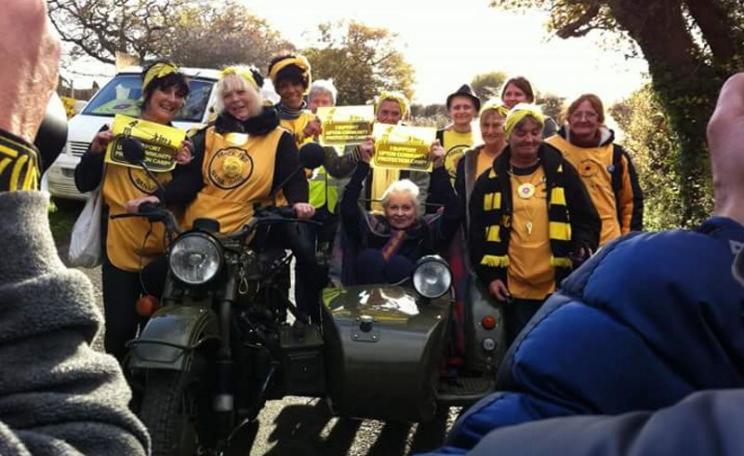
On Monday Cameron was waxing lyrical on climate change at COP21 in Paris, writes Natalie Bennett. But his true colours will be revealed tomorrow as a long established anti-fracking camp in Cheshire is set for eviction: all part of the plan for a new generation of gas-fired power stations that will blow the UK's emissions targets.