The EU Parliament has responded to the health concerns of millions by calling on the Commission to severely restrict permitted uses of the toxic herbicide glyphosate, including an effective ban on pre-harvest dessication of crops.
The global pesticide and bioscience giant Monsanto is a byword for evil for millions of campaigners and concerned citizens, writes JP Sottile. But that has never stopped it getting its way with the people that matter - politicians and regulators. And now the company is on the verge of biggest victory ever - winning clearance to spray biologically active RNA sequences on US crops.
GMO crops are marketed as providing quick fixes to complex problems, writes Julia Wright. But they only perpetuate 'business as usual' farming that's depleting soils, water and biodiversity, and entrench unsustainable models of agriculture in place of agroecological systems that work with, not against, nature.
Perhaps all the 'do gooders' busy forcing industrial models of agriculture onto poor but independent African farmers really do think they are helping them, writes Colin Todhunter. But if so they are deeply deluded. All they will achieve is the takeover of export-oriented agribusiness and GMOs, the destruction of agroecological farming systems, and a future of debt and landlessness.
The state government of Ekiti sent bulldozers to clear farmland for a new airport without even consulting the farmers who owned it, writes Rose Bridger. Crops, buildings and trees were all flattened. But the farmers fought back - and have now won a major legal victory that will inspire and empower other mega-project afflicted communities across Nigeria, and beyond.
Food has never been more affordable for middle class families in rich countries. But it comes at a high cost: the impact of industrial food production on health, environment and society has never been greater as Patrick Holden explained to Emily Lewis-Brown. Now the real cost of food US production will be examined in a ground-breaking conference in San Francisco.
India's food system, essentially clean just a generation ago, has been comprehensively contaminated with sugar, bad fats, synthetic additives, GMOs and pesticides under the country's neoliberal 'great leap forwards', writes Colin Todhunter. The result? a surge in obesity, diabetes and cancer incidence, but no let-up in the under-nutrition of those too poor to join in the over-consumption.
Among Cuba's greatest achievements is its organic farming sector, writes Miguel Altieri. Developed in the 1990s following the collapse of the Soviet Union, small agroecological farms now employ 300,000 campesinos and provide an abundance of healthy fruit and vegetables. But now US food and agribusiness corporations are eyeing up a multi-billion dollar business opportunity.
Oxford researchers have quantified the benefits of the world becoming vegetarian, writes Marco Springmann. Their study shows that simple changes - like moving to diets low in meat and high in fruit and vegetables - could lead to significant reduction in mortality and health care costs, while cutting food sector greenhouse gas emissions by two thirds.
Groups representing over 5 million Nigerians are resisting Monsanto's attempt to introduce GM maize and cotton, writes Vanessa Amaral-Rogers. With growing evidence of harm to human health and environment, and failing GM crops in other countries, they say Monsanto's applications must be refused.
Coffee may be grown all around the tropics, writes Fiona Hesselden, but it originates in just one place: the 'coffee rainforests' of the Ethiopian highlands. We depend on the wild plants for new genes and varieties, yet the forests are falling fast to the advance of farmers. To preserve the forests and all their biodiversity, the original people of the forest must receive their just rewards.
GMO enthusiasts insist that organic, agroecological farming could never feed the world, writes Colin Todhunter. But it has been feeding us all for millennia - and it's the only way to continue while enriching the soils and biodiversity on which all farming depends. As Mahatma Gandhi once observed, industrial agriculture is but a nine-day wonder. And its time will soon be up.
It will take decades to completely leave fossil fuels, writes Richard Heinberg. But we can do it, starting with the easy stuff: going big time for wind and solar, raising energy efficiency, replacing oil-fuelled vehicles, and moving to organic farming. But deeper changes will follow as we transition to a more enduring sustainability - consuming better, and much less.
To understand how technology is used in the real world we must appreciate who owns and controls it, writes Colin Todhunter: whose interests it serves, and how it works in an economic system driven by profit, geopolitics and the compulsion to capture and control markets - while the monopolists proclaim a noble ideology of 'free choice' and 'democracy'.
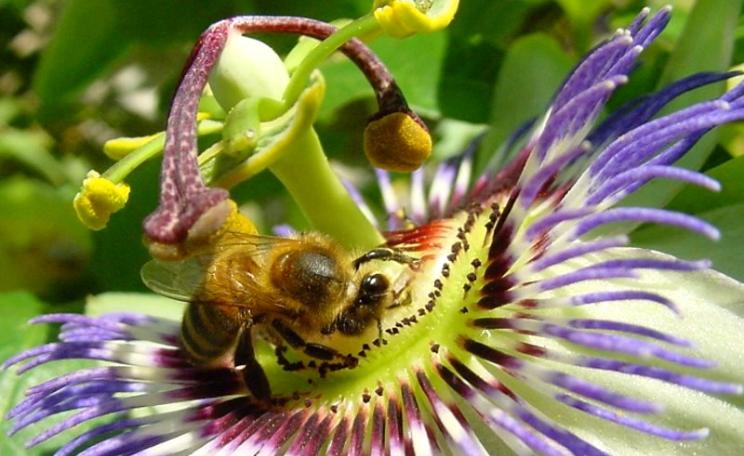
The insecticide chlorpyrifos is not just highly toxic to developing human foetuses. A new study finds that it also damages the memory and learning ability of Forager bees even at very low doses, threatening the survival of this important pollinator.
Labels on meat, egg and dairy products are often the only clue we have into the lives of the animals they came from, writes Philip Lymbery. But they are often confusing or even misleading about the truth of cruel farming practices. Labelling needs to be clearer to allow ethical consumers to make the right choices.
BASF are to halve their GM research and development and reduce the time spent on developing these technologies, writes Peter Melchett. Given the many problems that GM agriculture is facing, and that new non-GE technologies offer such valuable benefits as increased crop yields, does BASF's announcement spell the beginning of the end of GM crops?
A new study shows that 99.6% of Germans are contaminated with the herbicide glyphosate, writes Nicole Sagener. The news comes as the EU puts off a crucial decision on whether to re-authorise the chemical, described by IARC as 'probably carcinogenic', until 2031.
After beavers' reintroduction to Scotland, landowners have accused the native rodents of damaging the environment, causing floods, and worse, writes Louise Ramsay. But the public have rallied to the cause of these charming, beneficial creatures, leaving conservative landowners isolated. Could the shift in sentiment trigger long overdue change in the Scottish countryside?
Agroecology is key to retaking control over food, farming and land from the 'monstrous machine' of agribusiness, biotech, big finance and 'free trade', writes Colin Todhunter, as it represents a truly viable alternative to agriculture for corporate profit. But such are the powers ranged against the world's small farmers that it must be supported by a broad-based, global people's movement.
The British Veterinary Association has just launched its long-anticipated Animal Welfare Strategy, writes Mark Jones - and very welcome it is too. But it's also completely incompatible with the BVA's support for England's cruel and utterly unscientific badger culls. It's time for an urgent rethink.
The way food is produced has a profound impact on its nutritional profile, according to research published in the British Journal of Nutrition. Not only is organic farming better for animal welfare, the environment and wildlife, writes Peter Melchett, but organic meat, dairy, fruit and vegetables all have tangible health benefits for the people who eat them.
Next week, EU governments will vote on whether to re-authorise the weedkiller glyphosate, judged by IARC to be a probable human carcinogen, writes Molly Scott Cato. The disgraceful shenanigans of the Commission and the European Food Safety Agency to date provide a clear example of the EU and member states conspiring with corporations, against citizens.
A year after Shell was forced into a £55 million settlement with an indigenous community in Nigeria devastated by oil spills, a UK High Court judge has allowed two new such cases to proceed on behalf of some 43,000 subsistence farmers and fishers whose livelihoods have been wiped out by the same cause.