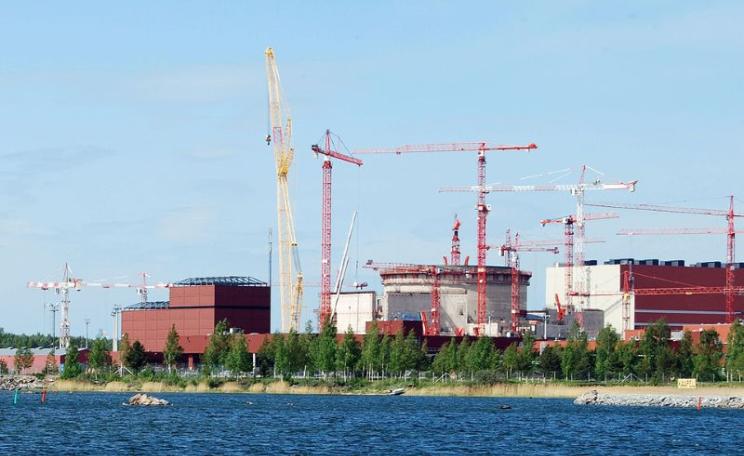
The EDF board is meeting tomorrow to reach its 'final investment decision' on Hinkley C. It was meant to be a rubber stamp but now it's anything but, as EDF's share price sinks to a new low, unions and employee directors harden their opposition to the project, and projects in France, Finland and China run way over time and cost with severe technical problems and safety concerns.
The cash-strapped French energy giant EDF may sell off profitable stakes in its in its eight existing UK nuclear reactors to raise money for the Hinkley Point C project. But with no example of the EPR design planned for Hinkley even near completion, it may all prove a risk too far.
With COP21 out of the way there is absolutely no time to lose, Greenpeace director Kumi Naidoo told Pavlos Georgiadis: 'Because by tomorrow, there might be no tomorrow.' We need substantial, structural, systemic change - and this change can only be led by the youth, who are not infected by the political pollution of the past. And whose future is it anyway?
In this new age of austerity money is a perpetual struggle for the public sector and ordinary people, writes Pete Dolack. Yet central banks have squandered trillions to boost profits in the financial sector, reward speculation and push up real estate values. In fact, the world is awash with money as never before - our money. Just don't expect to get your hands on it any time soon.
The nuclear industry has had a disappointing COP21, writes Jim Green. Lobbyists were there en masse desperately trying to get pro-nuclear wording into the Paris Agreement, and they failed. The word does not occur even once in the entire document. But we must prepare for the next battle: keeping nuclear power out of the $100 billion a year Green Climate Fund.
Energy Secretary Amber Rudd's plan to deliver the UK's emissions reductions promised in COP21 rely on nuclear power as the main 'low carbon' energy source, writes Paul Flynn. But the high cost of nuclear, and the ruinous track record of current technologies, show that this path leads only to massive failure at public expense.
The impact of the Paris Agreement on leading rating agency Moody's assessment of the world's fossil fuel companies is ... nothing at all. The one change is in Europe, where thermal generators have a worsening outlook, and renewables are 'credit positive'.
Overtaken by massive regional trade agreements like TPP, TTIP, CETA and TINA, the World Trade Organisation has slipped into the background, writes Polly Jones. But this week it's back with a vengeance, with its first big meeting in two years. The US's plan is to globalise the investment protection regime set out in the TTP, and open a new era of corporate rule and the eradication of democracy.
Campaigners at COP21 in Paris are calling for a new 'upstream' carbon tax to be levied on fossil fuel producers, writes Henner Weithoener, and so send a clear market signal and finance poor countries' compensation for 'loss and damage' caused by climate change.
Coal prices are in terminal decline, writes Kyla Mandel, oil giant Statoil is calling for the strongest possible agreement, and the world's energy bosses are planning for a decarbonised future. COP21 is marking the definitive tipping point in the demise of fossil fuels.
No matter what bullying tactics they encounter in the final stages of COP21, writes Laurence Delina, 'climate vulnerable' countries must hold firm - and demand a legally binding treaty that delivers deep emissions cuts and secure, sufficient climate finance, all backed by strong sanctions for non-compliance. Nothing less will do.
The EU's decision to renew 'punitive' tariffs on imports of PV modules and cells from China will cost the EU's solar installers an extra £700 million, writes Oliver Tickell - just as the UK industry is reeling from 87% government cuts.
Saturday's delivery of the draft Paris Agreement text for ministers to run with today was a small miracle, writes Luke Kemp. But it came at the cost of 935 bracketed texts to be argued over by ministers this week, while key questions - whether it will be a legally binding treaty, and how poorer countries will be paid to adapt to and mitigate climate change - are still up for grabs.
Last week a new billionaires club strode into COP21 in Paris promising big money for 'clean energy': the Breakthrough Energy Coalition. But most of its members are nuclear obsessives, writes Linda Pentz Gunter, from Bill Gates to Jeff Bezos and Richard Branson. And what the the world needs is not 'patient investment' into nuclear research, but impatient investment into renewables deployment.
The latest text of the Paris Agreement on climate change published today sets 1.5C as its 'long term temperature goal', half a degree lower than previously agreed. It's a big victory for poor 'climate vulnerable' countries - and a blow for Saudi Arabia.
'Pay up or there's no deal', a coalition of 134 developing nations have warned the rich industrial countries at COP21 in Paris - the ones that caused the climate problem in the first place. As Paul Brown writes, much more than the $64 billion so far pledged will be needed to get them on board.
Earthship Brighton, an award-winning off-grid community centre set in an organic farm within the South Downs National Park, has hosted hundreds of events and inspired tens of thousands of visitors over the last decade, writes Phil Moore, demonstrating green technologies and energy-efficient living. But now it's in need of a refit.
The theme at COP21 today has been the urgent need to cut fossil fuel subsidies that favour dirty energy over renewables, writes Tony Juniper. Sadly the UK is setting all the wrong examples - ramping up its spending on fossil fuels, while slashing its much smaller renewable energy budgets.
The surprise removal of tax benefits for investors in community renewable energy schemes - effective from Monday - is unlawful and must be reversed, states a legal letter to the Treasury. But meanwhile, investments in the sector have hit record levels, with two days still to go.
As negotiators from around the world gather in Paris for what's hoped to be a groundbreaking climate summit, many will be surprised to discover that COP21 is funded by some of the world's biggest coal burners, writes Pavlos Georgiadis, and a leading financier of coal and tar sands development. Shouldn't we just ... kick them out?
The 'Autumn Statement' delivered with such aplomb by the Chancellor is yet another attack on the UK's sustainable future, write David Lowry & Oliver Tickell - cutting energy efficiency funds just as tens of thousands are set to die of cold this winter, betting £250m on pointless nuclear research, and raiding the renewables budget to fund subsidies to nuclear power and fossil fuels.
A new report warns that coal, oil and gas assets will be stranded if the world is to limit temperature rise to 2C. Losses are projected to reach $2.2 trillion over the next decade, with coal taking the biggest hit, while oil demand peaks in 2020. Yet fossil energy companies are ignoring the very innovations that will put them out of business.
The governor of the Bank of England recently argued that the risk to the stability of the financial system from climate change is a responsibility of central banks, writes Matthias Kroll. They can begin by using QE - 'quantitative easing' - to finance the Green Climate Fund, and so stimulate the economy, rescue the climate, and save the global financial system.
An energy revolution that would take the world to 100% renewables in 15 years is possible, write Sam Cossar-Gilbert and Dipti Bhatnagar. We have the technology, and we even have the money - only it's currently being spent to subsidise fossil fuels. The time has come to tackle two hugely destructive and closely entwined crises - growing inequality and climate change.