Information from Colombia's National Hydrocarbons Agency shows that at least 43 new fracking concessions have been handed out to multinational companies including Exxon Mobil, ConocoPhillips and Drummond. These concessions affect over three hundred municipalities, in the departments of Cesar, Santander, Boyacá, Cundinamarca and Tolima. SEBASTIAN ORDOñEZ and DANIEL MACMILLEN VOSKOBOYNIK report.
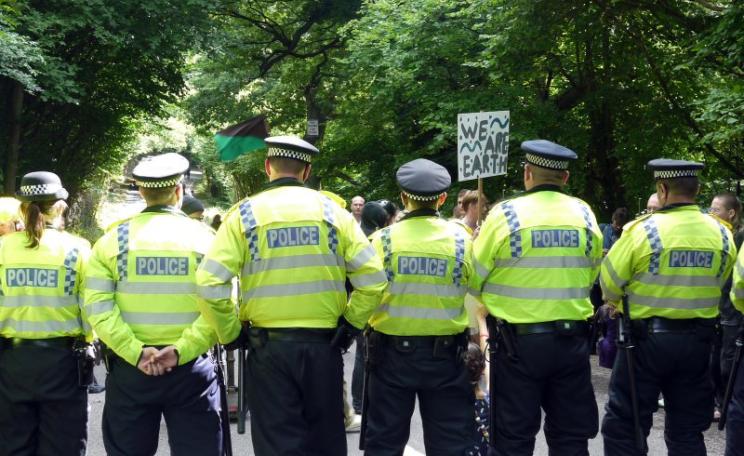
Post Brexit, get ready for a massive attack on our liberty, especially on the right to protest, writes Paul Mobbs. With the UK likely to secede from the European Convention on Human Rights, prepare for a new empowerment of police to act with impunity against peaceful activists. We must be ready to stand up, with honour and dignity, for our ancient British right to dissent.
2017 began with bang for Friends of the Earth, writes Tony Juniper, with a hostile media blitz orchestrated by the fracking industry and abetted by the Advertising Standards Authority (ASA). But the storm, over alleged errors in an FoE leaflet about the hazards of fracking, reveals nothing so clearly as the disgraceful conflict of interest at the top of the ASA itself.
Fracking has no social licence in the UK, will contribute little to the economy, will have a huge adverse impact on other sectors, will be a disaster to climate and the environment, and won't even improve energy security, write Peter Strachan and Alex Russell. Do we really want to see 16,000 or more shale gas wells drilled in the British countryside? Let's FraXit now!
A Lancashire grandmother is to appear in a Preston court tomorrow to defend a £55,000 claim pressed by fracking company Cuadrilla and its CEO Francis Egan for the costs of an eviction that never even took place, writes Oliver Tickell. Now a campaign calling on Cuadrilla to drop its unjust and oppressive legal action is gaining momentum - and its Egan who's on the defensive.
Eight years ago the first exploration applications for unconventional gas extraction were submitted in South Africa. Last week fracking finally received official attention from South Africa's legislature during a debate that revealed how the country's different political parties gauge the benefits and risks linked to the drilling technique. JASPER FINKELDEY was at that debate.
The jobs and quick money that fracking can generate may seem initially attractive, indigenous Canadian activist Caleb Behn told Jen Stout on his recent visit to Scotland. But after decades of oil and gas production, the ineradicable legacy is of fractured landscapes and long-term pollution. 'My land is bisected, divided, by pipelines, roads, well sites, pads, all that. It's really hard on my heart.'
The UK government's insistence of pursuing fracking is based on a flawed and utterly misinformed vision of our future, write Alex Russell and Peter Strachan. Rather than delivering the prosperity they promise, large scale fracking would cause massive pollution of air and water, undermine vital export industries, and leave us with an irretrievably damaged economy and natural environment.
Last week the EU ratified the Paris Agreement to limit climate change, writes Tony Bosworth. So how did Communities Secretary Sajid Javid mark the occasion? By overturning Lancashire's democratic rejection of fracking, so giving a whole new fossil fuel industry the green light to let rip. Hypocrisy? The word hardly does justice to our government's mendacity.
Sajid Javid's decision to allow shale gas wells to go ahead in Lancashire marks a new phase in the industry's development, writes Michael Bradshaw. But it will also trigger a new phase of organisation, protest and resistance among impacted communities. Cuadrilla, IGas and other companies may just find the 'social licence' they thought they didn't need is essential, after all.
With its choice of Hinkley Point C - a £100 billion nuclear boondoggle - its enthusiastic support for expensive and environmentally harmful fracking, and its relentless attack on renewable energy, the UK government's energy policy is both morally and economically bankrupt, write Peter Strachan & Alex Russell. It must urgently reconsider this folly and embrace the renewable energy transition.
A future Labour government will ban all fracking in the UK and drive forward a clean, affordable energy revolution, Barry Gardiner promised in his conference speech today. And it will openly negotiate 'Just Trade' agreements that respect the environment, health and labour, boosting small business not just multinational corporations.
Knitting Nannas Against Gas (KNAG), an anti-fracking group held their national gathering in the heart of Australia's Coal Seam Gas (CSG) industry where the ‘Nannas' workshopped ways of evading arrest, media strategies, avoiding defaming energy companies, lawful protest, successful campaigns, protest songs and nanna naps. MAXINE NEWLANDS joined them for the gathering
Internal Glasgow University emails show that it terminated geophysics professor David Smythe's email account and access to scientific papers because his concerns about the impacts of fracking were upsetting its 'industrial research partners', writes Kyla Mandel - not as part of a 'routine review' as previously stated.
A long-awaited report by the UK Climate Change Committee has found that fracking could produce a 'substantial' emissions footprint if left unregulated, writes Victoria Seabrook, and force the government into more rapid emissions cuts in other areas of the economy to compensate.
We know who the likely runners and riders are in the race to be the new Tory leader and prime minister - but where do the prospective candidates stand on fracking and other environmental issues? Joe Sandler Clarke finds them all decidedly un-green.
Thanks to fracking company Cuadrilla, grandmother Tina Rothery will be in court tomorrow over a £55,000 'debt' imposed on her for joining a peaceful occupation of a fracking site in Lancashire. But as she explains, she can't pay, she won't pay, and even if she could pay, she wouldn't. Someone has to stand up to corporate vandalism and abuse of justice - and in this case, it's her, no matter what the consequences.
Almost all UK laws that regulate fracking's impact on the environment emanate from EU directives and regulations, writes Zachary Davies Boren. Once out of the EU, the UK would be free to amend them, scrap them or simply ignore them. And given the UK's record of support for fracking and lobbying in Brussels for deregulation, that may be exactly what the Brexiteers have planned.
The key study that justifies the Government's claim that fracking is a climate change 'solution' is based on serious scientific errors, writes Nick Cowern. Not only has the Government failed to correct them, but it is now delaying the publication of a new official report that would reveal the truth - that fracking is considerably worse for the world's climate than coal.
The UK government is all for fracking, writes Dr Robin Russell-Jones, but on climate grounds alone it should be banned. Evidence from the US shows that shale gas is twice as dirty as coal from a climate viewpoint due to 'fugitive emissions' of methane. That makes fracking incompatible with the UK's climate change commitments and the Paris Agreement - as the CCC may soon rule.
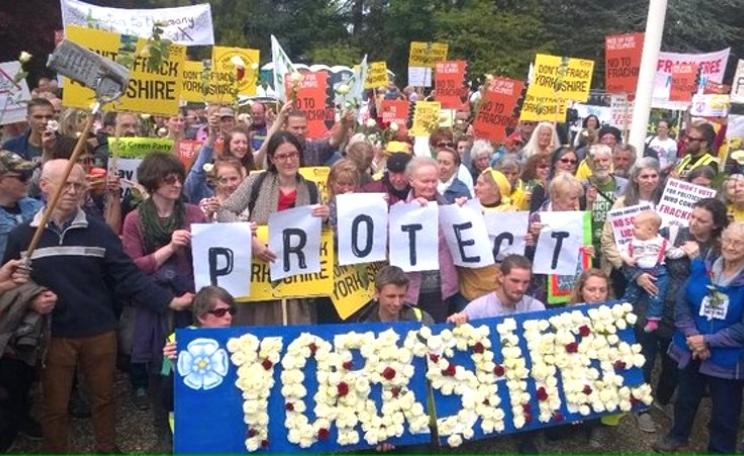
Conservative councillors have passed an application to frack in the Yorkshire Dales by Third Energy, signalling the return of shale gas exploitation in the UK after a five year break, writes Victoria Seabrook. Campaigners vow: 'We will fight on!'
Local people are furiously trying to stop a fracking company from drilling near a drinking water reservoir serving tens of thousands of homes, after Northern Ireland planners failed to block Infrastrata's claim for 'permitted development' rights.
Almost entirely unknown to the outside world, and even to most local residents, hundreds of square kilometres of South Africa's Karoo dryland have been bought up by uranium mining companies, writes Dr Stefan Cramer. With no strategic assessment of the industry's devastating impacts and massive water demand, official permission could soon be granted for vast open pit mines.
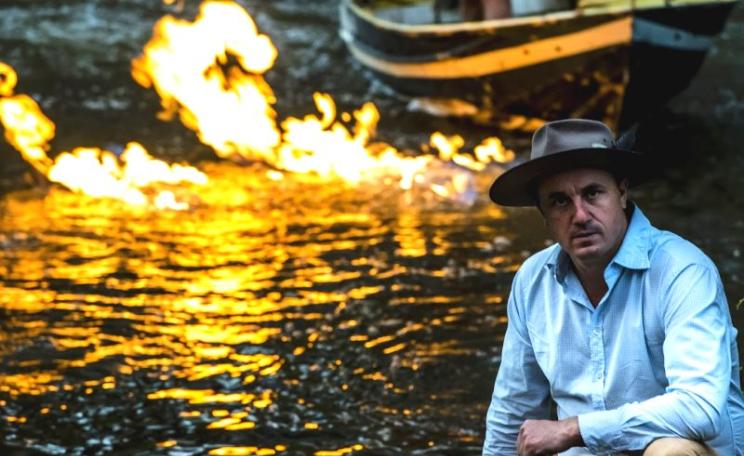
So much methane is bubbling into a river surrounded by hundreds of fracking wells that it's a fire hazard! Local campaigners blame the coal seam gas industry for the gas releases which are spreading along Queensland's river Condamine and gaining in intensity.