A landmark 6-part documentary series is planned with Satish Kumar - peace and environment activist, religious philosopher, teacher, writer and broadcaster.
The risk of cancer from the world's top herbicide, glyphosate, is just the tip of the iceberg of health damage caused by exposure to pesticides and other toxic agrochemicals, writes Georgina Downs. It's time for governments to correct their scandalous failure to protect rural residents from the cocktails of poisons sprayed on crops.
Moves to control powerful HFC greenhouse gases used in refrigeration could culminate in a landmark deal this November, writes David Doniger - the perfect prelude to the main Paris climate talks.
The presence of the tigers is the world's greatest mangrove forest vital to its survival, writes Joydip Kundu. It's the fear of the tiger that deters people from entering the forest to cut its trees and hunt its wildlife - and so these majestic predators protect its fisheries, and guard millions of people in south Bengal from the rising seas.
Palestinian children as young as 11 work on Israeli farms in the occupied West Bank, an HRW investigation reveals. While the EU buys produce worth $300m a year from the illegal 'settlements', undocumented child labourers are exposed to pesticides, paid well below the minimum wage, enjoy no employment rights, and toil long hours in hot fields and greenhouses.
The over-enrichment of waters and ecosystems with waste nutrients from industrial corn farming is one of America's greatest environmental problems, writes Donald Scavia. And it's a problem that can be solved - by eating less meat and sugar, by adopting rational energy policies, and by demanding sustainably-grown food.
Rainforests around the world and the wildlife they sustain have a rosier future after the European Parliament voted to limit the growth of biofuels such as palm oil in the transport sector.
Australia's deliberate and calculated attacks on its indigenous population carry many of the hallmarks of genocide, writes John Pilger. And things are getting worse, not better, as states that have grown rich by exploiting Aboriginal land evict and demolish remote Aboriginal communities.
British taxpayers are forcing private health care and schooling onto many of the world's poorest countries including Nepal, Rwanda, Ethiopia and Mozambique, writes Nick Dearden - backing a huge neoliberal experiment whose only certain outcomes are high costs, low standards and massive corporate profits.
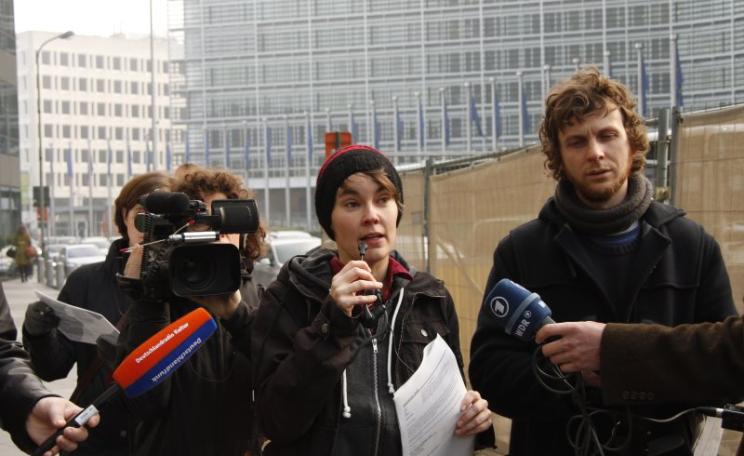
Brussels is a city of ruthless, well-resourced corporate lobbyists. And unlike ordinary EU citizens, they enjoy priviliged access to officials, negotiators and parliamentarians, and are used to getting their own way. That's a state of affairs that David Lundy & Olivier Hoedeman are determined to end with their 'citizens tours' of EU Lobbyland ...
The stricken 4th reactor at Chernobyl presents a massive long term hazard, writes Kendra Ulrich. A planned €2.15 billion containment arch remains underfunded, and even if it's ever completed, it will only last 100 years. Meanwhile the intensely radioactive nuclear fuel will remain in place representing a long term risk of further huge radiation releases.
Decades of regular mowing left my front lawn looking bare and sterile, writes Jo Cartmell. But in fact, the exhausted, infertile soil made it the perfect place for a host of wild flowers to take up residence - some from planted seed, others blown-in, or from long buried seed lying dormant in the soil. And after that, the butterflies ...
The return of the lynx to the British Isles could bring many benefits, writes Niki Rust, not least to the ecology of our woodlands, ravaged by too many deer. But we must not forget the human factor: livestock farmers may fear the arrival of a top-level predator, and their support will be essential to the success of any reintroduction.
The dispersant used in the Deepwater Horizon clean-up appears to be more toxic to corals than crude oil, writes Danielle M DeLeo. It also increases the concentration of oil in seawater, leading to higher, more toxic exposures of oil components when they come into contact with corals and other marine organisms.
A new high-performance 'aluminum-ion' battery could be the technical breakthrough needed to boost the renewable energy takeover. It's safe, uses abundant low-cost materials, recharges in one minute and withstands many thousands of recharge cycles.