No matter what bullying tactics they encounter in the final stages of COP21, writes Laurence Delina, 'climate vulnerable' countries must hold firm - and demand a legally binding treaty that delivers deep emissions cuts and secure, sufficient climate finance, all backed by strong sanctions for non-compliance. Nothing less will do.
Levels of CO2 are at their the highest in 800,000 years, writes Tim Radford, but news of a probable decline in emissions this year is providing welcome cheer at the COP21 climate summit: thanks to renewables, economic growth and falling emissions can go hand in hand.
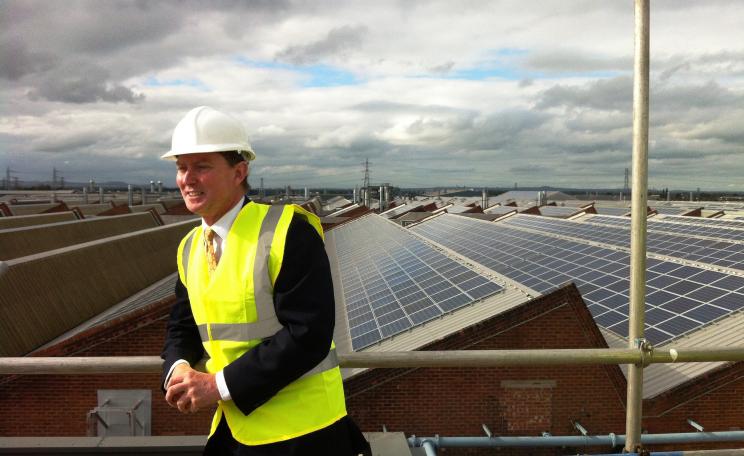
The EU's decision to renew 'punitive' tariffs on imports of PV modules and cells from China will cost the EU's solar installers an extra £700 million, writes Oliver Tickell - just as the UK industry is reeling from 87% government cuts.
Saturday's delivery of the draft Paris Agreement text for ministers to run with today was a small miracle, writes Luke Kemp. But it came at the cost of 935 bracketed texts to be argued over by ministers this week, while key questions - whether it will be a legally binding treaty, and how poorer countries will be paid to adapt to and mitigate climate change - are still up for grabs.
Last week a new billionaires club strode into COP21 in Paris promising big money for 'clean energy': the Breakthrough Energy Coalition. But most of its members are nuclear obsessives, writes Linda Pentz Gunter, from Bill Gates to Jeff Bezos and Richard Branson. And what the the world needs is not 'patient investment' into nuclear research, but impatient investment into renewables deployment.
The latest text of the Paris Agreement on climate change published today sets 1.5C as its 'long term temperature goal', half a degree lower than previously agreed. It's a big victory for poor 'climate vulnerable' countries - and a blow for Saudi Arabia.
'Pay up or there's no deal', a coalition of 134 developing nations have warned the rich industrial countries at COP21 in Paris - the ones that caused the climate problem in the first place. As Paul Brown writes, much more than the $64 billion so far pledged will be needed to get them on board.
Earthship Brighton, an award-winning off-grid community centre set in an organic farm within the South Downs National Park, has hosted hundreds of events and inspired tens of thousands of visitors over the last decade, writes Phil Moore, demonstrating green technologies and energy-efficient living. But now it's in need of a refit.
The most significant feature of COP21 is the topics that never even made it onto the agenda for discussion, writes Steffen Böhm. And the biggest of all the growth-driven economic system that ultimately thwarts all efforts at sustainability, as it drives ever increasing consumption of energy and resources.
The theme at COP21 today has been the urgent need to cut fossil fuel subsidies that favour dirty energy over renewables, writes Tony Juniper. Sadly the UK is setting all the wrong examples - ramping up its spending on fossil fuels, while slashing its much smaller renewable energy budgets.
Black Friday is yet another manifestation of a consumer culture that is both empty and destructive, writes Vicki Hird. So instead let's join in creative celebrations of Buy Nothing Day ('no purchase necessary'), and develop a new life-enhancing ethic of joyful frugality.
The surprise removal of tax benefits for investors in community renewable energy schemes - effective from Monday - is unlawful and must be reversed, states a legal letter to the Treasury. But meanwhile, investments in the sector have hit record levels, with two days still to go.
As negotiators from around the world gather in Paris for what's hoped to be a groundbreaking climate summit, many will be surprised to discover that COP21 is funded by some of the world's biggest coal burners, writes Pavlos Georgiadis, and a leading financier of coal and tar sands development. Shouldn't we just ... kick them out?
The 'Autumn Statement' delivered with such aplomb by the Chancellor is yet another attack on the UK's sustainable future, write David Lowry & Oliver Tickell - cutting energy efficiency funds just as tens of thousands are set to die of cold this winter, betting £250m on pointless nuclear research, and raiding the renewables budget to fund subsidies to nuclear power and fossil fuels.
A new report warns that coal, oil and gas assets will be stranded if the world is to limit temperature rise to 2C. Losses are projected to reach $2.2 trillion over the next decade, with coal taking the biggest hit, while oil demand peaks in 2020. Yet fossil energy companies are ignoring the very innovations that will put them out of business.