Campaigners are celebrating after defeating plans to build America’s largest open pit coal mine, writes Nick Engelfriend. In an epic 'David and Goliath' battle, Montana activists challenged the project, and all the politicians and businessmen that supported it, with fierce opposition, protests and demonstrations. The outcome spells hope for all in the fight against dirty energy.
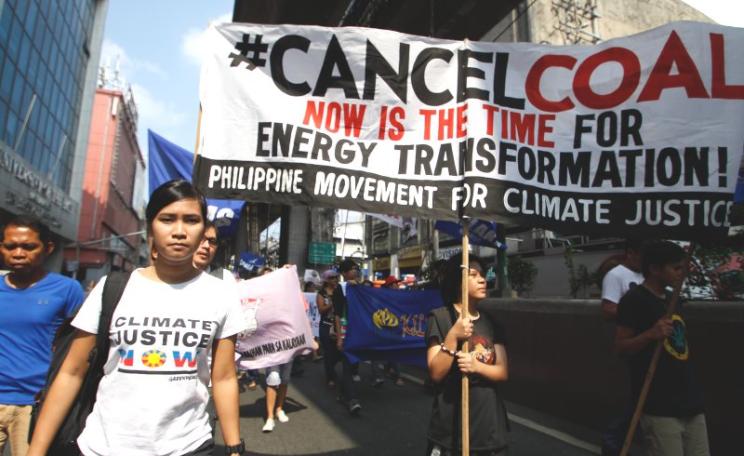
JP Morgan's announcement that it's pulling out of coal is purest doublespeak, writes Assaad Razzouk. But it's not the only financier to engage in climate hypocrisy, as banks prepare to lend $5 trillion to build 2,440 new coal power stations. To deliver the Paris Agreement they - and the loans that would finance them - must be cancelled.
MPs today grilled EDF Energy supremo Vincent de Rivaz over the troubled Hinkley C nuclear plant in Somerset. He insisted that the project was definitely going ahead - but refused to say when the 'final investment decision' was due. Confused? Bewildered? Frustrated? So were the MPs.
Backed up the Information Commissioner, DECC refuses to release the documents it sent to the European Commission to support its massive subsidy package for the Hinkley C nuclear plant, writes Terry McAlister. But now the case will go before a tribunal which could order their release.
For the second year running CO2 emissions flatlined even as the global economy was growing at around 3%, writes Alex Kirby. But sharply rising temperatures show the need for further massive renewable energy deployment to actually bring emissions down.
It will take decades to completely leave fossil fuels, writes Richard Heinberg. But we can do it, starting with the easy stuff: going big time for wind and solar, raising energy efficiency, replacing oil-fuelled vehicles, and moving to organic farming. But deeper changes will follow as we transition to a more enduring sustainability - consuming better, and much less.
Is the UK sinking into authoritarian rule? That's how it looks, writes Jonathon Porritt, as the government joins with right wing media and fossil fuel companies to attack local democracy and environmental campaigners. Is this 'merger of state and corporate power' a sign of more, and worse, to come?
Barring a miracle Marco Rubio is set to be Trumped in the Republican primary tomorrow in Florida, his home state, putting an effective end to his campaign. But it's not for want of support from one of the US's biggest frackers, Devon energy, and its politically active CEO Larry Nichols. And with or without Rubio, Nichols's influence on the red states' energy policy is only going to get bigger.
Climate change is perhaps our generation's greatest challenge, and few people are better placed to know it than academics in our top universities, writes James Dyke. But they are still accepting huge sums of fossil fuel money, in the process helping donors in their quest to extract and burn ever more coal, oil and gas. This must stop.
Oil giant BP is the UK's single biggest EU lobbyist, spending over £2 million reaching out to European policy makers in 2014, new figures show. But citing hard times, the company has dropped its controversial sponsorship of the London's Tate Galleries - and more such branding deals may bite the dust.
Low Emissions Zones have their place in cleaning up the UK's worst air pollution hotspots, writes Richard Howard. But we also need to adopt fiscal measures to encourage a shift away from diesel vehicles, at once delivering cleaner air, increased tax revenues, and lower carbon emissions.
Five years after the Fukushima nuclear disaster began to unfold, the searing psychological effects are still being felt among the 160,000 refugees who fled the fallout, writes Linda Pentz Gunter. But now there's growing pressure to return to contaminated areas declared 'safe' in efforts to whitewash the disaster's impacts. Why the rush? To clear the way for the 2020 Tokyo Summer Olympics, complete with events in Fukushima City.
Improved technology and falling costs are moving electric car sales into the fast lane as manufacturers seek achieve significant economies of scale, writes Kieran Cooke. And now China is leading the EV charge with its plans for 5 million plug-in vehicles by 2020.
The main claim used to justify nuclear is that it's the only low carbon power source that can supply 'reliable, baseload electricity', writes Mark Diesendorf - unlike wind and solar. But not only can renewables supply baseload power, they can do something far more valuable: supply power flexibly according to demand. Now nuclear power really is redundant.
One of the world's biggest energy companies has been caught out in what may be the biggest ever climate scandal, writes Bill McKibben. Way back in the 1980s ExxonMobil knew of the 'potentially catastrophic' and 'irreversible' effects of increasing fossil fuel consumption, but chose to cover up the findings, spread misinformation on climate change, and go for high carbon energy sources.